

cations that have been inserted. Exchange by monovalent cations is usually fast and
easy. Divalent cations enter sometimes very fast and sometimes more reluctantly.
Not more than one trivalent cation per u.c. can be exchanged, and the preparation
conditions must be selected with care. They play an important role in the ship-in-abottle synthesis of rare earth complexes. The cations listed in Table 1 are usually not
the only guest in the channels. Very often water molecules are present. Potassium is
the most frequent co-cation, and care has to be taken to control the amount of the
often less wanted protons. The insertion temperature is limited by the thermal
stability of the guests and by the boiling point of the solvent. It can sometimes be
extended by using a poly(tetrafluoroethylene) (PTFE) bottle placed in a tight PTFE
pressure vessel that supports temperature of up to about 180
C and pressures up to
16 bar, similar as used for ZL synthesis. The maximum temperature that can be used
for the insertion of neutral guests is limited by their temperature stability and goes up
to a maximum of about 300
C. The insertion temperature of many perylene diimide
dyes, as an example, was 260
C [16]. Water is removed by usually moderate heating
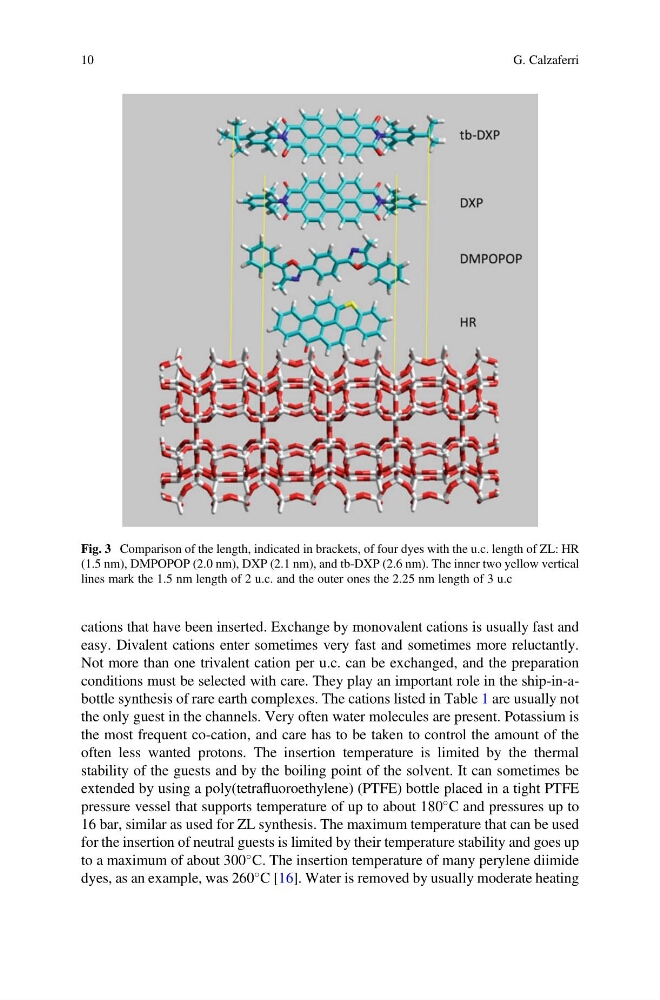
Fig. 3 Comparison of the length, indicated in brackets, of four dyes with the u.c. length of ZL: HR
(1.5 nm), DMPOPOP (2.0 nm), DXP (2.1 nm), and tb-DXP (2.6 nm). The inner two yellow vertical
lines mark the 1.5 nm length of 2 u.c. and the outer ones the 2.25 nm length of 3 u.c
10
G. Calzaferri
easy. Divalent cations enter sometimes very fast and sometimes more reluctantly.
Not more than one trivalent cation per u.c. can be exchanged, and the preparation
conditions must be selected with care. They play an important role in the ship-in-abottle synthesis of rare earth complexes. The cations listed in Table 1 are usually not
the only guest in the channels. Very often water molecules are present. Potassium is
the most frequent co-cation, and care has to be taken to control the amount of the
often less wanted protons. The insertion temperature is limited by the thermal
stability of the guests and by the boiling point of the solvent. It can sometimes be
extended by using a poly(tetrafluoroethylene) (PTFE) bottle placed in a tight PTFE
pressure vessel that supports temperature of up to about 180
C and pressures up to
16 bar, similar as used for ZL synthesis. The maximum temperature that can be used
for the insertion of neutral guests is limited by their temperature stability and goes up
to a maximum of about 300
C. The insertion temperature of many perylene diimide
dyes, as an example, was 260
C [16]. Water is removed by usually moderate heating
Fig. 3 Comparison of the length, indicated in brackets, of four dyes with the u.c. length of ZL: HR
(1.5 nm), DMPOPOP (2.0 nm), DXP (2.1 nm), and tb-DXP (2.6 nm). The inner two yellow vertical
lines mark the 1.5 nm length of 2 u.c. and the outer ones the 2.25 nm length of 3 u.c
10
G. Calzaferri