

and Ox
+ (Table 1), which are of nearly identical size and shape, as donor-acceptor
pair in a Förster resonance energy transfer (FRET) experiment [43]. The time needed
for homogeneous filling depends on the length of the channels, the type of guests,
and the reaction conditions [16, 43, 44]. This allows to freeze non-equilibrated states
for inspection purposes by simply cooling the samples to room temperature, a
method popular for measuring and presenting luminescence microscopy images;
see, e.g., Fig. 3 in [45], Fig. 20 in [14], or Figs. 4 and 5 in [46]. This should, however,
not be misinterpreted in the sense that achieving homogenous filling is difficult,
which is usually not the case, but has probably been assumed in [47]; homogenous
filling is usually just a question of choosing appropriate conditions. Composites with
the highest possible packing, based on barrel-shaped crystals of about 500 nm
length, namely, 1.5 fluorenone (Table 3) per u.c., have been prepared by Tabacchi
et al. and used for structural analysis [48]. High-pressure studies of fluorenone-ZL
composites revealed an impressive stability even at GPa pressures, evidencing a
pressure-induced strengthening of the interaction between the fluorenone carbonyl
group and the ZL potassium cations, thus indicating a way to the realization of, e.g.,
optical devices able to maintain their functionality under extreme conditions [49].
We use the value of p, Eq. (3), for denoting a system as follows: a composite
name, such as guest-ZL.05 or dye-ZL.25, indicates a guest loading (occupation
probability) of the ZL host of 0.05 or 0.25, respectively. A comparison of the length
of four representative dyes with the length of the u.c. of ZL is shown in Fig. 3. This
allows to state that HR molecules demand 2 u.c.; hence n s ¼ 2. DMPOPOP and DXP
occupy about 3 u.c.; hence n s % 2.5 to 3 is a meaningful measure, while n s % 3.5
applies for tb-DXP. The occupation probability p based on such arguments is a
rough but useful measure and can be used as a guideline. More precise information
can be obtained using theoretical and experimental structural analysis data [40, 47–
49].
Most synthesis procedures for obtaining guest-ZL composites start from
(M
+
) 9 ([AlO 2 ] 9 [SiO 2 ] 27 )xnH 2 O, with potassium as the monovalent cation M
+ . Up
to a maximum of 3.6 out of the 9 M
+ cations per u.c. can be exchanged. Table 1 lists
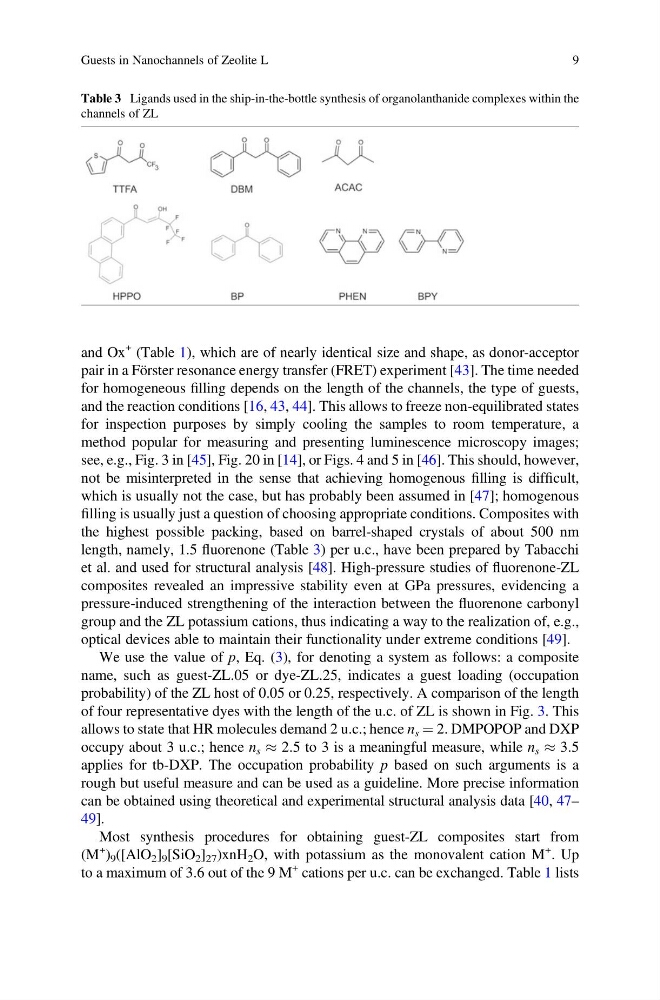
Table 3 Ligands used in the ship-in-the-bottle synthesis of organolanthanide complexes within the
channels of ZL
Guests in Nanochannels of Zeolite L
9
+ (Table 1), which are of nearly identical size and shape, as donor-acceptor
pair in a Förster resonance energy transfer (FRET) experiment [43]. The time needed
for homogeneous filling depends on the length of the channels, the type of guests,
and the reaction conditions [16, 43, 44]. This allows to freeze non-equilibrated states
for inspection purposes by simply cooling the samples to room temperature, a
method popular for measuring and presenting luminescence microscopy images;
see, e.g., Fig. 3 in [45], Fig. 20 in [14], or Figs. 4 and 5 in [46]. This should, however,
not be misinterpreted in the sense that achieving homogenous filling is difficult,
which is usually not the case, but has probably been assumed in [47]; homogenous
filling is usually just a question of choosing appropriate conditions. Composites with
the highest possible packing, based on barrel-shaped crystals of about 500 nm
length, namely, 1.5 fluorenone (Table 3) per u.c., have been prepared by Tabacchi
et al. and used for structural analysis [48]. High-pressure studies of fluorenone-ZL
composites revealed an impressive stability even at GPa pressures, evidencing a
pressure-induced strengthening of the interaction between the fluorenone carbonyl
group and the ZL potassium cations, thus indicating a way to the realization of, e.g.,
optical devices able to maintain their functionality under extreme conditions [49].
We use the value of p, Eq. (3), for denoting a system as follows: a composite
name, such as guest-ZL.05 or dye-ZL.25, indicates a guest loading (occupation
probability) of the ZL host of 0.05 or 0.25, respectively. A comparison of the length
of four representative dyes with the length of the u.c. of ZL is shown in Fig. 3. This
allows to state that HR molecules demand 2 u.c.; hence n s ¼ 2. DMPOPOP and DXP
occupy about 3 u.c.; hence n s % 2.5 to 3 is a meaningful measure, while n s % 3.5
applies for tb-DXP. The occupation probability p based on such arguments is a
rough but useful measure and can be used as a guideline. More precise information
can be obtained using theoretical and experimental structural analysis data [40, 47–
49].
Most synthesis procedures for obtaining guest-ZL composites start from
(M
+
) 9 ([AlO 2 ] 9 [SiO 2 ] 27 )xnH 2 O, with potassium as the monovalent cation M
+ . Up
to a maximum of 3.6 out of the 9 M
+ cations per u.c. can be exchanged. Table 1 lists
Table 3 Ligands used in the ship-in-the-bottle synthesis of organolanthanide complexes within the
channels of ZL
Guests in Nanochannels of Zeolite L
9