

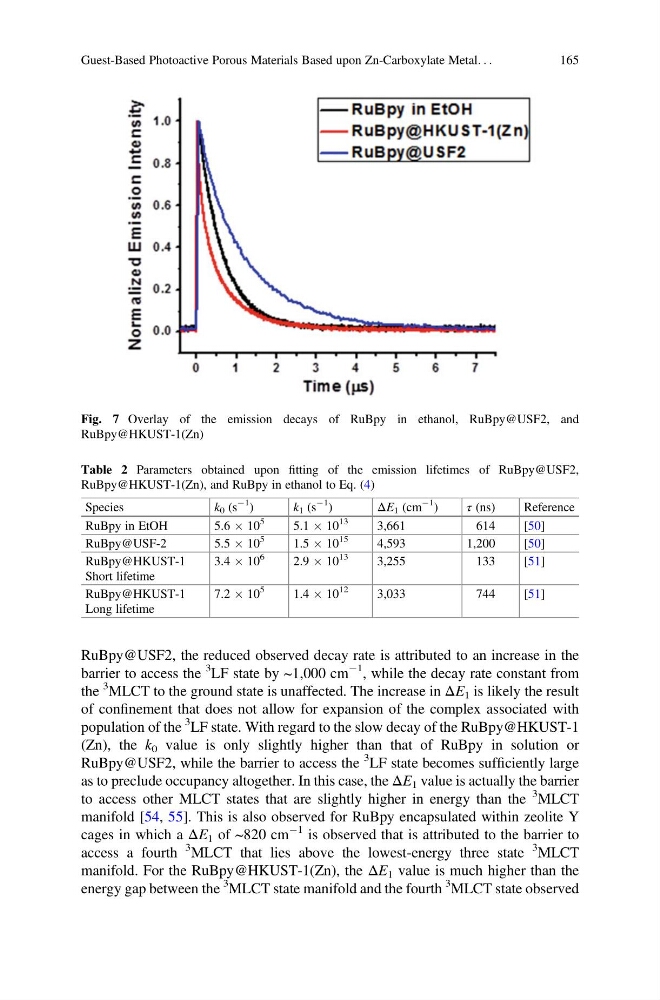
RuBpy@USF2, the reduced observed decay rate is attributed to an increase in the
barrier to access the
3 LF state by ~1,000 cm
À1 , while the decay rate constant from
the
3 MLCT to the ground state is unaffected. The increase in ΔE 1 is likely the result
of confinement that does not allow for expansion of the complex associated with
population of the
3 LF state. With regard to the slow decay of the RuBpy@HKUST-1
(Zn), the k 0 value is only slightly higher than that of RuBpy in solution or
RuBpy@USF2, while the barrier to access the
3 LF state becomes sufficiently large
as to preclude occupancy altogether. In this case, the ΔE 1 value is actually the barrier
to access other MLCT states that are slightly higher in energy than the
3 MLCT
manifold [54, 55]. This is also observed for RuBpy encapsulated within zeolite Y
cages in which a ΔE 1 of ~820 cm
À1 is observed that is attributed to the barrier to
access a fourth
3 MLCT that lies above the lowest-energy three state
3 MLCT
manifold. For the RuBpy@HKUST-1(Zn), the ΔE 1 value is much higher than the
energy gap between the
3 MLCT state manifold and the fourth
3 MLCT state observed
Fig. 7 Overlay of the emission decays of RuBpy in ethanol, RuBpy@USF2, and
RuBpy@HKUST-1(Zn)
Table 2 Parameters obtained upon fitting of the emission lifetimes of RuBpy@USF2,
RuBpy@HKUST-1(Zn), and RuBpy in ethanol to Eq. (4)
Species
k 0 (s
À1
)
k 1 (s
À1
)
ΔE 1 (cm
À1
)
τ (ns)
Reference
RuBpy in EtOH
5.6 Â 10
5
5.1 Â 10
13
3,661
614
[50]
RuBpy@USF-2
5.5 Â 10
5
1.5 Â 10
15
4,593
1,200
[50]
RuBpy@HKUST-1
Short lifetime
3.4 Â 10
6
2.9 Â 10
13
3,255
133
[51]
RuBpy@HKUST-1
Long lifetime
7.2 Â 10
5
1.4 Â 10
12
3,033
744
[51]
Guest-Based Photoactive Porous Materials Based upon Zn-Carboxylate Metal. . .
165
barrier to access the
3 LF state by ~1,000 cm
À1 , while the decay rate constant from
the
3 MLCT to the ground state is unaffected. The increase in ΔE 1 is likely the result
of confinement that does not allow for expansion of the complex associated with
population of the
3 LF state. With regard to the slow decay of the RuBpy@HKUST-1
(Zn), the k 0 value is only slightly higher than that of RuBpy in solution or
RuBpy@USF2, while the barrier to access the
3 LF state becomes sufficiently large
as to preclude occupancy altogether. In this case, the ΔE 1 value is actually the barrier
to access other MLCT states that are slightly higher in energy than the
3 MLCT
manifold [54, 55]. This is also observed for RuBpy encapsulated within zeolite Y
cages in which a ΔE 1 of ~820 cm
À1 is observed that is attributed to the barrier to
access a fourth
3 MLCT that lies above the lowest-energy three state
3 MLCT
manifold. For the RuBpy@HKUST-1(Zn), the ΔE 1 value is much higher than the
energy gap between the
3 MLCT state manifold and the fourth
3 MLCT state observed
Fig. 7 Overlay of the emission decays of RuBpy in ethanol, RuBpy@USF2, and
RuBpy@HKUST-1(Zn)
Table 2 Parameters obtained upon fitting of the emission lifetimes of RuBpy@USF2,
RuBpy@HKUST-1(Zn), and RuBpy in ethanol to Eq. (4)
Species
k 0 (s
À1
)
k 1 (s
À1
)
ΔE 1 (cm
À1
)
τ (ns)
Reference
RuBpy in EtOH
5.6 Â 10
5
5.1 Â 10
13
3,661
614
[50]
RuBpy@USF-2
5.5 Â 10
5
1.5 Â 10
15
4,593
1,200
[50]
RuBpy@HKUST-1
Short lifetime
3.4 Â 10
6
2.9 Â 10
13
3,255
133
[51]
RuBpy@HKUST-1
Long lifetime
7.2 Â 10
5
1.4 Â 10
12
3,033
744
[51]
Guest-Based Photoactive Porous Materials Based upon Zn-Carboxylate Metal. . .
165