

particular for spiropyrans, an increase in solvent polarity causes blue-shifted absorption bands. Consequently, the electronic structure of the excited species shifts from a
polymethine-like state to a polyene-like state by increasing the solvent’s polarity
[32, 48]. For spirooxazines, both types of solvatochromism have been observed,
mainly dependent on the substitution of the benzoxazine ring [54].
Both photochromic and solvatochromic properties are mostly observed in solution and only rarely in the pure solids. Therefore, encapsulation of photoswitchable
dye molecules into a (porous) host matrix seems to be of great potential, since the
single molecules are separated from each other in a confined environment, which, in
turn, might influence the optical properties of the incorporated species.
1.3 Metal-Organic Frameworks
Since the publication of MOF-5 by Yaghi and co-workers in 1999 [55], the interest in
metal-organic frameworks (MOFs) has increased rapidly [56]. MOFs are hybrid
materials consisting of inorganic nodes, mostly metal cations or metal-oxo-clusters,
which are linked by organic linker molecules with at least two functional groups,
forming a two- or three-dimensional framework with potential voids [57]. These
compounds were already described before 1999 [58–62], but MOF-5 somehow gave
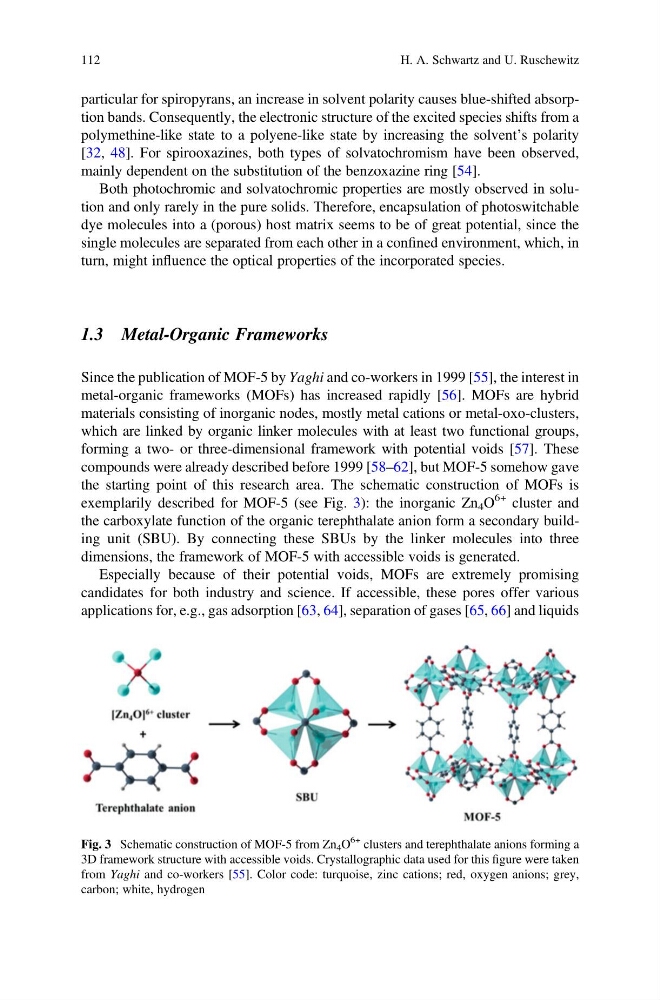
the starting point of this research area. The schematic construction of MOFs is
exemplarily described for MOF-5 (see Fig. 3): the inorganic Zn 4 O
6+ cluster and
the carboxylate function of the organic terephthalate anion form a secondary building unit (SBU). By connecting these SBUs by the linker molecules into three
dimensions, the framework of MOF-5 with accessible voids is generated.
Especially because of their potential voids, MOFs are extremely promising
candidates for both industry and science. If accessible, these pores offer various
applications for, e.g., gas adsorption [63, 64], separation of gases [65, 66] and liquids
Fig. 3 Schematic construction of MOF-5 from Zn 4 O
6+ clusters and terephthalate anions forming a
3D framework structure with accessible voids. Crystallographic data used for this figure were taken
from Yaghi and co-workers [55]. Color code: turquoise, zinc cations; red, oxygen anions; grey,
carbon; white, hydrogen
112
H. A. Schwartz and U. Ruschewitz
polymethine-like state to a polyene-like state by increasing the solvent’s polarity
[32, 48]. For spirooxazines, both types of solvatochromism have been observed,
mainly dependent on the substitution of the benzoxazine ring [54].
Both photochromic and solvatochromic properties are mostly observed in solution and only rarely in the pure solids. Therefore, encapsulation of photoswitchable
dye molecules into a (porous) host matrix seems to be of great potential, since the
single molecules are separated from each other in a confined environment, which, in
turn, might influence the optical properties of the incorporated species.
1.3 Metal-Organic Frameworks
Since the publication of MOF-5 by Yaghi and co-workers in 1999 [55], the interest in
metal-organic frameworks (MOFs) has increased rapidly [56]. MOFs are hybrid
materials consisting of inorganic nodes, mostly metal cations or metal-oxo-clusters,
which are linked by organic linker molecules with at least two functional groups,
forming a two- or three-dimensional framework with potential voids [57]. These
compounds were already described before 1999 [58–62], but MOF-5 somehow gave
the starting point of this research area. The schematic construction of MOFs is
exemplarily described for MOF-5 (see Fig. 3): the inorganic Zn 4 O
6+ cluster and
the carboxylate function of the organic terephthalate anion form a secondary building unit (SBU). By connecting these SBUs by the linker molecules into three
dimensions, the framework of MOF-5 with accessible voids is generated.
Especially because of their potential voids, MOFs are extremely promising
candidates for both industry and science. If accessible, these pores offer various
applications for, e.g., gas adsorption [63, 64], separation of gases [65, 66] and liquids
Fig. 3 Schematic construction of MOF-5 from Zn 4 O
6+ clusters and terephthalate anions forming a
3D framework structure with accessible voids. Crystallographic data used for this figure were taken
from Yaghi and co-workers [55]. Color code: turquoise, zinc cations; red, oxygen anions; grey,
carbon; white, hydrogen
112
H. A. Schwartz and U. Ruschewitz