

definitions will be briefly described in the following. For more details, we refer to the
literature [48].
A molecule is designated as solvatochrome, if the absorption band of this
molecule dissolved in solvents of different polarity shows alterations with respect
to position, shape, and intensity. In particular interest of this work, only changes in
position are examined: with increasing polarity of the solvent, the absorption maxima
may be red- (bathochromic) or blue-shifted (hypsochromic), which is denoted as
negative solvatochromism for the latter and positive solvatochromism for the former.
These alterations originate from solute-solvent interactions, such as dipole-dipole or
hydrogen bonding interactions, etc. By these interactions, the energy gap between the
ground and the excited state is modified. Here, the effect on the spectra is primarily
dependent on the dye and its type of transition. For spiropyrans and spirooxazines, the
electronic transitions of interest are π ! πà and n ! πÃ, as well as charge-transfer
absorptions. Both molecules form the so-called merocyanine form upon UV light
irradiation, which has already been described earlier. Merocyanines are part of the
class of the intramolecular ionic meropolymethine dyes, which are located in between
the polyenes and polymethines [49, 50].
Those compounds, which merocyanines belong to, have an electron-donating
group A, which is linked by a conjugated system B to the electron accepting group
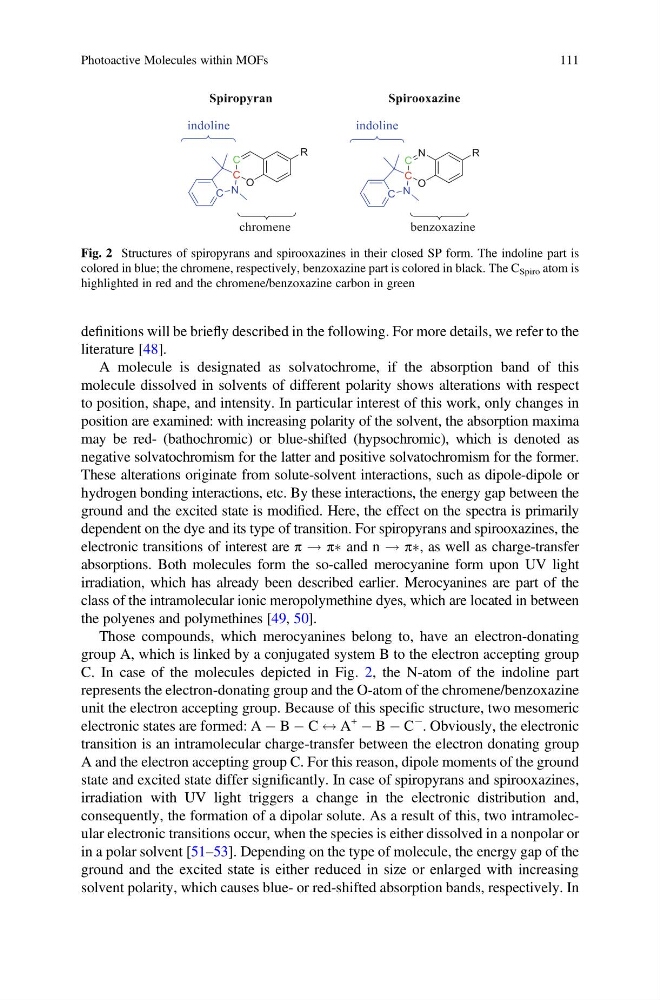
C. In case of the molecules depicted in Fig. 2, the N-atom of the indoline part
represents the electron-donating group and the O-atom of the chromene/benzoxazine
unit the electron accepting group. Because of this specific structure, two mesomeric
electronic states are formed: A À B À C $ A
+
À B À C
À . Obviously, the electronic
transition is an intramolecular charge-transfer between the electron donating group
A and the electron accepting group C. For this reason, dipole moments of the ground
state and excited state differ significantly. In case of spiropyrans and spirooxazines,
irradiation with UV light triggers a change in the electronic distribution and,
consequently, the formation of a dipolar solute. As a result of this, two intramolecular electronic transitions occur, when the species is either dissolved in a nonpolar or
in a polar solvent [51–53]. Depending on the type of molecule, the energy gap of the
ground and the excited state is either reduced in size or enlarged with increasing
solvent polarity, which causes blue- or red-shifted absorption bands, respectively. In
Fig. 2 Structures of spiropyrans and spirooxazines in their closed SP form. The indoline part is
colored in blue; the chromene, respectively, benzoxazine part is colored in black. The C Spiro atom is
highlighted in red and the chromene/benzoxazine carbon in green
Photoactive Molecules within MOFs
111
literature [48].
A molecule is designated as solvatochrome, if the absorption band of this
molecule dissolved in solvents of different polarity shows alterations with respect
to position, shape, and intensity. In particular interest of this work, only changes in
position are examined: with increasing polarity of the solvent, the absorption maxima
may be red- (bathochromic) or blue-shifted (hypsochromic), which is denoted as
negative solvatochromism for the latter and positive solvatochromism for the former.
These alterations originate from solute-solvent interactions, such as dipole-dipole or
hydrogen bonding interactions, etc. By these interactions, the energy gap between the
ground and the excited state is modified. Here, the effect on the spectra is primarily
dependent on the dye and its type of transition. For spiropyrans and spirooxazines, the
electronic transitions of interest are π ! πà and n ! πÃ, as well as charge-transfer
absorptions. Both molecules form the so-called merocyanine form upon UV light
irradiation, which has already been described earlier. Merocyanines are part of the
class of the intramolecular ionic meropolymethine dyes, which are located in between
the polyenes and polymethines [49, 50].
Those compounds, which merocyanines belong to, have an electron-donating
group A, which is linked by a conjugated system B to the electron accepting group
C. In case of the molecules depicted in Fig. 2, the N-atom of the indoline part
represents the electron-donating group and the O-atom of the chromene/benzoxazine
unit the electron accepting group. Because of this specific structure, two mesomeric
electronic states are formed: A À B À C $ A
+
À B À C
À . Obviously, the electronic
transition is an intramolecular charge-transfer between the electron donating group
A and the electron accepting group C. For this reason, dipole moments of the ground
state and excited state differ significantly. In case of spiropyrans and spirooxazines,
irradiation with UV light triggers a change in the electronic distribution and,
consequently, the formation of a dipolar solute. As a result of this, two intramolecular electronic transitions occur, when the species is either dissolved in a nonpolar or
in a polar solvent [51–53]. Depending on the type of molecule, the energy gap of the
ground and the excited state is either reduced in size or enlarged with increasing
solvent polarity, which causes blue- or red-shifted absorption bands, respectively. In
Fig. 2 Structures of spiropyrans and spirooxazines in their closed SP form. The indoline part is
colored in blue; the chromene, respectively, benzoxazine part is colored in black. The C Spiro atom is
highlighted in red and the chromene/benzoxazine carbon in green
Photoactive Molecules within MOFs
111