

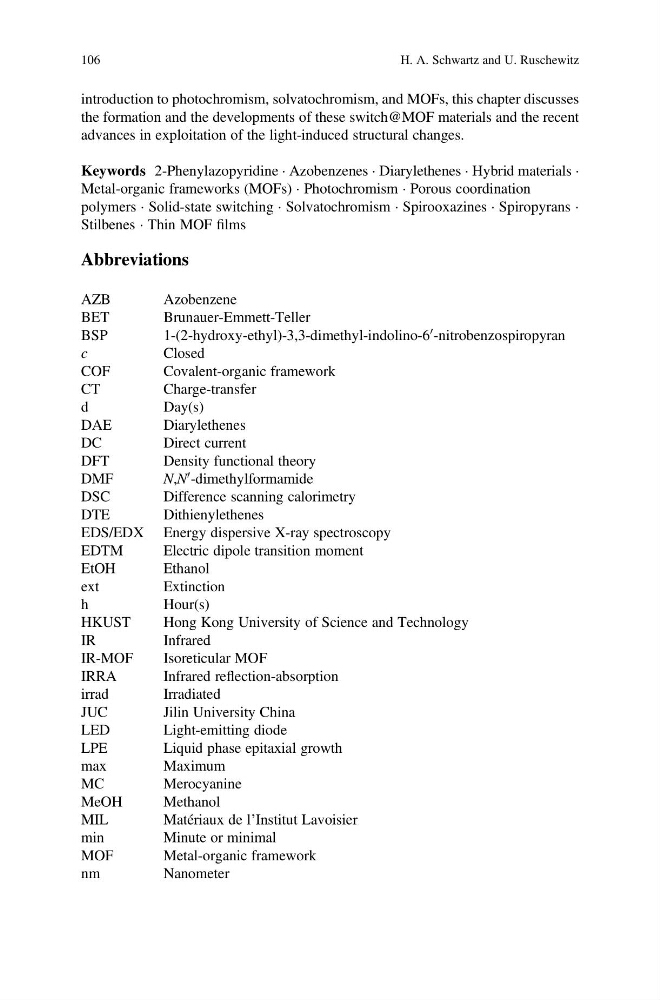
introduction to photochromism, solvatochromism, and MOFs, this chapter discusses
the formation and the developments of these switch@MOF materials and the recent
advances in exploitation of the light-induced structural changes.
Keywords 2-Phenylazopyridine · Azobenzenes · Diarylethenes · Hybrid materials ·
Metal-organic frameworks (MOFs) · Photochromism · Porous coordination
polymers · Solid-state switching · Solvatochromism · Spirooxazines · Spiropyrans ·
Stilbenes · Thin MOF films
Abbreviations
AZB
Azobenzene
BET
Brunauer-Emmett-Teller
BSP
1-(2-hydroxy-ethyl)-3,3-dimethyl-indolino-6
0 -nitrobenzospiropyran
c
Closed
COF
Covalent-organic framework
CT
Charge-transfer
d
Day(s)
DAE
Diarylethenes
DC
Direct current
DFT
Density functional theory
DMF
N,N
0 -dimethylformamide
DSC
Difference scanning calorimetry
DTE
Dithienylethenes
EDS/EDX Energy dispersive X-ray spectroscopy
EDTM
Electric dipole transition moment
EtOH
Ethanol
ext
Extinction
h
Hour(s)
HKUST
Hong Kong University of Science and Technology
IR
Infrared
IR-MOF
Isoreticular MOF
IRRA
Infrared reflection-absorption
irrad
Irradiated
JUC
Jilin University China
LED
Light-emitting diode
LPE
Liquid phase epitaxial growth
max
Maximum
MC
Merocyanine
MeOH
Methanol
MIL
Matériaux de l’Institut Lavoisier
min
Minute or minimal
MOF
Metal-organic framework
nm
Nanometer
106
H. A. Schwartz and U. Ruschewitz
the formation and the developments of these switch@MOF materials and the recent
advances in exploitation of the light-induced structural changes.
Keywords 2-Phenylazopyridine · Azobenzenes · Diarylethenes · Hybrid materials ·
Metal-organic frameworks (MOFs) · Photochromism · Porous coordination
polymers · Solid-state switching · Solvatochromism · Spirooxazines · Spiropyrans ·
Stilbenes · Thin MOF films
Abbreviations
AZB
Azobenzene
BET
Brunauer-Emmett-Teller
BSP
1-(2-hydroxy-ethyl)-3,3-dimethyl-indolino-6
0 -nitrobenzospiropyran
c
Closed
COF
Covalent-organic framework
CT
Charge-transfer
d
Day(s)
DAE
Diarylethenes
DC
Direct current
DFT
Density functional theory
DMF
N,N
0 -dimethylformamide
DSC
Difference scanning calorimetry
DTE
Dithienylethenes
EDS/EDX Energy dispersive X-ray spectroscopy
EDTM
Electric dipole transition moment
EtOH
Ethanol
ext
Extinction
h
Hour(s)
HKUST
Hong Kong University of Science and Technology
IR
Infrared
IR-MOF
Isoreticular MOF
IRRA
Infrared reflection-absorption
irrad
Irradiated
JUC
Jilin University China
LED
Light-emitting diode
LPE
Liquid phase epitaxial growth
max
Maximum
MC
Merocyanine
MeOH
Methanol
MIL
Matériaux de l’Institut Lavoisier
min
Minute or minimal
MOF
Metal-organic framework
nm
Nanometer
106
H. A. Schwartz and U. Ruschewitz