

approach by Peng et al. are a bulge of the cDNA during hybridization which
increases the charge-transfer resistance as well as a covalently attached ferrocene.
Their design results in a linear range of 0.2–100 nM in a buffer system, while Xia
et al. enabled a linear range of 0.2–4 nM and a limit of detection (LoD) of 70 pM
[14, 15]. Additionally, Xia et al. have shown the impact of incubation time. Maximal
charge-transfer resistance was achieved after 80 min of incubation [15].
In order to achieve improved fabrication of the functionalized electrode with
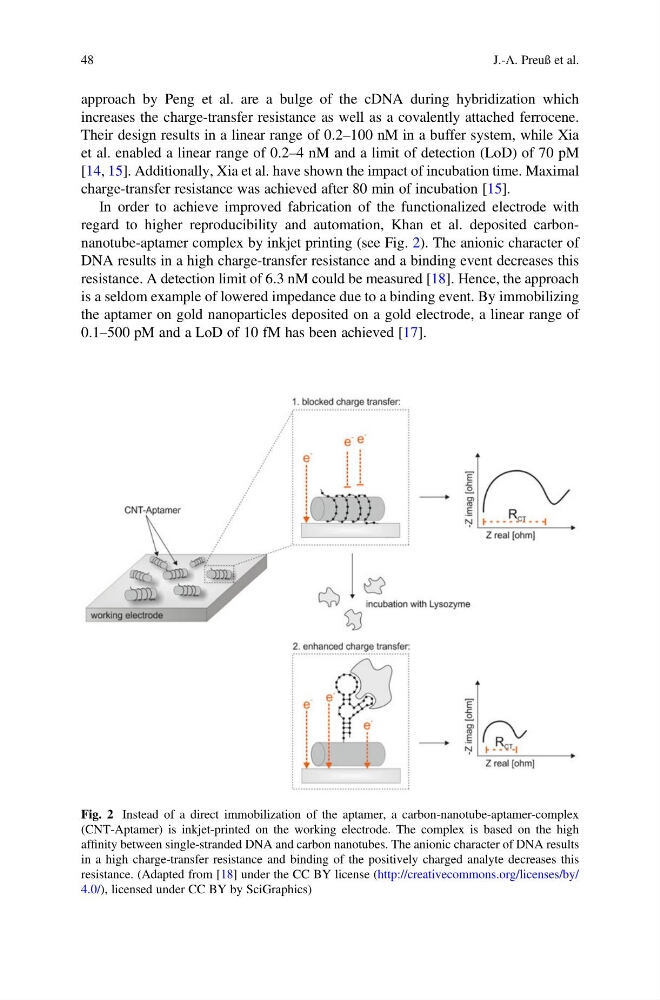
regard to higher reproducibility and automation, Khan et al. deposited carbonnanotube-aptamer complex by inkjet printing (see Fig. 2). The anionic character of
DNA results in a high charge-transfer resistance and a binding event decreases this
resistance. A detection limit of 6.3 nM could be measured [18]. Hence, the approach
is a seldom example of lowered impedance due to a binding event. By immobilizing
the aptamer on gold nanoparticles deposited on a gold electrode, a linear range of
0.1–500 pM and a LoD of 10 fM has been achieved [17].
Fig. 2 Instead of a direct immobilization of the aptamer, a carbon-nanotube-aptamer-complex
(CNT-Aptamer) is inkjet-printed on the working electrode. The complex is based on the high
affinity between single-stranded DNA and carbon nanotubes. The anionic character of DNA results
in a high charge-transfer resistance and binding of the positively charged analyte decreases this
resistance. (Adapted from [18] under the CC BY license (http://creativecommons.org/licenses/by/
4.0/), licensed under CC BY by SciGraphics)
48
J.-A. Preuß et al.
increases the charge-transfer resistance as well as a covalently attached ferrocene.
Their design results in a linear range of 0.2–100 nM in a buffer system, while Xia
et al. enabled a linear range of 0.2–4 nM and a limit of detection (LoD) of 70 pM
[14, 15]. Additionally, Xia et al. have shown the impact of incubation time. Maximal
charge-transfer resistance was achieved after 80 min of incubation [15].
In order to achieve improved fabrication of the functionalized electrode with
regard to higher reproducibility and automation, Khan et al. deposited carbonnanotube-aptamer complex by inkjet printing (see Fig. 2). The anionic character of
DNA results in a high charge-transfer resistance and a binding event decreases this
resistance. A detection limit of 6.3 nM could be measured [18]. Hence, the approach
is a seldom example of lowered impedance due to a binding event. By immobilizing
the aptamer on gold nanoparticles deposited on a gold electrode, a linear range of
0.1–500 pM and a LoD of 10 fM has been achieved [17].
Fig. 2 Instead of a direct immobilization of the aptamer, a carbon-nanotube-aptamer-complex
(CNT-Aptamer) is inkjet-printed on the working electrode. The complex is based on the high
affinity between single-stranded DNA and carbon nanotubes. The anionic character of DNA results
in a high charge-transfer resistance and binding of the positively charged analyte decreases this
resistance. (Adapted from [18] under the CC BY license (http://creativecommons.org/licenses/by/
4.0/), licensed under CC BY by SciGraphics)
48
J.-A. Preuß et al.