

2.1 Diagnosis of Diseases
The body’s health status can be portrayed by the quantitative determination of
different biomarkers which include hormones or infection-related components.
Depending on the application, the diagnostic tool can facilitate a rapid alert system
by the determination of general biomarkers such as the inflammatory marker CRP
(C-reactive protein) or specific biomarkers for a virus type during the early stage of
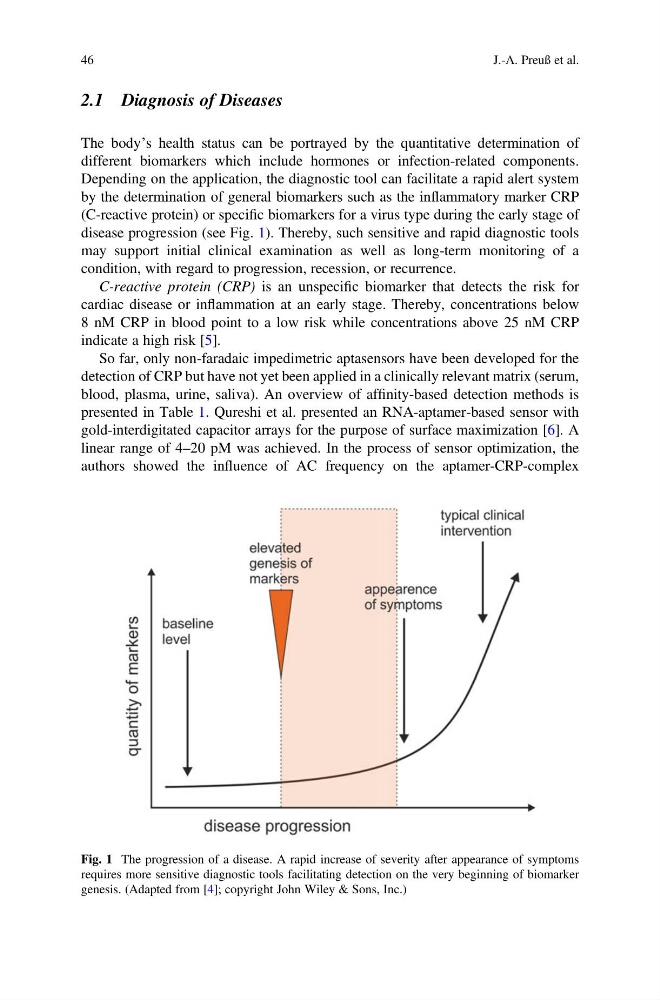
disease progression (see Fig. 1). Thereby, such sensitive and rapid diagnostic tools
may support initial clinical examination as well as long-term monitoring of a
condition, with regard to progression, recession, or recurrence.
C-reactive protein (CRP) is an unspecific biomarker that detects the risk for
cardiac disease or inflammation at an early stage. Thereby, concentrations below
8 nM CRP in blood point to a low risk while concentrations above 25 nM CRP
indicate a high risk [5].
So far, only non-faradaic impedimetric aptasensors have been developed for the
detection of CRP but have not yet been applied in a clinically relevant matrix (serum,
blood, plasma, urine, saliva). An overview of affinity-based detection methods is
presented in Table 1. Qureshi et al. presented an RNA-aptamer-based sensor with
gold-interdigitated capacitor arrays for the purpose of surface maximization [6]. A
linear range of 4–20 pM was achieved. In the process of sensor optimization, the
authors showed the influence of AC frequency on the aptamer-CRP-complex
Fig. 1 The progression of a disease. A rapid increase of severity after appearance of symptoms
requires more sensitive diagnostic tools facilitating detection on the very beginning of biomarker
genesis. (Adapted from [4]; copyright John Wiley & Sons, Inc.)
46
J.-A. Preuß et al.
The body’s health status can be portrayed by the quantitative determination of
different biomarkers which include hormones or infection-related components.
Depending on the application, the diagnostic tool can facilitate a rapid alert system
by the determination of general biomarkers such as the inflammatory marker CRP
(C-reactive protein) or specific biomarkers for a virus type during the early stage of
disease progression (see Fig. 1). Thereby, such sensitive and rapid diagnostic tools
may support initial clinical examination as well as long-term monitoring of a
condition, with regard to progression, recession, or recurrence.
C-reactive protein (CRP) is an unspecific biomarker that detects the risk for
cardiac disease or inflammation at an early stage. Thereby, concentrations below
8 nM CRP in blood point to a low risk while concentrations above 25 nM CRP
indicate a high risk [5].
So far, only non-faradaic impedimetric aptasensors have been developed for the
detection of CRP but have not yet been applied in a clinically relevant matrix (serum,
blood, plasma, urine, saliva). An overview of affinity-based detection methods is
presented in Table 1. Qureshi et al. presented an RNA-aptamer-based sensor with
gold-interdigitated capacitor arrays for the purpose of surface maximization [6]. A
linear range of 4–20 pM was achieved. In the process of sensor optimization, the
authors showed the influence of AC frequency on the aptamer-CRP-complex
Fig. 1 The progression of a disease. A rapid increase of severity after appearance of symptoms
requires more sensitive diagnostic tools facilitating detection on the very beginning of biomarker
genesis. (Adapted from [4]; copyright John Wiley & Sons, Inc.)
46
J.-A. Preuß et al.