

As this chapter is reviewing impedimetric aptasensors, the following recommendations refer to this class of biosensors, although most criteria are common to all
classes. Aptasensors belong to the affinity sensors, and the biological signal is
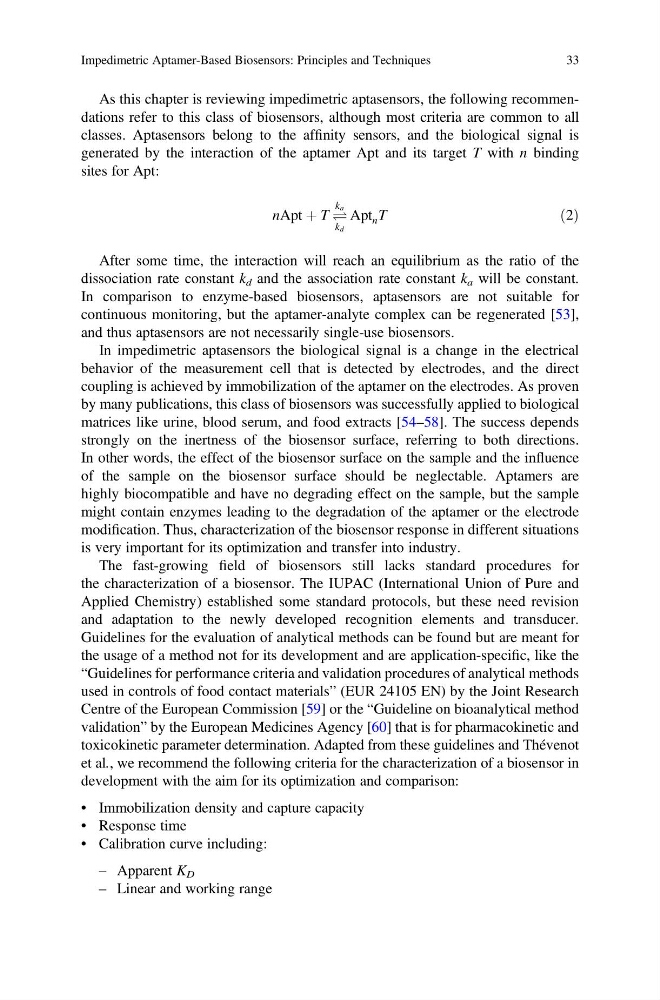
generated by the interaction of the aptamer Apt and its target T with n binding
sites for Apt:
nApt þ T Ð
k a
k d
Apt n T
ð2Þ
After some time, the interaction will reach an equilibrium as the ratio of the
dissociation rate constant k d and the association rate constant k a will be constant.
In comparison to enzyme-based biosensors, aptasensors are not suitable for
continuous monitoring, but the aptamer-analyte complex can be regenerated [53],
and thus aptasensors are not necessarily single-use biosensors.
In impedimetric aptasensors the biological signal is a change in the electrical
behavior of the measurement cell that is detected by electrodes, and the direct
coupling is achieved by immobilization of the aptamer on the electrodes. As proven
by many publications, this class of biosensors was successfully applied to biological
matrices like urine, blood serum, and food extracts [54–58]. The success depends
strongly on the inertness of the biosensor surface, referring to both directions.
In other words, the effect of the biosensor surface on the sample and the influence
of the sample on the biosensor surface should be neglectable. Aptamers are
highly biocompatible and have no degrading effect on the sample, but the sample
might contain enzymes leading to the degradation of the aptamer or the electrode
modification. Thus, characterization of the biosensor response in different situations
is very important for its optimization and transfer into industry.
The fast-growing field of biosensors still lacks standard procedures for
the characterization of a biosensor. The IUPAC (International Union of Pure and
Applied Chemistry) established some standard protocols, but these need revision
and adaptation to the newly developed recognition elements and transducer.
Guidelines for the evaluation of analytical methods can be found but are meant for
the usage of a method not for its development and are application-specific, like the
“Guidelines for performance criteria and validation procedures of analytical methods
used in controls of food contact materials” (EUR 24105 EN) by the Joint Research
Centre of the European Commission [59] or the “Guideline on bioanalytical method
validation” by the European Medicines Agency [60] that is for pharmacokinetic and
toxicokinetic parameter determination. Adapted from these guidelines and Thévenot
et al., we recommend the following criteria for the characterization of a biosensor in
development with the aim for its optimization and comparison:
• Immobilization density and capture capacity
• Response time
• Calibration curve including:
– Apparent K D
– Linear and working range
Impedimetric Aptamer-Based Biosensors: Principles and Techniques
33
classes. Aptasensors belong to the affinity sensors, and the biological signal is
generated by the interaction of the aptamer Apt and its target T with n binding
sites for Apt:
nApt þ T Ð
k a
k d
Apt n T
ð2Þ
After some time, the interaction will reach an equilibrium as the ratio of the
dissociation rate constant k d and the association rate constant k a will be constant.
In comparison to enzyme-based biosensors, aptasensors are not suitable for
continuous monitoring, but the aptamer-analyte complex can be regenerated [53],
and thus aptasensors are not necessarily single-use biosensors.
In impedimetric aptasensors the biological signal is a change in the electrical
behavior of the measurement cell that is detected by electrodes, and the direct
coupling is achieved by immobilization of the aptamer on the electrodes. As proven
by many publications, this class of biosensors was successfully applied to biological
matrices like urine, blood serum, and food extracts [54–58]. The success depends
strongly on the inertness of the biosensor surface, referring to both directions.
In other words, the effect of the biosensor surface on the sample and the influence
of the sample on the biosensor surface should be neglectable. Aptamers are
highly biocompatible and have no degrading effect on the sample, but the sample
might contain enzymes leading to the degradation of the aptamer or the electrode
modification. Thus, characterization of the biosensor response in different situations
is very important for its optimization and transfer into industry.
The fast-growing field of biosensors still lacks standard procedures for
the characterization of a biosensor. The IUPAC (International Union of Pure and
Applied Chemistry) established some standard protocols, but these need revision
and adaptation to the newly developed recognition elements and transducer.
Guidelines for the evaluation of analytical methods can be found but are meant for
the usage of a method not for its development and are application-specific, like the
“Guidelines for performance criteria and validation procedures of analytical methods
used in controls of food contact materials” (EUR 24105 EN) by the Joint Research
Centre of the European Commission [59] or the “Guideline on bioanalytical method
validation” by the European Medicines Agency [60] that is for pharmacokinetic and
toxicokinetic parameter determination. Adapted from these guidelines and Thévenot
et al., we recommend the following criteria for the characterization of a biosensor in
development with the aim for its optimization and comparison:
• Immobilization density and capture capacity
• Response time
• Calibration curve including:
– Apparent K D
– Linear and working range
Impedimetric Aptamer-Based Biosensors: Principles and Techniques
33