

Fe
2+ and Fe
3+ , hexacyanoferrate has two ions, ferricyanide ([Fe(CN) 6 ]
3À ) and
ferrocyanide ([Fe(CN) 6 ]
4À ), which are easily converted into each other. The
ions are formed by the dissolution of the corresponding salts, e.g., potassium
ferricyanide K 3 [Fe(CN) 6 ] and potassium ferrocyanide K 4 [Fe(CN) 6 ]. This redox
couple [Fe(CN) 6 ]
3À/4À is widely used due to its fast electron transfer to electrodes
(Pt, Au) described by the standard heterogeneous electron transfer rate constant
k 0 (0.06 cm/s) and its high diffusion rate D of 6 Â 10
6 cm
2
/s [21].
As mentioned above, due to the existence of many review articles about detection
strategies for electrochemical biosensors, we want to report only recent innovative
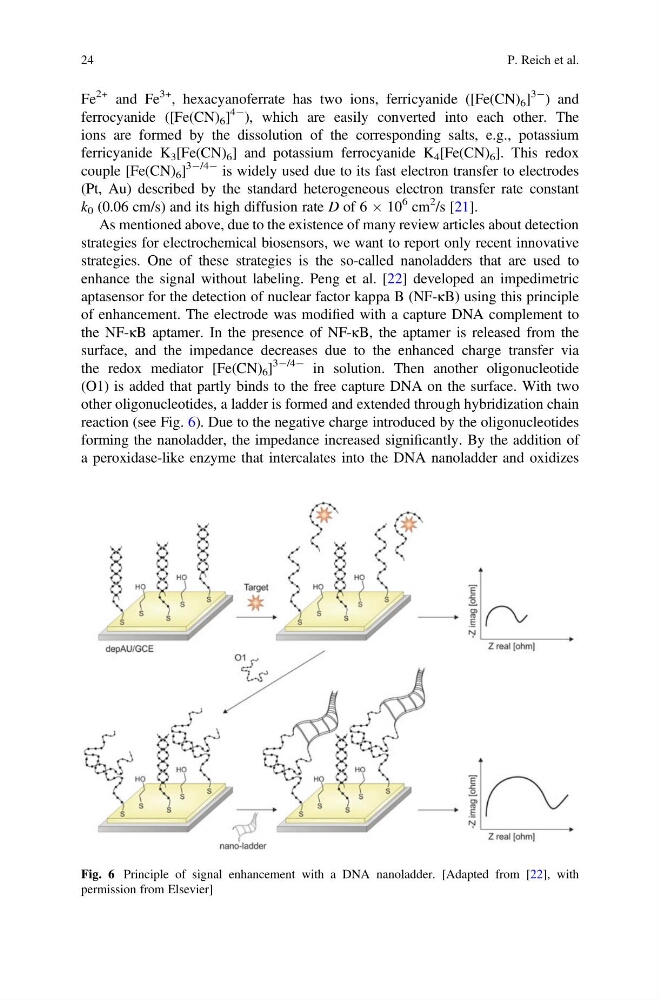
strategies. One of these strategies is the so-called nanoladders that are used to
enhance the signal without labeling. Peng et al. [22] developed an impedimetric
aptasensor for the detection of nuclear factor kappa B (NF-κB) using this principle
of enhancement. The electrode was modified with a capture DNA complement to
the NF-κB aptamer. In the presence of NF-κB, the aptamer is released from the
surface, and the impedance decreases due to the enhanced charge transfer via
the redox mediator [Fe(CN) 6 ]
3À/4À in solution. Then another oligonucleotide
(O1) is added that partly binds to the free capture DNA on the surface. With two
other oligonucleotides, a ladder is formed and extended through hybridization chain
reaction (see Fig. 6). Due to the negative charge introduced by the oligonucleotides
forming the nanoladder, the impedance increased significantly. By the addition of
a peroxidase-like enzyme that intercalates into the DNA nanoladder and oxidizes
Fig. 6 Principle of signal enhancement with a DNA nanoladder. [Adapted from [22], with
permission from Elsevier]
24
P. Reich et al.
2+ and Fe
3+ , hexacyanoferrate has two ions, ferricyanide ([Fe(CN) 6 ]
3À ) and
ferrocyanide ([Fe(CN) 6 ]
4À ), which are easily converted into each other. The
ions are formed by the dissolution of the corresponding salts, e.g., potassium
ferricyanide K 3 [Fe(CN) 6 ] and potassium ferrocyanide K 4 [Fe(CN) 6 ]. This redox
couple [Fe(CN) 6 ]
3À/4À is widely used due to its fast electron transfer to electrodes
(Pt, Au) described by the standard heterogeneous electron transfer rate constant
k 0 (0.06 cm/s) and its high diffusion rate D of 6 Â 10
6 cm
2
/s [21].
As mentioned above, due to the existence of many review articles about detection
strategies for electrochemical biosensors, we want to report only recent innovative
strategies. One of these strategies is the so-called nanoladders that are used to
enhance the signal without labeling. Peng et al. [22] developed an impedimetric
aptasensor for the detection of nuclear factor kappa B (NF-κB) using this principle
of enhancement. The electrode was modified with a capture DNA complement to
the NF-κB aptamer. In the presence of NF-κB, the aptamer is released from the
surface, and the impedance decreases due to the enhanced charge transfer via
the redox mediator [Fe(CN) 6 ]
3À/4À in solution. Then another oligonucleotide
(O1) is added that partly binds to the free capture DNA on the surface. With two
other oligonucleotides, a ladder is formed and extended through hybridization chain
reaction (see Fig. 6). Due to the negative charge introduced by the oligonucleotides
forming the nanoladder, the impedance increased significantly. By the addition of
a peroxidase-like enzyme that intercalates into the DNA nanoladder and oxidizes
Fig. 6 Principle of signal enhancement with a DNA nanoladder. [Adapted from [22], with
permission from Elsevier]
24
P. Reich et al.