

on labeled as well as label-free techniques is given by Mascini et al. [4] and Evtugyn
et al. [61].
In opposite to salts and ions present in buffers, the special structure of redoxactive molecules enables a fast electron transfer at low AC voltage amplitudes,
whereas the level of the DC voltage depends on the redox molecule. In presence
of a redox mediator in solution, upon binding of the target to the immobilized
aptamer, mostly an increase of impedance is observed due to the hindered charge
transfer by the bound target. But in some publications, a decrease of impedance was
observed, for example, for thrombin detection, in which 4 of 26 publications showed
a decrease of impedance [17–20]. Another example is the detection of lysozyme, in
which five out of seven publications report a decrease of impedance. Rodriguez et al.
stated that the positive charge of the target increased the attraction of the negatively
charged redox mediator and thus decreased the impedance [1]. As the isoelectric
points of lysozyme and thrombin are ~11 and ~7, respectively, lysozyme is at
physiological pH more positively charged than thrombin. This point supports
the statement, but no confirming experiment was performed yet.
The most commonly used redox mediator is hexacyanoferrate (Fig. 5), which is
a complex of an iron (Fe) bound in the center of six cyanides (CN) arranged
in an octahedral geometry. Because iron exists usually in two oxidation states,
Fig. 5 The redox couple
ferricyanide (left) and
ferrocyanide (right)
commonly used in faradaic
impedance measurements
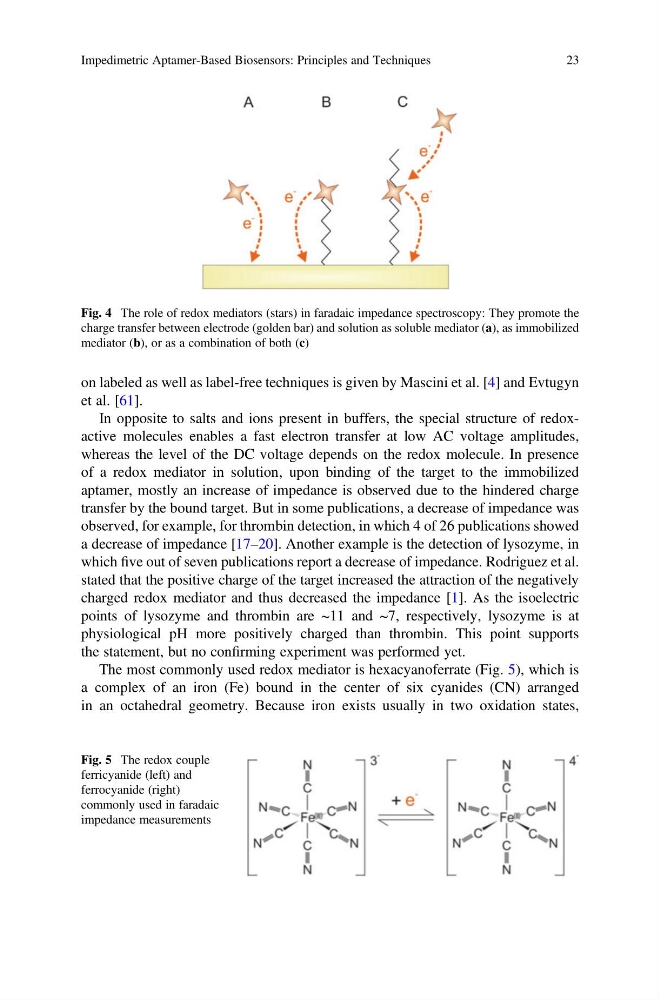
Fig. 4 The role of redox mediators (stars) in faradaic impedance spectroscopy: They promote the
charge transfer between electrode (golden bar) and solution as soluble mediator (a), as immobilized
mediator (b), or as a combination of both (c)
Impedimetric Aptamer-Based Biosensors: Principles and Techniques
23
et al. [61].
In opposite to salts and ions present in buffers, the special structure of redoxactive molecules enables a fast electron transfer at low AC voltage amplitudes,
whereas the level of the DC voltage depends on the redox molecule. In presence
of a redox mediator in solution, upon binding of the target to the immobilized
aptamer, mostly an increase of impedance is observed due to the hindered charge
transfer by the bound target. But in some publications, a decrease of impedance was
observed, for example, for thrombin detection, in which 4 of 26 publications showed
a decrease of impedance [17–20]. Another example is the detection of lysozyme, in
which five out of seven publications report a decrease of impedance. Rodriguez et al.
stated that the positive charge of the target increased the attraction of the negatively
charged redox mediator and thus decreased the impedance [1]. As the isoelectric
points of lysozyme and thrombin are ~11 and ~7, respectively, lysozyme is at
physiological pH more positively charged than thrombin. This point supports
the statement, but no confirming experiment was performed yet.
The most commonly used redox mediator is hexacyanoferrate (Fig. 5), which is
a complex of an iron (Fe) bound in the center of six cyanides (CN) arranged
in an octahedral geometry. Because iron exists usually in two oxidation states,
Fig. 5 The redox couple
ferricyanide (left) and
ferrocyanide (right)
commonly used in faradaic
impedance measurements
Fig. 4 The role of redox mediators (stars) in faradaic impedance spectroscopy: They promote the
charge transfer between electrode (golden bar) and solution as soluble mediator (a), as immobilized
mediator (b), or as a combination of both (c)
Impedimetric Aptamer-Based Biosensors: Principles and Techniques
23