

by adding odd harmonic frequencies in the range 1 Hz–20 kHz and applying five
periods of the created excitation signal. They modified a glassy carbon electrode
with multiwalled carbon nanotubes (MWCNT) and an aptamer against 2-hydroxy2
0 ,3
0 ,4
0 ,5
0 ,5
0 -pentachloro-biphenyl (OH-PCB), an environmentally harmful pollutant.
For comparison, single-sine and multisine signals were applied, and the results showed
no significant difference between the two techniques with errors 6%. They were
able to detect OH-PCB down to 1 nM. Another advantage of using multisine instead
of single sine is the gain of information about noise, linearity, and stationarity of the
measurement. In that way, they found nonlinearity and non-stationarity for frequencies
below 100 Hz and concluded that the selected model does not represent the data
properly. In 2014, they showed the application of this aptasensor in human blood
serum samples with a LoD of 10 nM [14].
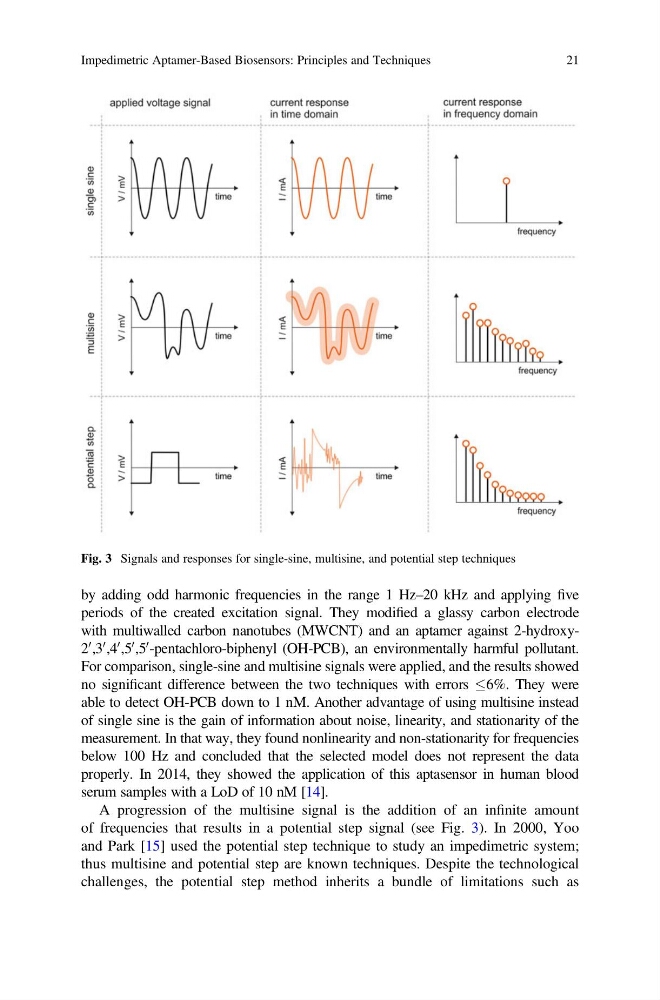
A progression of the multisine signal is the addition of an infinite amount
of frequencies that results in a potential step signal (see Fig. 3). In 2000, Yoo
and Park [15] used the potential step technique to study an impedimetric system;
thus multisine and potential step are known techniques. Despite the technological
challenges, the potential step method inherits a bundle of limitations such as
Fig. 3 Signals and responses for single-sine, multisine, and potential step techniques
Impedimetric Aptamer-Based Biosensors: Principles and Techniques
21
periods of the created excitation signal. They modified a glassy carbon electrode
with multiwalled carbon nanotubes (MWCNT) and an aptamer against 2-hydroxy2
0 ,3
0 ,4
0 ,5
0 ,5
0 -pentachloro-biphenyl (OH-PCB), an environmentally harmful pollutant.
For comparison, single-sine and multisine signals were applied, and the results showed
no significant difference between the two techniques with errors 6%. They were
able to detect OH-PCB down to 1 nM. Another advantage of using multisine instead
of single sine is the gain of information about noise, linearity, and stationarity of the
measurement. In that way, they found nonlinearity and non-stationarity for frequencies
below 100 Hz and concluded that the selected model does not represent the data
properly. In 2014, they showed the application of this aptasensor in human blood
serum samples with a LoD of 10 nM [14].
A progression of the multisine signal is the addition of an infinite amount
of frequencies that results in a potential step signal (see Fig. 3). In 2000, Yoo
and Park [15] used the potential step technique to study an impedimetric system;
thus multisine and potential step are known techniques. Despite the technological
challenges, the potential step method inherits a bundle of limitations such as
Fig. 3 Signals and responses for single-sine, multisine, and potential step techniques
Impedimetric Aptamer-Based Biosensors: Principles and Techniques
21