

of this chapter discusses parameters that should be determined for a developed
electrochemical aptasensor to enable the comparison of different aptasensors with
each other. Another chapter enclosed in this book describes the possible applications
of impedimetric aptasensors in health care, food inspection, and environmental
protection.
2 Impedimetric Measurement Techniques
The term impedance Z was established by Oliver Heaviside in 1886 and is defined
as the ratio of the applied voltage u of a specific frequency f and its current
response i [11]:
Z 2πf
ð Þ ¼ u=i
ð1Þ
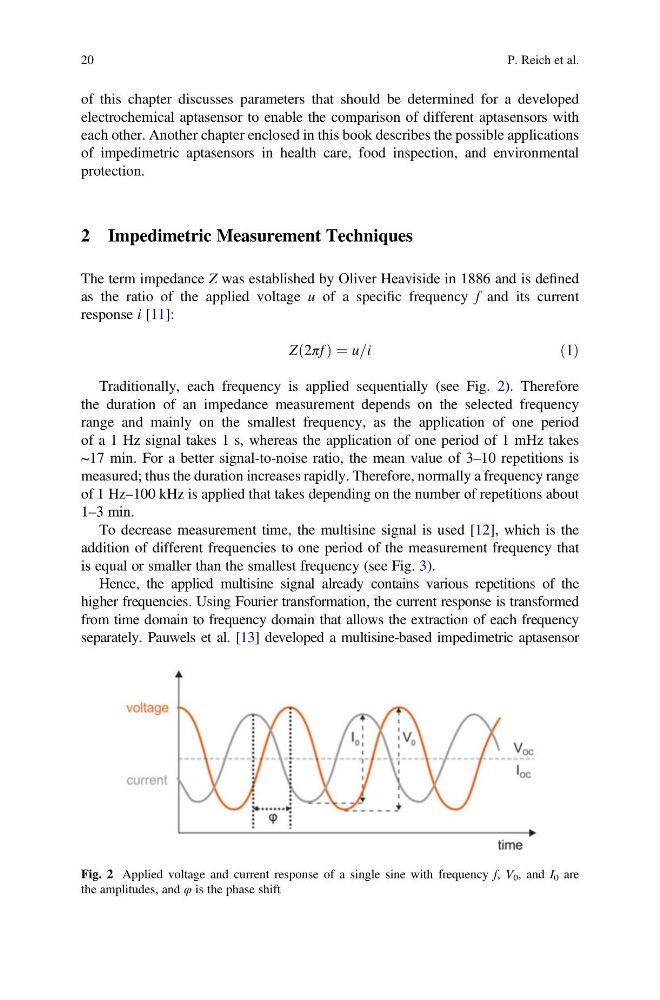
Traditionally, each frequency is applied sequentially (see Fig. 2). Therefore
the duration of an impedance measurement depends on the selected frequency
range and mainly on the smallest frequency, as the application of one period
of a 1 Hz signal takes 1 s, whereas the application of one period of 1 mHz takes
~17 min. For a better signal-to-noise ratio, the mean value of 3–10 repetitions is
measured; thus the duration increases rapidly. Therefore, normally a frequency range
of 1 Hz–100 kHz is applied that takes depending on the number of repetitions about
1–3 min.
To decrease measurement time, the multisine signal is used [12], which is the
addition of different frequencies to one period of the measurement frequency that
is equal or smaller than the smallest frequency (see Fig. 3).
Hence, the applied multisine signal already contains various repetitions of the
higher frequencies. Using Fourier transformation, the current response is transformed
from time domain to frequency domain that allows the extraction of each frequency
separately. Pauwels et al. [13] developed a multisine-based impedimetric aptasensor
Fig. 2 Applied voltage and current response of a single sine with frequency f, V 0 , and I 0 are
the amplitudes, and φ is the phase shift
20
P. Reich et al.
electrochemical aptasensor to enable the comparison of different aptasensors with
each other. Another chapter enclosed in this book describes the possible applications
of impedimetric aptasensors in health care, food inspection, and environmental
protection.
2 Impedimetric Measurement Techniques
The term impedance Z was established by Oliver Heaviside in 1886 and is defined
as the ratio of the applied voltage u of a specific frequency f and its current
response i [11]:
Z 2πf
ð Þ ¼ u=i
ð1Þ
Traditionally, each frequency is applied sequentially (see Fig. 2). Therefore
the duration of an impedance measurement depends on the selected frequency
range and mainly on the smallest frequency, as the application of one period
of a 1 Hz signal takes 1 s, whereas the application of one period of 1 mHz takes
~17 min. For a better signal-to-noise ratio, the mean value of 3–10 repetitions is
measured; thus the duration increases rapidly. Therefore, normally a frequency range
of 1 Hz–100 kHz is applied that takes depending on the number of repetitions about
1–3 min.
To decrease measurement time, the multisine signal is used [12], which is the
addition of different frequencies to one period of the measurement frequency that
is equal or smaller than the smallest frequency (see Fig. 3).
Hence, the applied multisine signal already contains various repetitions of the
higher frequencies. Using Fourier transformation, the current response is transformed
from time domain to frequency domain that allows the extraction of each frequency
separately. Pauwels et al. [13] developed a multisine-based impedimetric aptasensor
Fig. 2 Applied voltage and current response of a single sine with frequency f, V 0 , and I 0 are
the amplitudes, and φ is the phase shift
20
P. Reich et al.