

systemic clearance by preventing the binding of plasma proteins and thereby
preventing recognition by the mononuclear phagocyte system [84, 87].
Despite the popularity of block copolymers, other nanoparticles are composed of
only a single type of polymer, e.g., poly(lactic-co-glycolic acid) (PLGA), and
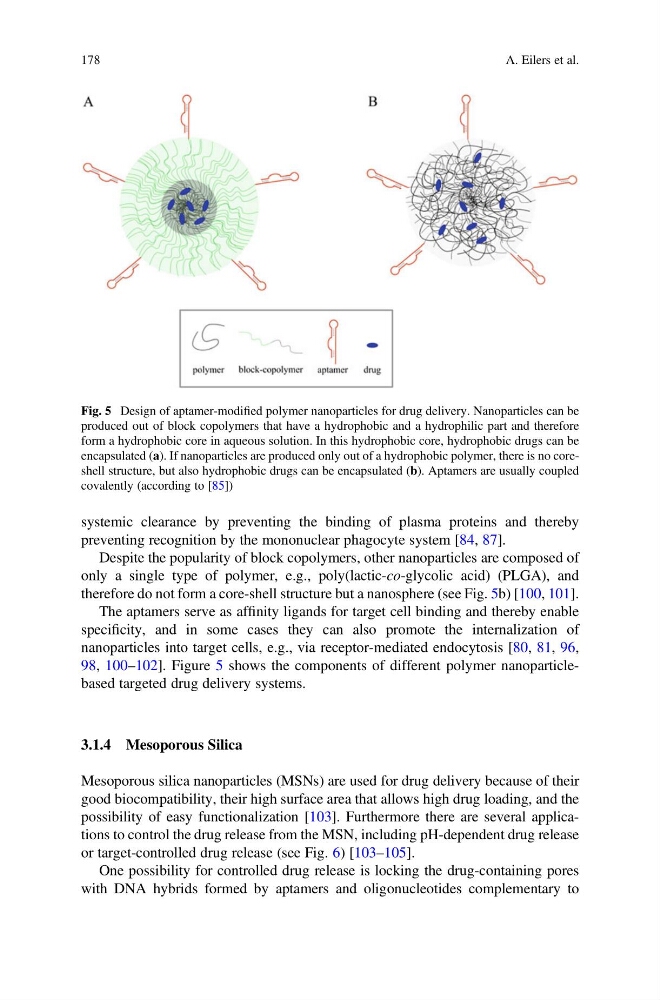
therefore do not form a core-shell structure but a nanosphere (see Fig. 5b) [100, 101].
The aptamers serve as affinity ligands for target cell binding and thereby enable
specificity, and in some cases they can also promote the internalization of
nanoparticles into target cells, e.g., via receptor-mediated endocytosis [80, 81, 96,
98, 100–102]. Figure 5 shows the components of different polymer nanoparticlebased targeted drug delivery systems.
3.1.4 Mesoporous Silica
Mesoporous silica nanoparticles (MSNs) are used for drug delivery because of their
good biocompatibility, their high surface area that allows high drug loading, and the
possibility of easy functionalization [103]. Furthermore there are several applications to control the drug release from the MSN, including pH-dependent drug release
or target-controlled drug release (see Fig. 6) [103–105].
One possibility for controlled drug release is locking the drug-containing pores
with DNA hybrids formed by aptamers and oligonucleotides complementary to
Fig. 5 Design of aptamer-modified polymer nanoparticles for drug delivery. Nanoparticles can be
produced out of block copolymers that have a hydrophobic and a hydrophilic part and therefore
form a hydrophobic core in aqueous solution. In this hydrophobic core, hydrophobic drugs can be
encapsulated (a). If nanoparticles are produced only out of a hydrophobic polymer, there is no coreshell structure, but also hydrophobic drugs can be encapsulated (b). Aptamers are usually coupled
covalently (according to [85])
178
A. Eilers et al.
preventing recognition by the mononuclear phagocyte system [84, 87].
Despite the popularity of block copolymers, other nanoparticles are composed of
only a single type of polymer, e.g., poly(lactic-co-glycolic acid) (PLGA), and
therefore do not form a core-shell structure but a nanosphere (see Fig. 5b) [100, 101].
The aptamers serve as affinity ligands for target cell binding and thereby enable
specificity, and in some cases they can also promote the internalization of
nanoparticles into target cells, e.g., via receptor-mediated endocytosis [80, 81, 96,
98, 100–102]. Figure 5 shows the components of different polymer nanoparticlebased targeted drug delivery systems.
3.1.4 Mesoporous Silica
Mesoporous silica nanoparticles (MSNs) are used for drug delivery because of their
good biocompatibility, their high surface area that allows high drug loading, and the
possibility of easy functionalization [103]. Furthermore there are several applications to control the drug release from the MSN, including pH-dependent drug release
or target-controlled drug release (see Fig. 6) [103–105].
One possibility for controlled drug release is locking the drug-containing pores
with DNA hybrids formed by aptamers and oligonucleotides complementary to
Fig. 5 Design of aptamer-modified polymer nanoparticles for drug delivery. Nanoparticles can be
produced out of block copolymers that have a hydrophobic and a hydrophilic part and therefore
form a hydrophobic core in aqueous solution. In this hydrophobic core, hydrophobic drugs can be
encapsulated (a). If nanoparticles are produced only out of a hydrophobic polymer, there is no coreshell structure, but also hydrophobic drugs can be encapsulated (b). Aptamers are usually coupled
covalently (according to [85])
178
A. Eilers et al.