

PEG-modified liposome with encapsulated doxorubicin was the first FDA-approved
nanodrug (Doxil
® ), but this system was still without a targeting ligand [93]. The
results of Kang et al. showed that aptamers increase the binding of the system to
target cells, which could be a promising advancement for future applications
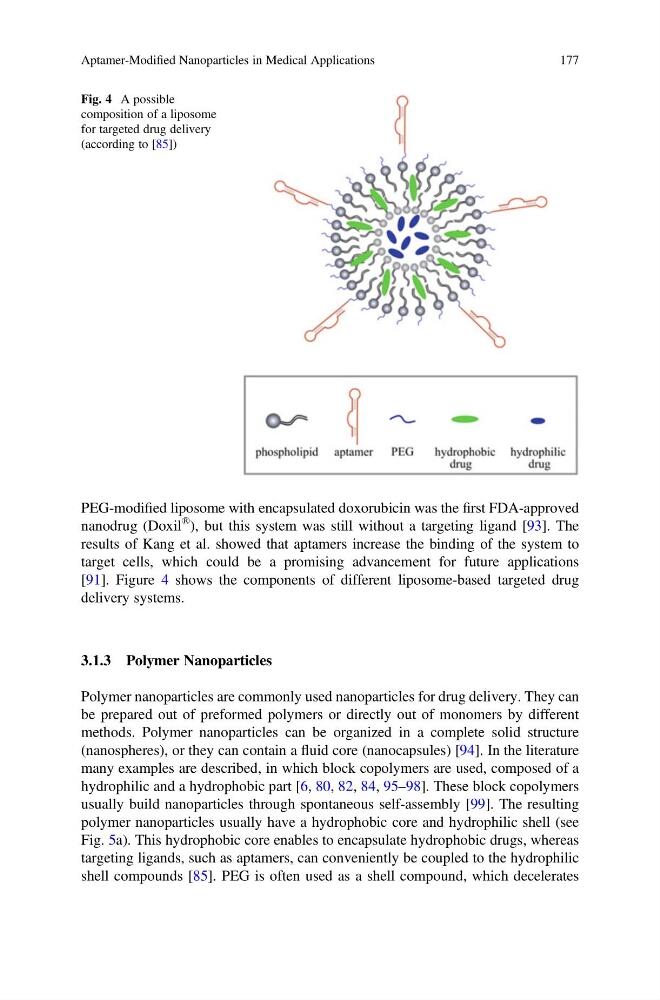
[91]. Figure 4 shows the components of different liposome-based targeted drug
delivery systems.
3.1.3 Polymer Nanoparticles
Polymer nanoparticles are commonly used nanoparticles for drug delivery. They can
be prepared out of preformed polymers or directly out of monomers by different
methods. Polymer nanoparticles can be organized in a complete solid structure
(nanospheres), or they can contain a fluid core (nanocapsules) [94]. In the literature
many examples are described, in which block copolymers are used, composed of a
hydrophilic and a hydrophobic part [6, 80, 82, 84, 95–98]. These block copolymers
usually build nanoparticles through spontaneous self-assembly [99]. The resulting
polymer nanoparticles usually have a hydrophobic core and hydrophilic shell (see
Fig. 5a). This hydrophobic core enables to encapsulate hydrophobic drugs, whereas
targeting ligands, such as aptamers, can conveniently be coupled to the hydrophilic
shell compounds [85]. PEG is often used as a shell compound, which decelerates
Fig. 4 A possible
composition of a liposome
for targeted drug delivery
(according to [85])
Aptamer-Modified Nanoparticles in Medical Applications
177
nanodrug (Doxil
® ), but this system was still without a targeting ligand [93]. The
results of Kang et al. showed that aptamers increase the binding of the system to
target cells, which could be a promising advancement for future applications
[91]. Figure 4 shows the components of different liposome-based targeted drug
delivery systems.
3.1.3 Polymer Nanoparticles
Polymer nanoparticles are commonly used nanoparticles for drug delivery. They can
be prepared out of preformed polymers or directly out of monomers by different
methods. Polymer nanoparticles can be organized in a complete solid structure
(nanospheres), or they can contain a fluid core (nanocapsules) [94]. In the literature
many examples are described, in which block copolymers are used, composed of a
hydrophilic and a hydrophobic part [6, 80, 82, 84, 95–98]. These block copolymers
usually build nanoparticles through spontaneous self-assembly [99]. The resulting
polymer nanoparticles usually have a hydrophobic core and hydrophilic shell (see
Fig. 5a). This hydrophobic core enables to encapsulate hydrophobic drugs, whereas
targeting ligands, such as aptamers, can conveniently be coupled to the hydrophilic
shell compounds [85]. PEG is often used as a shell compound, which decelerates
Fig. 4 A possible
composition of a liposome
for targeted drug delivery
(according to [85])
Aptamer-Modified Nanoparticles in Medical Applications
177