

purification using the aptamer affinity column, with a purity estimated close to 78%,
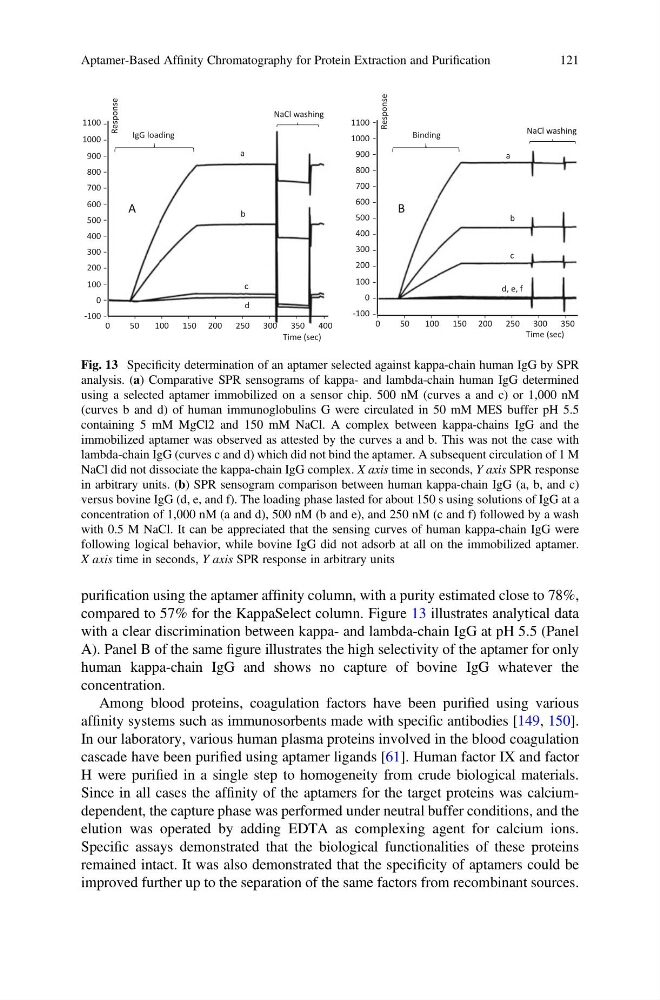
compared to 57% for the KappaSelect column. Figure 13 illustrates analytical data
with a clear discrimination between kappa- and lambda-chain IgG at pH 5.5 (Panel
A). Panel B of the same figure illustrates the high selectivity of the aptamer for only
human kappa-chain IgG and shows no capture of bovine IgG whatever the
concentration.
Among blood proteins, coagulation factors have been purified using various
affinity systems such as immunosorbents made with specific antibodies [149, 150].
In our laboratory, various human plasma proteins involved in the blood coagulation
cascade have been purified using aptamer ligands [61]. Human factor IX and factor
H were purified in a single step to homogeneity from crude biological materials.
Since in all cases the affinity of the aptamers for the target proteins was calciumdependent, the capture phase was performed under neutral buffer conditions, and the
elution was operated by adding EDTA as complexing agent for calcium ions.
Specific assays demonstrated that the biological functionalities of these proteins
remained intact. It was also demonstrated that the specificity of aptamers could be
improved further up to the separation of the same factors from recombinant sources.
1100
1000
900
800
700
600
500
400
300
200
100
0
-100
Response
0
50
100 150 200 250 300 350 400
Time (sec)
A
IgG loading
NaCl washing
a
b
c
d
Response
1100
1000
900
800
700
600
500
400
300
200
100
0
-100
0
5 0
1 0 0 1 5 0 200 250 300 350
Time (sec)
B
Binding
NaCl washing
a
b
c
d, e, f
Fig. 13 Specificity determination of an aptamer selected against kappa-chain human IgG by SPR
analysis. (a) Comparative SPR sensograms of kappa- and lambda-chain human IgG determined
using a selected aptamer immobilized on a sensor chip. 500 nM (curves a and c) or 1,000 nM
(curves b and d) of human immunoglobulins G were circulated in 50 mM MES buffer pH 5.5
containing 5 mM MgCl2 and 150 mM NaCl. A complex between kappa-chains IgG and the
immobilized aptamer was observed as attested by the curves a and b. This was not the case with
lambda-chain IgG (curves c and d) which did not bind the aptamer. A subsequent circulation of 1 M
NaCl did not dissociate the kappa-chain IgG complex. X axis time in seconds, Y axis SPR response
in arbitrary units. (b) SPR sensogram comparison between human kappa-chain IgG (a, b, and c)
versus bovine IgG (d, e, and f). The loading phase lasted for about 150 s using solutions of IgG at a
concentration of 1,000 nM (a and d), 500 nM (b and e), and 250 nM (c and f) followed by a wash
with 0.5 M NaCl. It can be appreciated that the sensing curves of human kappa-chain IgG were
following logical behavior, while bovine IgG did not adsorb at all on the immobilized aptamer.
X axis time in seconds, Y axis SPR response in arbitrary units
Aptamer-Based Affinity Chromatography for Protein Extraction and Purification
121
compared to 57% for the KappaSelect column. Figure 13 illustrates analytical data
with a clear discrimination between kappa- and lambda-chain IgG at pH 5.5 (Panel
A). Panel B of the same figure illustrates the high selectivity of the aptamer for only
human kappa-chain IgG and shows no capture of bovine IgG whatever the
concentration.
Among blood proteins, coagulation factors have been purified using various
affinity systems such as immunosorbents made with specific antibodies [149, 150].
In our laboratory, various human plasma proteins involved in the blood coagulation
cascade have been purified using aptamer ligands [61]. Human factor IX and factor
H were purified in a single step to homogeneity from crude biological materials.
Since in all cases the affinity of the aptamers for the target proteins was calciumdependent, the capture phase was performed under neutral buffer conditions, and the
elution was operated by adding EDTA as complexing agent for calcium ions.
Specific assays demonstrated that the biological functionalities of these proteins
remained intact. It was also demonstrated that the specificity of aptamers could be
improved further up to the separation of the same factors from recombinant sources.
1100
1000
900
800
700
600
500
400
300
200
100
0
-100
Response
0
50
100 150 200 250 300 350 400
Time (sec)
A
IgG loading
NaCl washing
a
b
c
d
Response
1100
1000
900
800
700
600
500
400
300
200
100
0
-100
0
5 0
1 0 0 1 5 0 200 250 300 350
Time (sec)
B
Binding
NaCl washing
a
b
c
d, e, f
Fig. 13 Specificity determination of an aptamer selected against kappa-chain human IgG by SPR
analysis. (a) Comparative SPR sensograms of kappa- and lambda-chain human IgG determined
using a selected aptamer immobilized on a sensor chip. 500 nM (curves a and c) or 1,000 nM
(curves b and d) of human immunoglobulins G were circulated in 50 mM MES buffer pH 5.5
containing 5 mM MgCl2 and 150 mM NaCl. A complex between kappa-chains IgG and the
immobilized aptamer was observed as attested by the curves a and b. This was not the case with
lambda-chain IgG (curves c and d) which did not bind the aptamer. A subsequent circulation of 1 M
NaCl did not dissociate the kappa-chain IgG complex. X axis time in seconds, Y axis SPR response
in arbitrary units. (b) SPR sensogram comparison between human kappa-chain IgG (a, b, and c)
versus bovine IgG (d, e, and f). The loading phase lasted for about 150 s using solutions of IgG at a
concentration of 1,000 nM (a and d), 500 nM (b and e), and 250 nM (c and f) followed by a wash
with 0.5 M NaCl. It can be appreciated that the sensing curves of human kappa-chain IgG were
following logical behavior, while bovine IgG did not adsorb at all on the immobilized aptamer.
X axis time in seconds, Y axis SPR response in arbitrary units
Aptamer-Based Affinity Chromatography for Protein Extraction and Purification
121