

adsorption and at pH 7.4 for the elution. The immobilization of the selected aptamer
against Fc fragment of human immunoglobulins G was made on an NHS-activated
solid support, using amino derivative spacers of six carbons in position 5
0 . Starting
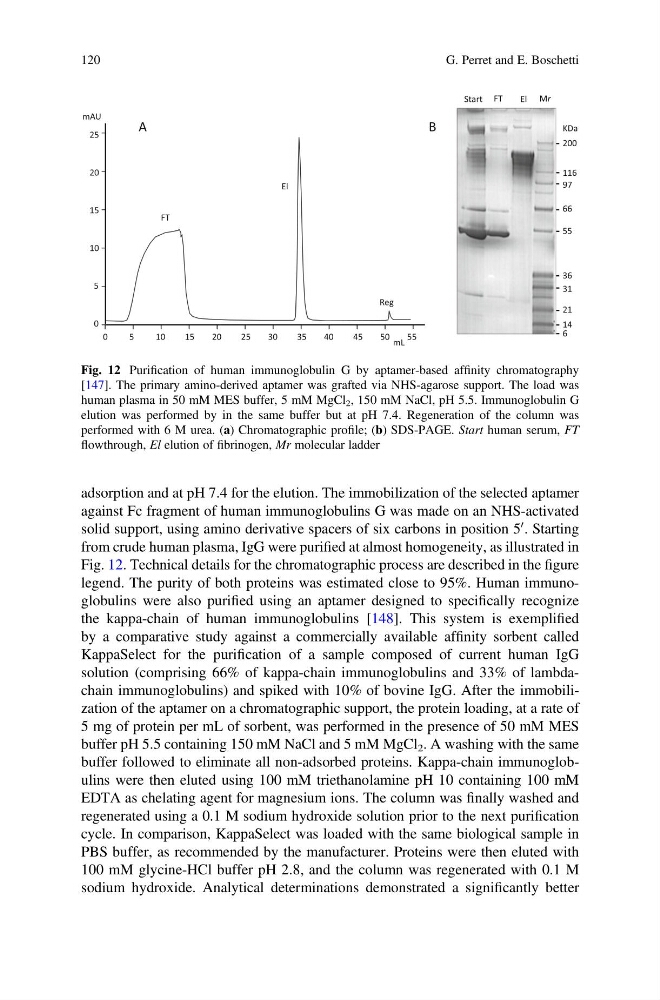
from crude human plasma, IgG were purified at almost homogeneity, as illustrated in
Fig. 12. Technical details for the chromatographic process are described in the figure
legend. The purity of both proteins was estimated close to 95%. Human immunoglobulins were also purified using an aptamer designed to specifically recognize
the kappa-chain of human immunoglobulins [148]. This system is exemplified
by a comparative study against a commercially available affinity sorbent called
KappaSelect for the purification of a sample composed of current human IgG
solution (comprising 66% of kappa-chain immunoglobulins and 33% of lambdachain immunoglobulins) and spiked with 10% of bovine IgG. After the immobilization of the aptamer on a chromatographic support, the protein loading, at a rate of
5 mg of protein per mL of sorbent, was performed in the presence of 50 mM MES
buffer pH 5.5 containing 150 mM NaCl and 5 mM MgCl 2 . A washing with the same
buffer followed to eliminate all non-adsorbed proteins. Kappa-chain immunoglobulins were then eluted using 100 mM triethanolamine pH 10 containing 100 mM
EDTA as chelating agent for magnesium ions. The column was finally washed and
regenerated using a 0.1 M sodium hydroxide solution prior to the next purification
cycle. In comparison, KappaSelect was loaded with the same biological sample in
PBS buffer, as recommended by the manufacturer. Proteins were then eluted with
100 mM glycine-HCl buffer pH 2.8, and the column was regenerated with 0.1 M
sodium hydroxide. Analytical determinations demonstrated a significantly better
B
Mr
Start FT
El
200
116
97
66
55
36
31
21
14
KDa
6
25
20
15
10
5
0
mAU
A
FT
El
Reg
0
5
10
15
20
25
30
35
40
45
50
55
mL
Fig. 12 Purification of human immunoglobulin G by aptamer-based affinity chromatography
[147]. The primary amino-derived aptamer was grafted via NHS-agarose support. The load was
human plasma in 50 mM MES buffer, 5 mM MgCl 2 , 150 mM NaCl, pH 5.5. Immunoglobulin G
elution was performed by in the same buffer but at pH 7.4. Regeneration of the column was
performed with 6 M urea. (a) Chromatographic profile; (b) SDS-PAGE. Start human serum, FT
flowthrough, El elution of fibrinogen, Mr molecular ladder
120
G. Perret and E. Boschetti
against Fc fragment of human immunoglobulins G was made on an NHS-activated
solid support, using amino derivative spacers of six carbons in position 5
0 . Starting
from crude human plasma, IgG were purified at almost homogeneity, as illustrated in
Fig. 12. Technical details for the chromatographic process are described in the figure
legend. The purity of both proteins was estimated close to 95%. Human immunoglobulins were also purified using an aptamer designed to specifically recognize
the kappa-chain of human immunoglobulins [148]. This system is exemplified
by a comparative study against a commercially available affinity sorbent called
KappaSelect for the purification of a sample composed of current human IgG
solution (comprising 66% of kappa-chain immunoglobulins and 33% of lambdachain immunoglobulins) and spiked with 10% of bovine IgG. After the immobilization of the aptamer on a chromatographic support, the protein loading, at a rate of
5 mg of protein per mL of sorbent, was performed in the presence of 50 mM MES
buffer pH 5.5 containing 150 mM NaCl and 5 mM MgCl 2 . A washing with the same
buffer followed to eliminate all non-adsorbed proteins. Kappa-chain immunoglobulins were then eluted using 100 mM triethanolamine pH 10 containing 100 mM
EDTA as chelating agent for magnesium ions. The column was finally washed and
regenerated using a 0.1 M sodium hydroxide solution prior to the next purification
cycle. In comparison, KappaSelect was loaded with the same biological sample in
PBS buffer, as recommended by the manufacturer. Proteins were then eluted with
100 mM glycine-HCl buffer pH 2.8, and the column was regenerated with 0.1 M
sodium hydroxide. Analytical determinations demonstrated a significantly better
B
Mr
Start FT
El
200
116
97
66
55
36
31
21
14
KDa
6
25
20
15
10
5
0
mAU
A
FT
El
Reg
0
5
10
15
20
25
30
35
40
45
50
55
mL
Fig. 12 Purification of human immunoglobulin G by aptamer-based affinity chromatography
[147]. The primary amino-derived aptamer was grafted via NHS-agarose support. The load was
human plasma in 50 mM MES buffer, 5 mM MgCl 2 , 150 mM NaCl, pH 5.5. Immunoglobulin G
elution was performed by in the same buffer but at pH 7.4. Regeneration of the column was
performed with 6 M urea. (a) Chromatographic profile; (b) SDS-PAGE. Start human serum, FT
flowthrough, El elution of fibrinogen, Mr molecular ladder
120
G. Perret and E. Boschetti