

Beneficial microorganisms isolated from crop rhizosphere could be exploited to
provide sustainable solutions to agricultural crop production by reducing pesticide
use (Philippot et al. 2013; Sindhu et al. 2017; Sehrawat and Sindhu 2019) or by
degradation of residual pesticides in soil (Sindhu et al. 2014; Huang et al. 2018).
Therefore, the microbial biodegradation or biological catalytic process of organic
contaminants in the soil or crop rhizosphere is of major importance for environmental restoration (Karigar and Rao 2011; Joutey et al. 2013; Kehinde and Isaac 2016;
Bharagava and Mishra 2018).
In bioremediation process, microorganisms and plants are used as biological
intermediates to eliminate toxic/hazardous organic and inorganic chemicals into
less hazardous compounds (Chandra et al. 2015; Saxena and Bharagava 2016). It
is an environment-friendly and efficient method that can be used as an alternative to
chemical and physical methods (Gilani et al. 2016). Antimicrobial control is an
effective tool for cleaning pesticide-contaminated areas. Toxic chemicals/substances
are converted to low-level toxic substances by the microbial control process (Saez
et al. 2014; Kurade et al. 2016; Pan et al. 2017). The main benefits of microbial
remediation of pesticides are easy multiplication and rapid growth leading to high
microbial population. Under suitable growth conditions (sufficient humidity, moderate or warm temperature, adequate pH, and air circulation), microbial decay can be
improved, leading to complete deprivation of pesticides.
Microbial degradation of pesticides, xenobiotic compounds, and biochemicals
has been broadly reported (McGuinness and Dowling 2009; Porto et al. 2011;
Ladino-Orjuela et al. 2016) to reduce pesticide residues in food and feed (Kadam
and Gangawane 2005; Castillo et al. 2011). Microbes like fungal and bacterial
species break down a variety of pesticide compounds counting phenols, substituted
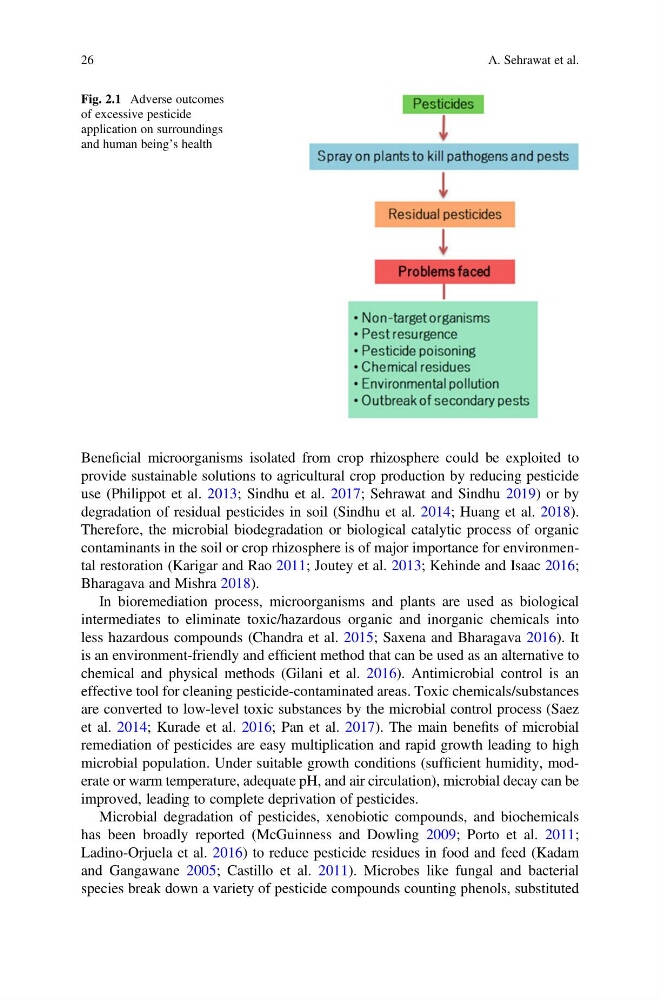
Fig. 2.1 Adverse outcomes
of excessive pesticide
application on surroundings
and human being’s health
26
A. Sehrawat et al.
provide sustainable solutions to agricultural crop production by reducing pesticide
use (Philippot et al. 2013; Sindhu et al. 2017; Sehrawat and Sindhu 2019) or by
degradation of residual pesticides in soil (Sindhu et al. 2014; Huang et al. 2018).
Therefore, the microbial biodegradation or biological catalytic process of organic
contaminants in the soil or crop rhizosphere is of major importance for environmental restoration (Karigar and Rao 2011; Joutey et al. 2013; Kehinde and Isaac 2016;
Bharagava and Mishra 2018).
In bioremediation process, microorganisms and plants are used as biological
intermediates to eliminate toxic/hazardous organic and inorganic chemicals into
less hazardous compounds (Chandra et al. 2015; Saxena and Bharagava 2016). It
is an environment-friendly and efficient method that can be used as an alternative to
chemical and physical methods (Gilani et al. 2016). Antimicrobial control is an
effective tool for cleaning pesticide-contaminated areas. Toxic chemicals/substances
are converted to low-level toxic substances by the microbial control process (Saez
et al. 2014; Kurade et al. 2016; Pan et al. 2017). The main benefits of microbial
remediation of pesticides are easy multiplication and rapid growth leading to high
microbial population. Under suitable growth conditions (sufficient humidity, moderate or warm temperature, adequate pH, and air circulation), microbial decay can be
improved, leading to complete deprivation of pesticides.
Microbial degradation of pesticides, xenobiotic compounds, and biochemicals
has been broadly reported (McGuinness and Dowling 2009; Porto et al. 2011;
Ladino-Orjuela et al. 2016) to reduce pesticide residues in food and feed (Kadam
and Gangawane 2005; Castillo et al. 2011). Microbes like fungal and bacterial
species break down a variety of pesticide compounds counting phenols, substituted
Fig. 2.1 Adverse outcomes
of excessive pesticide
application on surroundings
and human being’s health
26
A. Sehrawat et al.