

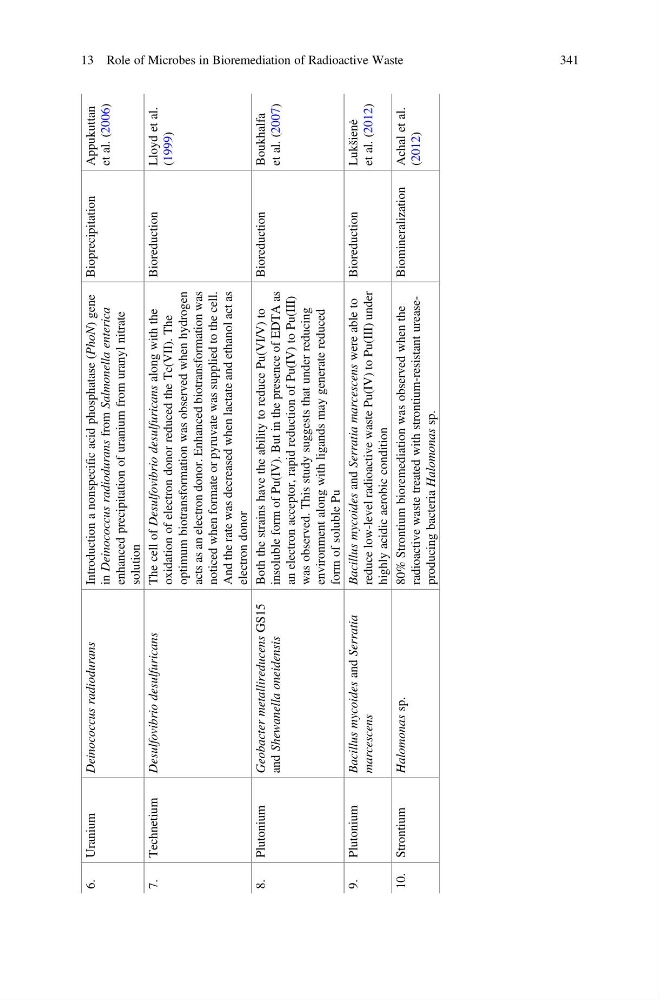
6.
Uranium
Deinococcus radiodurans
Introduction a nonspecific acid phosphatase (PhoN) gene
in Deinococcus radiodurans
from Salmonella enterica
enhanced precipitation of uranium from uranyl nitrate
solution
Bioprecipitation
Appukuttan
et al. (2006)
7.
Technetium
Desulfovibrio desulfuricans
The cell of Desulfovibrio desulfuricans
along with the
oxidation of electron donor reduced the Tc(VII). The
optimum biotransformation was observed when hydrogen
acts as an electron donor. Enhanced biotransformation was
noticed when formate or pyruvate was supplied to the cell.
And the rate was decreased when lactate and ethanol act as
electron donor
Bioreduction
Lloyd et al.
(1999)
8.
Plutonium
Geobacter metallireducens
GS15
and Shewanella oneidensis
Both the strains have the ability to reduce Pu(VI/V) to
insoluble form of Pu(IV). But in the presence of EDTA as
an electron acceptor, rapid reduction of Pu(IV) to Pu(III)
was observed. This study suggests that under reducing
environment along with ligands may generate reduced
form of soluble Pu
Bioreduction
Boukhalfa
et al. (2007)
9.
Plutonium
Bacillus mycoides
and Serratia
marcescens
Bacillus mycoides
and Serratia marcescens
were able to
reduce low-level radioactive waste Pu(IV) to Pu(III) under
highly acidic aerobic condition
Bioreduction
Lukšienė
et al. (2012)
10. Strontium
Halomonas
sp.
80% Strontium bioremediation was observed when the
radioactive waste treated with strontium-resistant ureaseproducing bacteria Halomonas
sp.
Biomineralization
Achal et al.
(2012)
13 Role of Microbes in Bioremediation of Radioactive Waste
341
Uranium
Deinococcus radiodurans
Introduction a nonspecific acid phosphatase (PhoN) gene
in Deinococcus radiodurans
from Salmonella enterica
enhanced precipitation of uranium from uranyl nitrate
solution
Bioprecipitation
Appukuttan
et al. (2006)
7.
Technetium
Desulfovibrio desulfuricans
The cell of Desulfovibrio desulfuricans
along with the
oxidation of electron donor reduced the Tc(VII). The
optimum biotransformation was observed when hydrogen
acts as an electron donor. Enhanced biotransformation was
noticed when formate or pyruvate was supplied to the cell.
And the rate was decreased when lactate and ethanol act as
electron donor
Bioreduction
Lloyd et al.
(1999)
8.
Plutonium
Geobacter metallireducens
GS15
and Shewanella oneidensis
Both the strains have the ability to reduce Pu(VI/V) to
insoluble form of Pu(IV). But in the presence of EDTA as
an electron acceptor, rapid reduction of Pu(IV) to Pu(III)
was observed. This study suggests that under reducing
environment along with ligands may generate reduced
form of soluble Pu
Bioreduction
Boukhalfa
et al. (2007)
9.
Plutonium
Bacillus mycoides
and Serratia
marcescens
Bacillus mycoides
and Serratia marcescens
were able to
reduce low-level radioactive waste Pu(IV) to Pu(III) under
highly acidic aerobic condition
Bioreduction
Lukšienė
et al. (2012)
10. Strontium
Halomonas
sp.
80% Strontium bioremediation was observed when the
radioactive waste treated with strontium-resistant ureaseproducing bacteria Halomonas
sp.
Biomineralization
Achal et al.
(2012)
13 Role of Microbes in Bioremediation of Radioactive Waste
341