

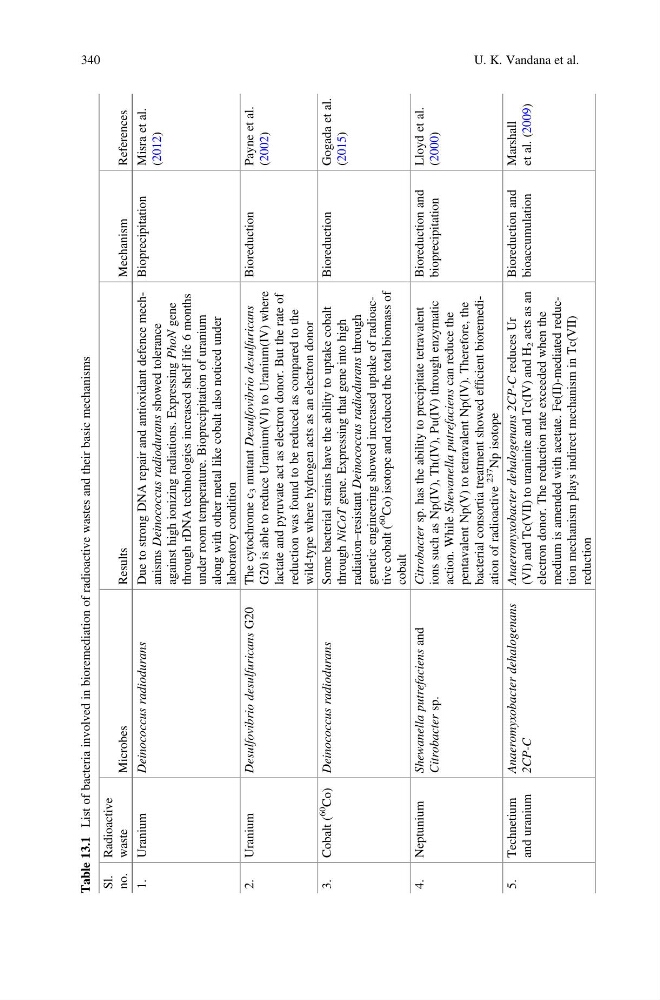
Table 13.1
List of bacteria involved in bioremediation of radioactive wastes and their basic mechanisms
Sl.
no.
Radioactive
waste
Microbes
Results
Mechanism
References
1.
Uranium
Deinococcus radiodurans
Due to strong DNA repair and antioxidant defence mechanisms Deinococcus radiodurans
showed tolerance
against high ionizing radiations. Expressing PhoN
gene
through rDNA technologies increased shelf life 6 months
under room temperature. Bioprecipitation of uranium
along with other metal like cobalt also noticed under
laboratory condition
Bioprecipitation
Misra et al.
(2012)
2.
Uranium
Desulfovibrio desulfuricans
G20
The cytochrome c
3 mutant Desulfovibrio desulfuricans
G20 is able to reduce Uranium(VI) to Uranium(IV) where
lactate and pyruvate act as electron donor. But the rate of
reduction was found to be reduced as compared to the
wild-type where hydrogen acts as an electron donor
Bioreduction
Payne et al.
(2002)
3.
Cobalt (
60
Co) Deinococcus radiodurans
Some bacterial strains have the ability to uptake cobalt
through NiCoT
gene. Expressing that gene into high
radiation–resistant Deinococcus radiodurans
through
genetic engineering showed increased uptake of radioactive cobalt (
60
Co) isotope and reduced the total biomass of
cobalt
Bioreduction
Gogada et al.
(2015)
4.
Neptunium
Shewanella putrefaciens
and
Citrobacter
sp.
Citrobacter
sp. has the ability to precipitate tetravalent
ions such as Np(IV), Th(IV), Pu(IV) through enzymatic
action. While Shewanella putrefaciens
can reduce the
pentavalent Np(V) to tetravalent Np(IV). Therefore, the
bacterial consortia treatment showed efficient bioremediation of radioactive
237
Np isotope
Bioreduction and
bioprecipitation
Lloyd et al.
(2000)
5.
Technetium
and uranium
Anaeromyxobacter dehalogenans
2CP-C
Anaeromyxobacter dehalogenans 2CP-C
reduces Ur
(VI) and Tc(VII) to uraninite and Tc(IV) and H
2 acts as an
electron donor. The reduction rate exceeded when the
medium is amended with acetate. Fe(II)-mediated reduction mechanism plays indirect mechanism in Tc(VII)
reduction
Bioreduction and
bioaccumulation
Marshall
et al. (2009)
340
U. K. Vandana et al.
List of bacteria involved in bioremediation of radioactive wastes and their basic mechanisms
Sl.
no.
Radioactive
waste
Microbes
Results
Mechanism
References
1.
Uranium
Deinococcus radiodurans
Due to strong DNA repair and antioxidant defence mechanisms Deinococcus radiodurans
showed tolerance
against high ionizing radiations. Expressing PhoN
gene
through rDNA technologies increased shelf life 6 months
under room temperature. Bioprecipitation of uranium
along with other metal like cobalt also noticed under
laboratory condition
Bioprecipitation
Misra et al.
(2012)
2.
Uranium
Desulfovibrio desulfuricans
G20
The cytochrome c
3 mutant Desulfovibrio desulfuricans
G20 is able to reduce Uranium(VI) to Uranium(IV) where
lactate and pyruvate act as electron donor. But the rate of
reduction was found to be reduced as compared to the
wild-type where hydrogen acts as an electron donor
Bioreduction
Payne et al.
(2002)
3.
Cobalt (
60
Co) Deinococcus radiodurans
Some bacterial strains have the ability to uptake cobalt
through NiCoT
gene. Expressing that gene into high
radiation–resistant Deinococcus radiodurans
through
genetic engineering showed increased uptake of radioactive cobalt (
60
Co) isotope and reduced the total biomass of
cobalt
Bioreduction
Gogada et al.
(2015)
4.
Neptunium
Shewanella putrefaciens
and
Citrobacter
sp.
Citrobacter
sp. has the ability to precipitate tetravalent
ions such as Np(IV), Th(IV), Pu(IV) through enzymatic
action. While Shewanella putrefaciens
can reduce the
pentavalent Np(V) to tetravalent Np(IV). Therefore, the
bacterial consortia treatment showed efficient bioremediation of radioactive
237
Np isotope
Bioreduction and
bioprecipitation
Lloyd et al.
(2000)
5.
Technetium
and uranium
Anaeromyxobacter dehalogenans
2CP-C
Anaeromyxobacter dehalogenans 2CP-C
reduces Ur
(VI) and Tc(VII) to uraninite and Tc(IV) and H
2 acts as an
electron donor. The reduction rate exceeded when the
medium is amended with acetate. Fe(II)-mediated reduction mechanism plays indirect mechanism in Tc(VII)
reduction
Bioreduction and
bioaccumulation
Marshall
et al. (2009)
340
U. K. Vandana et al.