

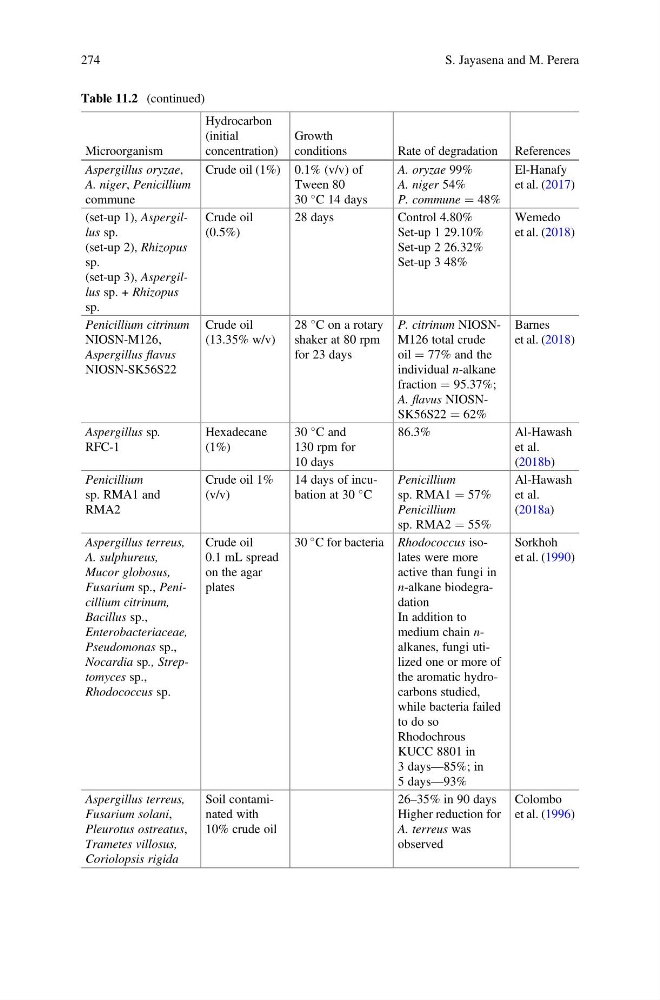
Table 11.2 (continued)
Microorganism
Hydrocarbon
(initial
concentration)
Growth
conditions
Rate of degradation References
Aspergillus oryzae,
A. niger, Penicillium
commune
Crude oil (1%) 0.1% (v/v) of
Tween 80
30
C 14 days
A. oryzae 99%
A. niger 54%
P. commune ¼ 48%
El-Hanafy
et al. (2017)
(set-up 1), Aspergillus sp.
(set-up 2), Rhizopus
sp.
(set-up 3), Aspergillus sp. + Rhizopus
sp.
Crude oil
(0.5%)
28 days
Control 4.80%
Set-up 1 29.10%
Set-up 2 26.32%
Set-up 3 48%
Wemedo
et al. (2018)
Penicillium citrinum
NIOSN-M126,
Aspergillus flavus
NIOSN-SK56S22
Crude oil
(13.35% w/v)
28
C on a rotary
shaker at 80 rpm
for 23 days
P. citrinum NIOSNM126 total crude
oil ¼ 77% and the
individual n-alkane
fraction ¼ 95.37%;
A. flavus NIOSNSK56S22 ¼ 62%
Barnes
et al. (2018)
Aspergillus sp.
RFC-1
Hexadecane
(1%)
30
C and
130 rpm for
10 days
86.3%
Al-Hawash
et al.
(2018b)
Penicillium
sp. RMA1 and
RMA2
Crude oil 1%
(v/v)
14 days of incubation at 30
C
Penicillium
sp. RMA1 ¼ 57%
Penicillium
sp. RMA2 ¼ 55%
Al-Hawash
et al.
(2018a)
Aspergillus terreus,
A. sulphureus,
Mucor globosus,
Fusarium sp., Penicillium citrinum,
Bacillus sp.,
Enterobacteriaceae,
Pseudomonas sp.,
Nocardia sp., Streptomyces sp.,
Rhodococcus sp.
Crude oil
0.1 mL spread
on the agar
plates
30
C for bacteria Rhodococcus isolates were more
active than fungi in
n-alkane biodegradation
In addition to
medium chain nalkanes, fungi utilized one or more of
the aromatic hydrocarbons studied,
while bacteria failed
to do so
Rhodochrous
KUCC 8801 in
3 days—85%; in
5 days—93%
Sorkhoh
et al. (1990)
Aspergillus terreus,
Fusarium solani,
Pleurotus ostreatus,
Trametes villosus,
Coriolopsis rigida
Soil contaminated with
10% crude oil
26–35% in 90 days
Higher reduction for
A. terreus was
observed
Colombo
et al. (1996)
274
S. Jayasena and M. Perera
Microorganism
Hydrocarbon
(initial
concentration)
Growth
conditions
Rate of degradation References
Aspergillus oryzae,
A. niger, Penicillium
commune
Crude oil (1%) 0.1% (v/v) of
Tween 80
30
C 14 days
A. oryzae 99%
A. niger 54%
P. commune ¼ 48%
El-Hanafy
et al. (2017)
(set-up 1), Aspergillus sp.
(set-up 2), Rhizopus
sp.
(set-up 3), Aspergillus sp. + Rhizopus
sp.
Crude oil
(0.5%)
28 days
Control 4.80%
Set-up 1 29.10%
Set-up 2 26.32%
Set-up 3 48%
Wemedo
et al. (2018)
Penicillium citrinum
NIOSN-M126,
Aspergillus flavus
NIOSN-SK56S22
Crude oil
(13.35% w/v)
28
C on a rotary
shaker at 80 rpm
for 23 days
P. citrinum NIOSNM126 total crude
oil ¼ 77% and the
individual n-alkane
fraction ¼ 95.37%;
A. flavus NIOSNSK56S22 ¼ 62%
Barnes
et al. (2018)
Aspergillus sp.
RFC-1
Hexadecane
(1%)
30
C and
130 rpm for
10 days
86.3%
Al-Hawash
et al.
(2018b)
Penicillium
sp. RMA1 and
RMA2
Crude oil 1%
(v/v)
14 days of incubation at 30
C
Penicillium
sp. RMA1 ¼ 57%
Penicillium
sp. RMA2 ¼ 55%
Al-Hawash
et al.
(2018a)
Aspergillus terreus,
A. sulphureus,
Mucor globosus,
Fusarium sp., Penicillium citrinum,
Bacillus sp.,
Enterobacteriaceae,
Pseudomonas sp.,
Nocardia sp., Streptomyces sp.,
Rhodococcus sp.
Crude oil
0.1 mL spread
on the agar
plates
30
C for bacteria Rhodococcus isolates were more
active than fungi in
n-alkane biodegradation
In addition to
medium chain nalkanes, fungi utilized one or more of
the aromatic hydrocarbons studied,
while bacteria failed
to do so
Rhodochrous
KUCC 8801 in
3 days—85%; in
5 days—93%
Sorkhoh
et al. (1990)
Aspergillus terreus,
Fusarium solani,
Pleurotus ostreatus,
Trametes villosus,
Coriolopsis rigida
Soil contaminated with
10% crude oil
26–35% in 90 days
Higher reduction for
A. terreus was
observed
Colombo
et al. (1996)
274
S. Jayasena and M. Perera