

wider debate about the limitations and possible improvements of currently employed
hydrocarbon bioremediation strategies.
Keywords Hydrocarbons · Degradation · Microorganisms
10.1 Introduction
At the present time, petroleum and its constituent hydrocarbons are widely used as
the main energy source in the industrial, transport, and domestic sectors (Varjani and
Upasani 2016; Arulazhagan et al. 2010). However, use of these hydrocarbons produces a number of harmful chemical substances that widely affect human beings and
the environment. The effectiveness of these substances depends upon the composition, concentration, and biological state of the affected organism at the time of
contamination and also on such environmental factors as temperature (Obire and
Ayanwu 2009).
In our environment, toxic components of hydrocarbons are released by transport,
vehicle factories, thermal plants, oil spills, pipelines, oil well leakages, diesel
stations, and contamination by vehicle garages (Costa et al. 2012). The petroleum
hydrocarbons are categorized into two broad divisions, aromatic and aliphatic
compounds. The simple aliphatic and aromatic compounds are degraded in the
environment, but because of their complex structure, the large aliphatic and aromatic
constituents of petroleum hydrocarbons are not degraded (Hasanuzzaman et al.
2007). Therefore, different strategies and approaches are used to degrade these
hydrocarbons, broadly categorized into three groups: physical, chemical, and thermal approaches (Adnan et al. 2018). All these methods are very costly, and the
chemicals required further greatly affect our environment. In the thermal process,
large amounts of heat are generated that affect both the flora and fauna of a specific
area (Ezeji et al. 2007).
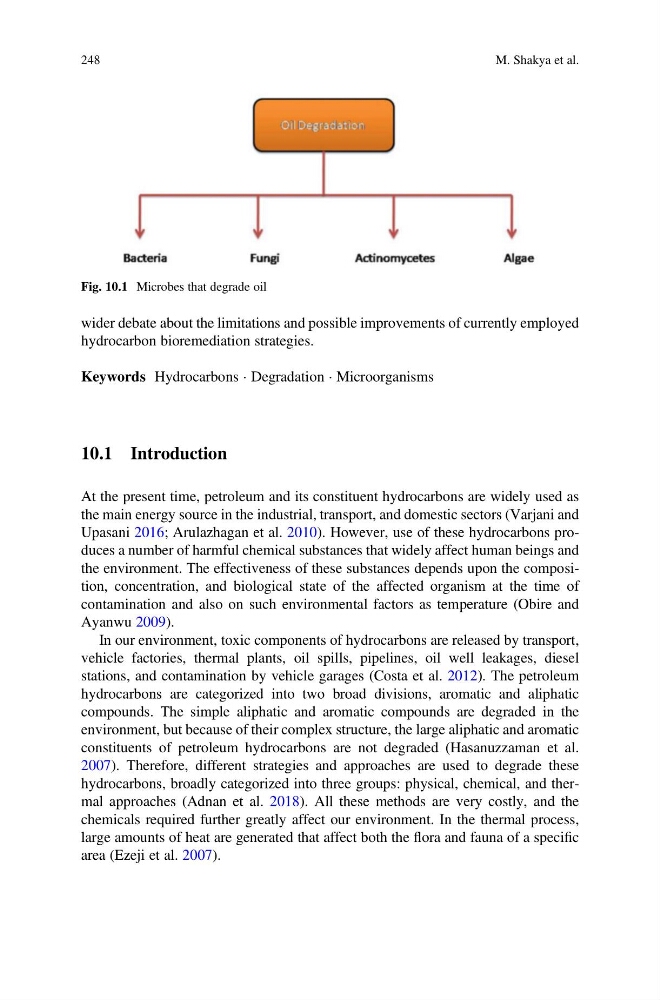
Fig. 10.1 Microbes that degrade oil
248
M. Shakya et al.
hydrocarbon bioremediation strategies.
Keywords Hydrocarbons · Degradation · Microorganisms
10.1 Introduction
At the present time, petroleum and its constituent hydrocarbons are widely used as
the main energy source in the industrial, transport, and domestic sectors (Varjani and
Upasani 2016; Arulazhagan et al. 2010). However, use of these hydrocarbons produces a number of harmful chemical substances that widely affect human beings and
the environment. The effectiveness of these substances depends upon the composition, concentration, and biological state of the affected organism at the time of
contamination and also on such environmental factors as temperature (Obire and
Ayanwu 2009).
In our environment, toxic components of hydrocarbons are released by transport,
vehicle factories, thermal plants, oil spills, pipelines, oil well leakages, diesel
stations, and contamination by vehicle garages (Costa et al. 2012). The petroleum
hydrocarbons are categorized into two broad divisions, aromatic and aliphatic
compounds. The simple aliphatic and aromatic compounds are degraded in the
environment, but because of their complex structure, the large aliphatic and aromatic
constituents of petroleum hydrocarbons are not degraded (Hasanuzzaman et al.
2007). Therefore, different strategies and approaches are used to degrade these
hydrocarbons, broadly categorized into three groups: physical, chemical, and thermal approaches (Adnan et al. 2018). All these methods are very costly, and the
chemicals required further greatly affect our environment. In the thermal process,
large amounts of heat are generated that affect both the flora and fauna of a specific
area (Ezeji et al. 2007).
Fig. 10.1 Microbes that degrade oil
248
M. Shakya et al.