

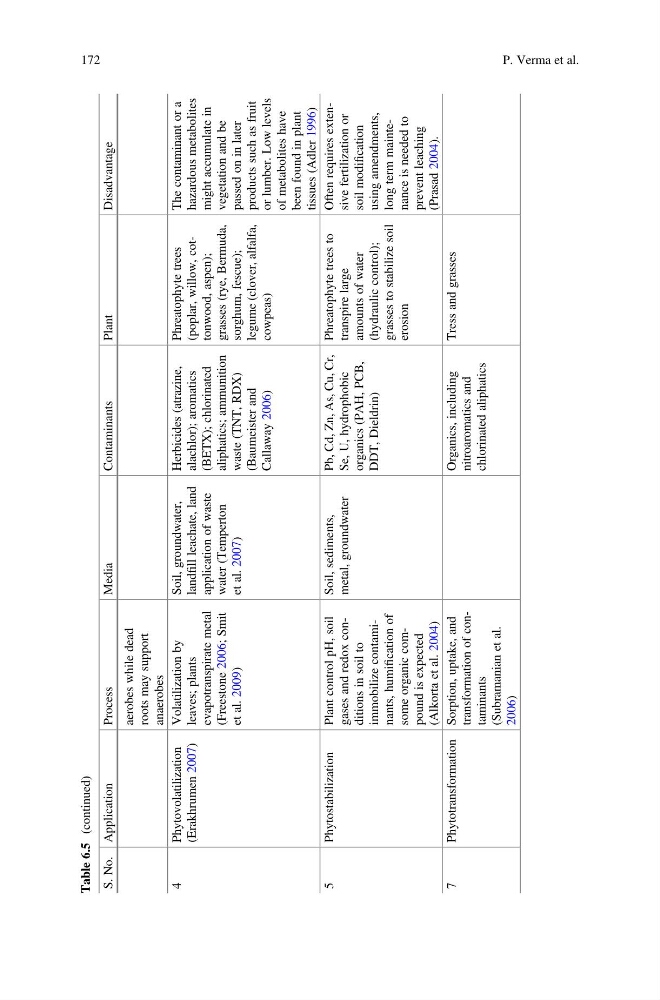
Table 6.5
(continued)
S. No. Application
Process
Media
Contaminants
Plant
Disadvantage
aerobes while dead
roots may support
anaerobes
4
Phytovolatilization
(Erakhrumen 2007)
Volatilization by
leaves; plants
evapotranspirate metal
(Freestone 2006; Smit
et al. 2009)
Soil, groundwater,
landfill leachate, land
application of waste
water (Temperton
et al. 2007)
Herbicides (atrazine,
alachlor); aromatics
(BETX); chlorinated
aliphatics; ammunition
waste (TNT, RDX)
(Baumeister and
Callaway 2006)
Phreatophyte trees
(poplar, willow, cottonwood, aspen);
grasses (rye, Bermuda,
sorghum, fescue);
legume (clover, alfalfa,
cowpeas)
The contaminant or a
hazardous metabolites
might accumulate in
vegetation and be
passed on in later
products such as fruit
or lumber. Low levels
of metabolites have
been found in plant
tissues (Adler 1996)
5
Phytostabilization
Plant control pH, soil
gases and redox conditions in soil to
immobilize contaminants, humification of
some organic compound is expected
(Alkorta et al. 2004)
Soil, sediments,
metal, groundwater
Pb, Cd, Zn, As, Cu, Cr,
Se, U, hydrophobic
organics (PAH, PCB,
DDT, Dieldrin)
Phreatophyte trees to
transpire large
amounts of water
(hydraulic control);
grasses to stabilize soil
erosion
Often requires extensive fertilization or
soil modification
using amendments,
long term maintenance is needed to
prevent leaching
(Prasad 2004).
7
Phytotransformation Sorption, uptake, and
transformation of contaminants
(Subramanian et al.
2006)
Organics, including
nitroaromatics and
chlorinated aliphatics
Tress and grasses
172
P. Verma et al.
(continued)
S. No. Application
Process
Media
Contaminants
Plant
Disadvantage
aerobes while dead
roots may support
anaerobes
4
Phytovolatilization
(Erakhrumen 2007)
Volatilization by
leaves; plants
evapotranspirate metal
(Freestone 2006; Smit
et al. 2009)
Soil, groundwater,
landfill leachate, land
application of waste
water (Temperton
et al. 2007)
Herbicides (atrazine,
alachlor); aromatics
(BETX); chlorinated
aliphatics; ammunition
waste (TNT, RDX)
(Baumeister and
Callaway 2006)
Phreatophyte trees
(poplar, willow, cottonwood, aspen);
grasses (rye, Bermuda,
sorghum, fescue);
legume (clover, alfalfa,
cowpeas)
The contaminant or a
hazardous metabolites
might accumulate in
vegetation and be
passed on in later
products such as fruit
or lumber. Low levels
of metabolites have
been found in plant
tissues (Adler 1996)
5
Phytostabilization
Plant control pH, soil
gases and redox conditions in soil to
immobilize contaminants, humification of
some organic compound is expected
(Alkorta et al. 2004)
Soil, sediments,
metal, groundwater
Pb, Cd, Zn, As, Cu, Cr,
Se, U, hydrophobic
organics (PAH, PCB,
DDT, Dieldrin)
Phreatophyte trees to
transpire large
amounts of water
(hydraulic control);
grasses to stabilize soil
erosion
Often requires extensive fertilization or
soil modification
using amendments,
long term maintenance is needed to
prevent leaching
(Prasad 2004).
7
Phytotransformation Sorption, uptake, and
transformation of contaminants
(Subramanian et al.
2006)
Organics, including
nitroaromatics and
chlorinated aliphatics
Tress and grasses
172
P. Verma et al.