

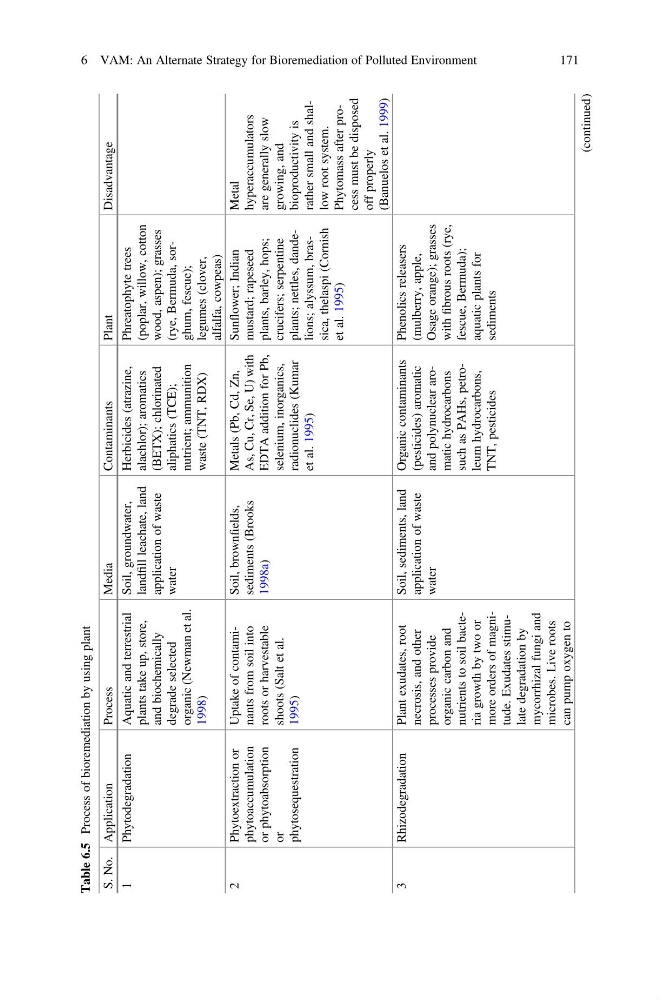
Table 6.5
Process of bioremediation by using plant
S. No. Application
Process
Media
Contaminants
Plant
Disadvantage
1
Phytodegradation
Aquatic and terrestrial
plants take up, store,
and biochemically
degrade selected
organic (Newman et al.
1998)
Soil, groundwater,
landfill leachate, land
application of waste
water
Herbicides (atrazine,
alachlor); aromatics
(BETX); chlorinated
aliphatics (TCE);
nutrient; ammunition
waste (TNT, RDX)
Phreatophyte trees
(poplar, willow, cotton
wood, aspen); grasses
(rye, Bermuda, sorghum, fescue);
legumes (clover,
alfalfa, cowpeas)
2
Phytoextraction or
phytoaccumulation
or phytoabsorption
or
phytosequestration
Uptake of contaminants from soil into
roots or harvestable
shoots (Salt et al.
1995)
Soil, brownfields,
sediments (Brooks
1998a)
Metals (Pb, Cd, Zn,
As, Cu, Cr, Se, U) with
EDTA addition for Pb,
selenium, inorganics,
radionuclides (Kumar
et al. 1995)
Sunflower; Indian
mustard; rapeseed
plants, barley, hops;
crucifers; serpentine
plants; nettles, dandelions; alyssum, brassica, thelaspi (Cornish
et al. 1995)
Metal
hyperaccumulators
are generally slow
growing, and
bioproductivity is
rather small and shallow root system.
Phytomass after process must be disposed
off properly
(Banuelos et al. 1999)
3
Rhizodegradation
Plant exudates, root
necrosis, and other
processes provide
organic carbon and
nutrients to soil bacteria growth by two or
more orders of magnitude. Exudates stimulate degradation by
mycorrhizal fungi and
microbes. Live roots
can pump oxygen to
Soil, sediments, land
application of waste
water
Organic contaminants
(pesticides) aromatic
and polynuclear aromatic hydrocarbons
such as PAHs, petroleum hydrocarbons,
TNT, pesticides
Phenolics releasers
(mulberry, apple,
Osage orange); grasses
with
fibrous roots (rye,
fescue, Bermuda);
aquatic plants for
sediments
(continued)
6 VAM: An Alternate Strategy for Bioremediation of Polluted Environment
171
Process of bioremediation by using plant
S. No. Application
Process
Media
Contaminants
Plant
Disadvantage
1
Phytodegradation
Aquatic and terrestrial
plants take up, store,
and biochemically
degrade selected
organic (Newman et al.
1998)
Soil, groundwater,
landfill leachate, land
application of waste
water
Herbicides (atrazine,
alachlor); aromatics
(BETX); chlorinated
aliphatics (TCE);
nutrient; ammunition
waste (TNT, RDX)
Phreatophyte trees
(poplar, willow, cotton
wood, aspen); grasses
(rye, Bermuda, sorghum, fescue);
legumes (clover,
alfalfa, cowpeas)
2
Phytoextraction or
phytoaccumulation
or phytoabsorption
or
phytosequestration
Uptake of contaminants from soil into
roots or harvestable
shoots (Salt et al.
1995)
Soil, brownfields,
sediments (Brooks
1998a)
Metals (Pb, Cd, Zn,
As, Cu, Cr, Se, U) with
EDTA addition for Pb,
selenium, inorganics,
radionuclides (Kumar
et al. 1995)
Sunflower; Indian
mustard; rapeseed
plants, barley, hops;
crucifers; serpentine
plants; nettles, dandelions; alyssum, brassica, thelaspi (Cornish
et al. 1995)
Metal
hyperaccumulators
are generally slow
growing, and
bioproductivity is
rather small and shallow root system.
Phytomass after process must be disposed
off properly
(Banuelos et al. 1999)
3
Rhizodegradation
Plant exudates, root
necrosis, and other
processes provide
organic carbon and
nutrients to soil bacteria growth by two or
more orders of magnitude. Exudates stimulate degradation by
mycorrhizal fungi and
microbes. Live roots
can pump oxygen to
Soil, sediments, land
application of waste
water
Organic contaminants
(pesticides) aromatic
and polynuclear aromatic hydrocarbons
such as PAHs, petroleum hydrocarbons,
TNT, pesticides
Phenolics releasers
(mulberry, apple,
Osage orange); grasses
with
fibrous roots (rye,
fescue, Bermuda);
aquatic plants for
sediments
(continued)
6 VAM: An Alternate Strategy for Bioremediation of Polluted Environment
171