

Finally, the tertiary treatment process eliminates potentially pathogenic bacteria
and/or viruses that are not removed with the previous treatment steps (Viancelli et al.
2013). These pathogens are structurally very different from one another (CerveroAragó et al. 2015). The most used methods include chlorination, UV irradiation
(De Sousa et al. 2013), or electrochemical (Ghernaout and Ghernaout 2010; Simas
et al. 2019). However, these processes are costly (Jin et al. 2014; Sun et al. 2016). A
promising biological treatment process is the phycoremediation, since
phycoremediation provides significant benefits such as (a) removal of nutrients,
even those in low concentration; (b) microalgae could be transformed into biofuel,
fertilizer, animal feed, among others (Whitton et al. 2015; Raheem et al. 2015)—
(Fig. 4.2).
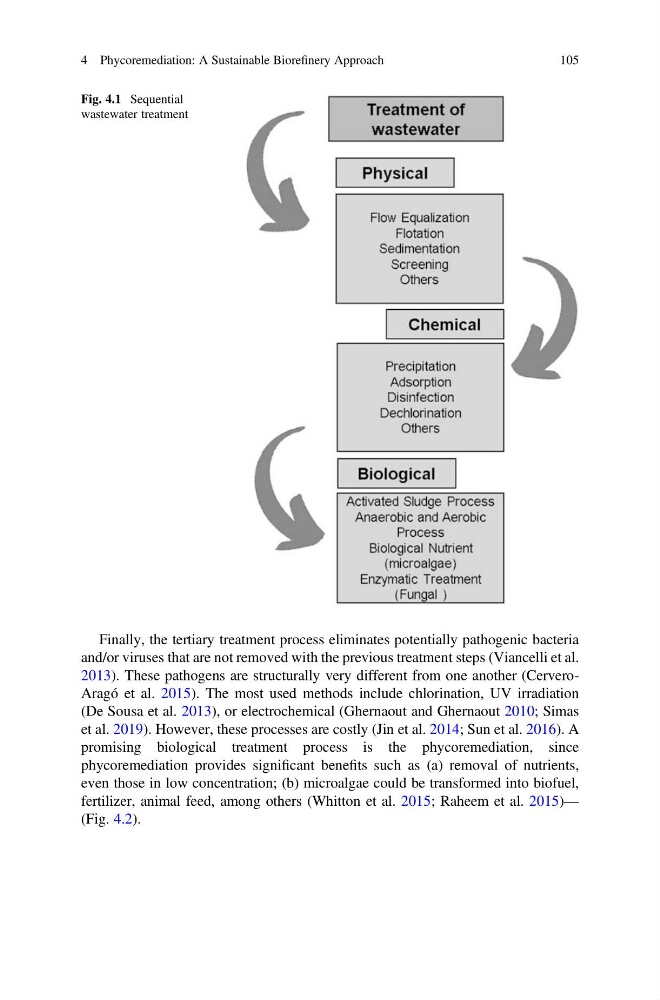
Fig. 4.1 Sequential
wastewater treatment
4 Phycoremediation: A Sustainable Biorefinery Approach
105
and/or viruses that are not removed with the previous treatment steps (Viancelli et al.
2013). These pathogens are structurally very different from one another (CerveroAragó et al. 2015). The most used methods include chlorination, UV irradiation
(De Sousa et al. 2013), or electrochemical (Ghernaout and Ghernaout 2010; Simas
et al. 2019). However, these processes are costly (Jin et al. 2014; Sun et al. 2016). A
promising biological treatment process is the phycoremediation, since
phycoremediation provides significant benefits such as (a) removal of nutrients,
even those in low concentration; (b) microalgae could be transformed into biofuel,
fertilizer, animal feed, among others (Whitton et al. 2015; Raheem et al. 2015)—
(Fig. 4.2).
Fig. 4.1 Sequential
wastewater treatment
4 Phycoremediation: A Sustainable Biorefinery Approach
105