

62
P. Sjödin et al.
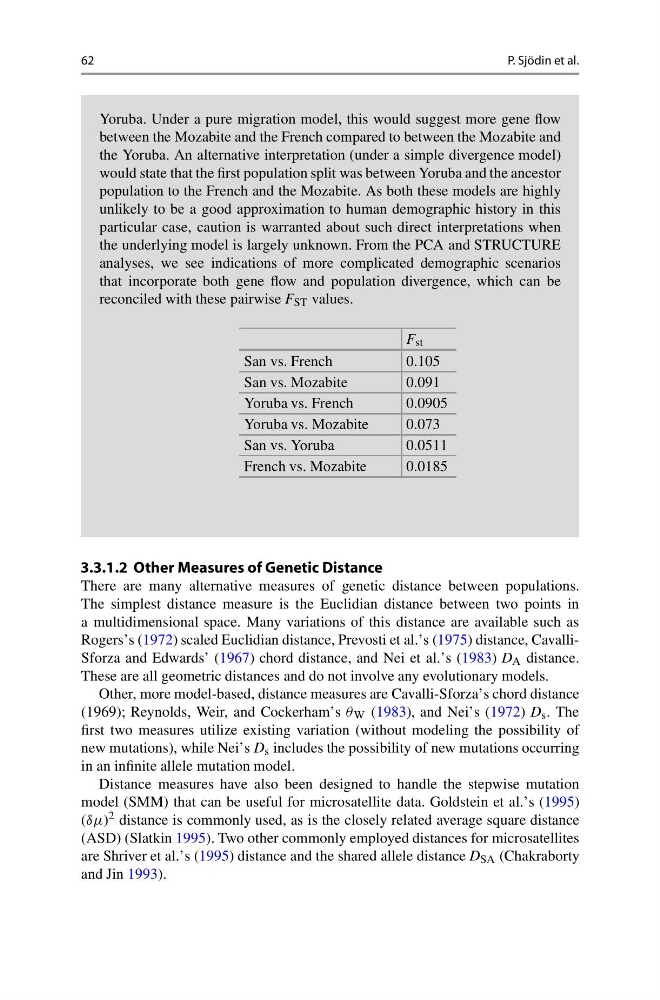
Yoruba. Under a pure migration model, this would suggest more gene flow
between the Mozabite and the French compared to between the Mozabite and
the Yoruba. An alternative interpretation (under a simple divergence model)
would state that the first population split was between Yoruba and the ancestor
population to the French and the Mozabite. As both these models are highly
unlikely to be a good approximation to human demographic history in this
particular case, caution is warranted about such direct interpretations when
the underlying model is largely unknown. From the PCA and STRUCTURE
analyses, we see indications of more complicated demographic scenarios
that incorporate both gene flow and population divergence, which can be
reconciled with these pairwise F ST values.
F st
San vs. French
0.105
San vs. Mozabite
0.091
Yoruba vs. French
0.0905
Yoruba vs. Mozabite
0.073
San vs. Yoruba
0.0511
French vs. Mozabite
0.0185
3.3.1.2 Other Measures of Genetic Distance
There are many alternative measures of genetic distance between populations.
The simplest distance measure is the Euclidian distance between two points in
a multidimensional space. Many variations of this distance are available such as
Rogers’s (1972) scaled Euclidian distance, Prevosti et al.’s (1975) distance, CavalliSforza and Edwards’ (1967) chord distance, and Nei et al.’s (1983) D A distance.
These are all geometric distances and do not involve any evolutionary models.
Other, more model-based, distance measures are Cavalli-Sforza’s chord distance
(1969); Reynolds, Weir, and Cockerham’s θ W (1983), and Nei’s (1972) D s . The
first two measures utilize existing variation (without modeling the possibility of
new mutations), while Nei’s D s includes the possibility of new mutations occurring
in an infinite allele mutation model.
Distance measures have also been designed to handle the stepwise mutation
model (SMM) that can be useful for microsatellite data. Goldstein et al.’s (1995)
(δμ) 2 distance is commonly used, as is the closely related average square distance
(ASD) (Slatkin 1995). Two other commonly employed distances for microsatellites
are Shriver et al.’s (1995) distance and the shared allele distance D SA (Chakraborty
and Jin 1993).
P. Sjödin et al.
Yoruba. Under a pure migration model, this would suggest more gene flow
between the Mozabite and the French compared to between the Mozabite and
the Yoruba. An alternative interpretation (under a simple divergence model)
would state that the first population split was between Yoruba and the ancestor
population to the French and the Mozabite. As both these models are highly
unlikely to be a good approximation to human demographic history in this
particular case, caution is warranted about such direct interpretations when
the underlying model is largely unknown. From the PCA and STRUCTURE
analyses, we see indications of more complicated demographic scenarios
that incorporate both gene flow and population divergence, which can be
reconciled with these pairwise F ST values.
F st
San vs. French
0.105
San vs. Mozabite
0.091
Yoruba vs. French
0.0905
Yoruba vs. Mozabite
0.073
San vs. Yoruba
0.0511
French vs. Mozabite
0.0185
3.3.1.2 Other Measures of Genetic Distance
There are many alternative measures of genetic distance between populations.
The simplest distance measure is the Euclidian distance between two points in
a multidimensional space. Many variations of this distance are available such as
Rogers’s (1972) scaled Euclidian distance, Prevosti et al.’s (1975) distance, CavalliSforza and Edwards’ (1967) chord distance, and Nei et al.’s (1983) D A distance.
These are all geometric distances and do not involve any evolutionary models.
Other, more model-based, distance measures are Cavalli-Sforza’s chord distance
(1969); Reynolds, Weir, and Cockerham’s θ W (1983), and Nei’s (1972) D s . The
first two measures utilize existing variation (without modeling the possibility of
new mutations), while Nei’s D s includes the possibility of new mutations occurring
in an infinite allele mutation model.
Distance measures have also been designed to handle the stepwise mutation
model (SMM) that can be useful for microsatellite data. Goldstein et al.’s (1995)
(δμ) 2 distance is commonly used, as is the closely related average square distance
(ASD) (Slatkin 1995). Two other commonly employed distances for microsatellites
are Shriver et al.’s (1995) distance and the shared allele distance D SA (Chakraborty
and Jin 1993).