

40
M. Slatkin
frequencies change from generation to generation because of genetic drift (Wright
1931). Genetic drift also affects the extent of LD. The mathematical theory that
predicts the effect of drift on D is too complicated to be presented here, but
the main conclusions from the theory are relatively simple (Hill and Robertson
1968; Ohta and Kimura 1969). At an equilibrium under drift, random mating,
and recombination, genetic drift will maintain some LD between closely linked
sites. Although the expected value of D is 0, the expectation of D 2 is nonzero and
decreases roughly with 1/c as c increases.
2.7
Genealogical Interpretation of LD
There is a close relationship between the gene genealogies of two loci and the extent
of LD between them. Refer to Chap. 1 for a discussion of gene genealogies for a
single locus. First, consider the case in which there is no recombination between the
A and B loci. Because there is no recombination, the gene genealogies of the two loci
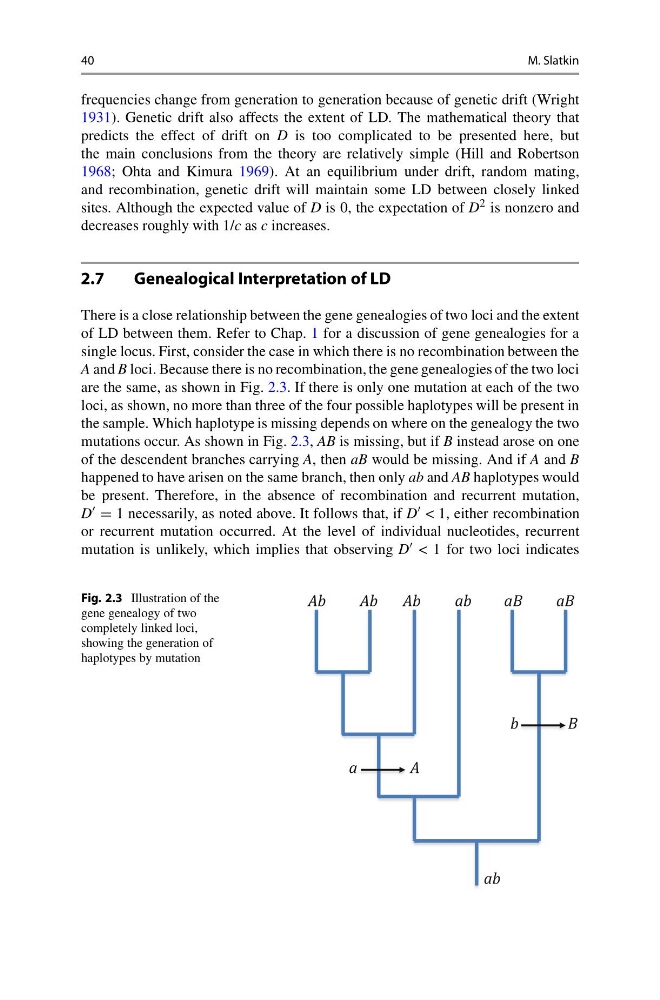
are the same, as shown in Fig. 2.3. If there is only one mutation at each of the two
loci, as shown, no more than three of the four possible haplotypes will be present in
the sample. Which haplotype is missing depends on where on the genealogy the two
mutations occur. As shown in Fig. 2.3, AB is missing, but if B instead arose on one
of the descendent branches carrying A, then aB would be missing. And if A and B
happened to have arisen on the same branch, then only ab and AB haplotypes would
be present. Therefore, in the absence of recombination and recurrent mutation,
D = 1 necessarily, as noted above. It follows that, if D < 1, either recombination
or recurrent mutation occurred. At the level of individual nucleotides, recurrent
mutation is unlikely, which implies that observing D < 1 for two loci indicates
Fig. 2.3 Illustration of the
gene genealogy of two
completely linked loci,
showing the generation of
haplotypes by mutation
Ab
Ab
Ab
ab
aB
b
a
A
ab
B
aB
M. Slatkin
frequencies change from generation to generation because of genetic drift (Wright
1931). Genetic drift also affects the extent of LD. The mathematical theory that
predicts the effect of drift on D is too complicated to be presented here, but
the main conclusions from the theory are relatively simple (Hill and Robertson
1968; Ohta and Kimura 1969). At an equilibrium under drift, random mating,
and recombination, genetic drift will maintain some LD between closely linked
sites. Although the expected value of D is 0, the expectation of D 2 is nonzero and
decreases roughly with 1/c as c increases.
2.7
Genealogical Interpretation of LD
There is a close relationship between the gene genealogies of two loci and the extent
of LD between them. Refer to Chap. 1 for a discussion of gene genealogies for a
single locus. First, consider the case in which there is no recombination between the
A and B loci. Because there is no recombination, the gene genealogies of the two loci
are the same, as shown in Fig. 2.3. If there is only one mutation at each of the two
loci, as shown, no more than three of the four possible haplotypes will be present in
the sample. Which haplotype is missing depends on where on the genealogy the two
mutations occur. As shown in Fig. 2.3, AB is missing, but if B instead arose on one
of the descendent branches carrying A, then aB would be missing. And if A and B
happened to have arisen on the same branch, then only ab and AB haplotypes would
be present. Therefore, in the absence of recombination and recurrent mutation,
D = 1 necessarily, as noted above. It follows that, if D < 1, either recombination
or recurrent mutation occurred. At the level of individual nucleotides, recurrent
mutation is unlikely, which implies that observing D < 1 for two loci indicates
Fig. 2.3 Illustration of the
gene genealogy of two
completely linked loci,
showing the generation of
haplotypes by mutation
Ab
Ab
Ab
ab
aB
b
a
A
ab
B
aB