

2 Linkage Disequilibrium
39
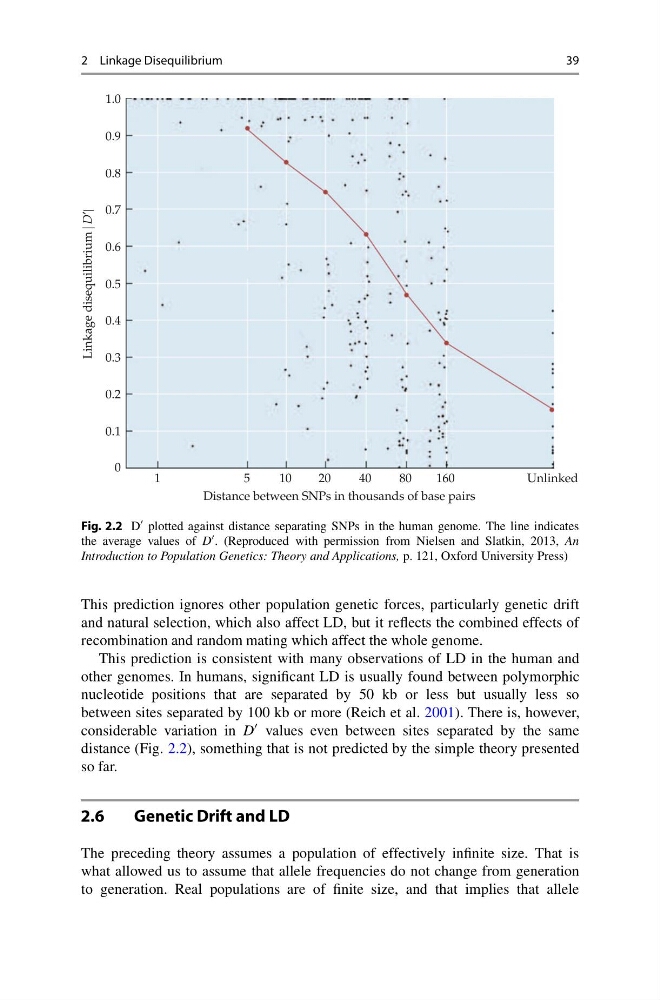
Fig. 2.2 D plotted against distance separating SNPs in the human genome. The line indicates
the average values of D . (Reproduced with permission from Nielsen and Slatkin, 2013, An
Introduction to Population Genetics: Theory and Applications, p. 121, Oxford University Press)
This prediction ignores other population genetic forces, particularly genetic drift
and natural selection, which also affect LD, but it reflects the combined effects of
recombination and random mating which affect the whole genome.
This prediction is consistent with many observations of LD in the human and
other genomes. In humans, significant LD is usually found between polymorphic
nucleotide positions that are separated by 50 kb or less but usually less so
between sites separated by 100 kb or more (Reich et al. 2001). There is, however,
considerable variation in D values even between sites separated by the same
distance (Fig. 2.2), something that is not predicted by the simple theory presented
so far.
2.6
Genetic Drift and LD
The preceding theory assumes a population of effectively infinite size. That is
what allowed us to assume that allele frequencies do not change from generation
to generation. Real populations are of finite size, and that implies that allele
39
Fig. 2.2 D plotted against distance separating SNPs in the human genome. The line indicates
the average values of D . (Reproduced with permission from Nielsen and Slatkin, 2013, An
Introduction to Population Genetics: Theory and Applications, p. 121, Oxford University Press)
This prediction ignores other population genetic forces, particularly genetic drift
and natural selection, which also affect LD, but it reflects the combined effects of
recombination and random mating which affect the whole genome.
This prediction is consistent with many observations of LD in the human and
other genomes. In humans, significant LD is usually found between polymorphic
nucleotide positions that are separated by 50 kb or less but usually less so
between sites separated by 100 kb or more (Reich et al. 2001). There is, however,
considerable variation in D values even between sites separated by the same
distance (Fig. 2.2), something that is not predicted by the simple theory presented
so far.
2.6
Genetic Drift and LD
The preceding theory assumes a population of effectively infinite size. That is
what allowed us to assume that allele frequencies do not change from generation
to generation. Real populations are of finite size, and that implies that allele