

152
E. A. Thompson
Table 6.7 Comparison of
the power of IBD-based and
association tests
Selection
# cases=
power
power
association
# controls
assoc.
IBD
vs. IBD
0.0005
500
0.87
0.57
assoc.
0.001
500
0.65
0.53
Not-Sig
0.002
1000
0.53
0.87
IBD
0.005
3000
0.47
0.90
IBD
In this case there is rarely a detectable association between any causal variant and
any of the 100 common marker SNPs.
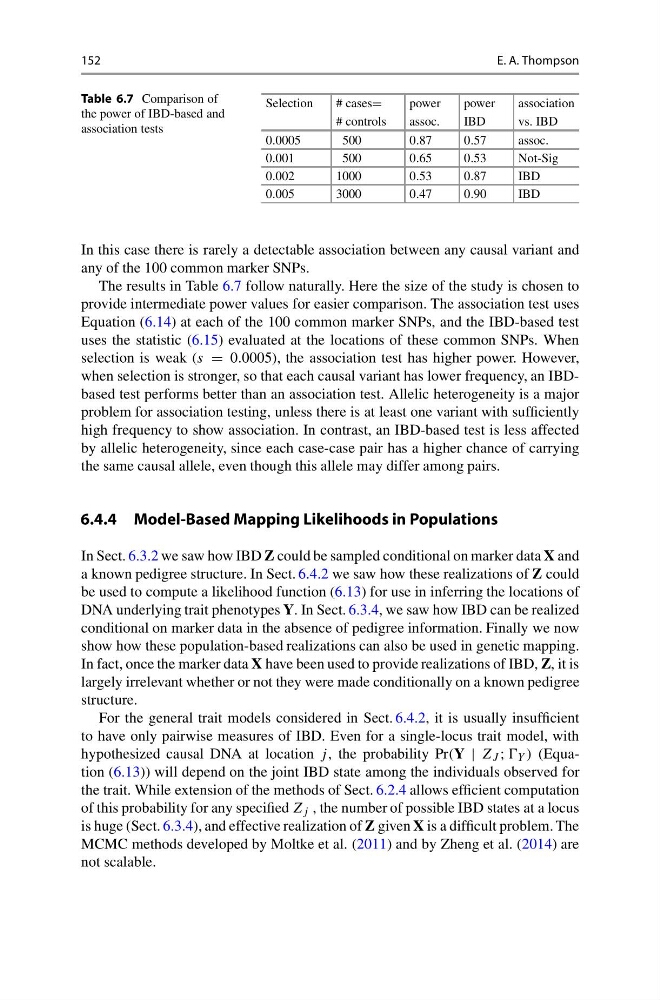
The results in Table 6.7 follow naturally. Here the size of the study is chosen to
provide intermediate power values for easier comparison. The association test uses
Equation (6.14) at each of the 100 common marker SNPs, and the IBD-based test
uses the statistic (6.15) evaluated at the locations of these common SNPs. When
selection is weak (s = 0.0005), the association test has higher power. However,
when selection is stronger, so that each causal variant has lower frequency, an IBDbased test performs better than an association test. Allelic heterogeneity is a major
problem for association testing, unless there is at least one variant with sufficiently
high frequency to show association. In contrast, an IBD-based test is less affected
by allelic heterogeneity, since each case-case pair has a higher chance of carrying
the same causal allele, even though this allele may differ among pairs.
6.4.4 Model-Based Mapping Likelihoods in Populations
In Sect. 6.3.2 we saw how IBD Z could be sampled conditional on marker data X and
a known pedigree structure. In Sect. 6.4.2 we saw how these realizations of Z could
be used to compute a likelihood function (6.13) for use in inferring the locations of
DNA underlying trait phenotypes Y. In Sect. 6.3.4, we saw how IBD can be realized
conditional on marker data in the absence of pedigree information. Finally we now
show how these population-based realizations can also be used in genetic mapping.
In fact, once the marker data X have been used to provide realizations of IBD, Z, it is
largely irrelevant whether or not they were made conditionally on a known pedigree
structure.
For the general trait models considered in Sect. 6.4.2, it is usually insufficient
to have only pairwise measures of IBD. Even for a single-locus trait model, with
hypothesized causal DNA at location j , the probability Pr(Y | Z J ; Y ) (Equation (6.13)) will depend on the joint IBD state among the individuals observed for
the trait. While extension of the methods of Sect. 6.2.4 allows efficient computation
of this probability for any specified Z j , the number of possible IBD states at a locus
is huge (Sect. 6.3.4), and effective realization of Z given X is a difficult problem. The
MCMC methods developed by Moltke et al. (2011) and by Zheng et al. (2014) are
not scalable.
E. A. Thompson
Table 6.7 Comparison of
the power of IBD-based and
association tests
Selection
# cases=
power
power
association
# controls
assoc.
IBD
vs. IBD
0.0005
500
0.87
0.57
assoc.
0.001
500
0.65
0.53
Not-Sig
0.002
1000
0.53
0.87
IBD
0.005
3000
0.47
0.90
IBD
In this case there is rarely a detectable association between any causal variant and
any of the 100 common marker SNPs.
The results in Table 6.7 follow naturally. Here the size of the study is chosen to
provide intermediate power values for easier comparison. The association test uses
Equation (6.14) at each of the 100 common marker SNPs, and the IBD-based test
uses the statistic (6.15) evaluated at the locations of these common SNPs. When
selection is weak (s = 0.0005), the association test has higher power. However,
when selection is stronger, so that each causal variant has lower frequency, an IBDbased test performs better than an association test. Allelic heterogeneity is a major
problem for association testing, unless there is at least one variant with sufficiently
high frequency to show association. In contrast, an IBD-based test is less affected
by allelic heterogeneity, since each case-case pair has a higher chance of carrying
the same causal allele, even though this allele may differ among pairs.
6.4.4 Model-Based Mapping Likelihoods in Populations
In Sect. 6.3.2 we saw how IBD Z could be sampled conditional on marker data X and
a known pedigree structure. In Sect. 6.4.2 we saw how these realizations of Z could
be used to compute a likelihood function (6.13) for use in inferring the locations of
DNA underlying trait phenotypes Y. In Sect. 6.3.4, we saw how IBD can be realized
conditional on marker data in the absence of pedigree information. Finally we now
show how these population-based realizations can also be used in genetic mapping.
In fact, once the marker data X have been used to provide realizations of IBD, Z, it is
largely irrelevant whether or not they were made conditionally on a known pedigree
structure.
For the general trait models considered in Sect. 6.4.2, it is usually insufficient
to have only pairwise measures of IBD. Even for a single-locus trait model, with
hypothesized causal DNA at location j , the probability Pr(Y | Z J ; Y ) (Equation (6.13)) will depend on the joint IBD state among the individuals observed for
the trait. While extension of the methods of Sect. 6.2.4 allows efficient computation
of this probability for any specified Z j , the number of possible IBD states at a locus
is huge (Sect. 6.3.4), and effective realization of Z given X is a difficult problem. The
MCMC methods developed by Moltke et al. (2011) and by Zheng et al. (2014) are
not scalable.