

6 Identity by Descent in the Mapping of Genetic Traits
147
approach to mapping QTL by considering the (negative) correlation between the
squared difference in trait values in sibs and the marker-based IBD probability.
More generally, the variance component approaches to QTL mapping in the SOLAR
software (Almasy and Blangero, 1998; Blangero et al., 2000) use pairwise locationspecific IBD probabilities computed conditionally on the pedigree structure and on
observed marker data to model covariances among relatives and map QTL.
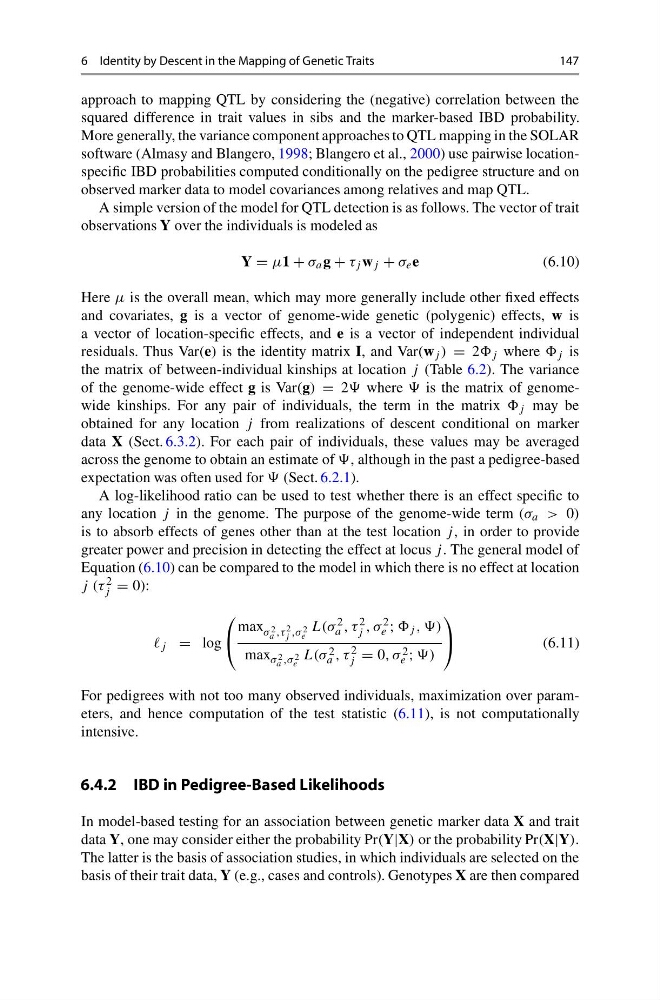
A simple version of the model for QTL detection is as follows. The vector of trait
observations Y over the individuals is modeled as
Y = μ1 + σ a g + τ j w j + σ e e
(6.10)
Here μ is the overall mean, which may more generally include other fixed effects
and covariates, g is a vector of genome-wide genetic (polygenic) effects, w is
a vector of location-specific effects, and e is a vector of independent individual
residuals. Thus Var(e) is the identity matrix I, and Var(w j ) = 2 j where j is
the matrix of between-individual kinships at location j (Table 6.2). The variance
of the genome-wide effect g is Var(g) = 2 where is the matrix of genomewide kinships. For any pair of individuals, the term in the matrix j may be
obtained for any location j from realizations of descent conditional on marker
data X (Sect. 6.3.2). For each pair of individuals, these values may be averaged
across the genome to obtain an estimate of , although in the past a pedigree-based
expectation was often used for (Sect. 6.2.1).
A log-likelihood ratio can be used to test whether there is an effect specific to
any location j in the genome. The purpose of the genome-wide term (σ a > 0)
is to absorb effects of genes other than at the test location j , in order to provide
greater power and precision in detecting the effect at locus j . The general model of
Equation (6.10) can be compared to the model in which there is no effect at location
j (τ 2
j = 0):
j = log
⎛
⎝
max σ 2
a ,τ 2
j ,σ 2
e
L(σ 2
a , τ 2
j , σ 2
e ; j , ,)
max σ 2
a ,σ 2
e
L(σ 2
a , τ 2
j = 0, σ 2
e ;
⎞
⎠
(6.11)
For pedigrees with not too many observed individuals, maximization over parameters, and hence computation of the test statistic (6.11), is not computationally
intensive.
6.4.2 IBD in Pedigree-Based Likelihoods
In model-based testing for an association between genetic marker data X and trait
data Y, one may consider either the probability Pr(Y|X) or the probability Pr(X|Y).
The latter is the basis of association studies, in which individuals are selected on the
basis of their trait data, Y (e.g., cases and controls). Genotypes X are then compared
147
approach to mapping QTL by considering the (negative) correlation between the
squared difference in trait values in sibs and the marker-based IBD probability.
More generally, the variance component approaches to QTL mapping in the SOLAR
software (Almasy and Blangero, 1998; Blangero et al., 2000) use pairwise locationspecific IBD probabilities computed conditionally on the pedigree structure and on
observed marker data to model covariances among relatives and map QTL.
A simple version of the model for QTL detection is as follows. The vector of trait
observations Y over the individuals is modeled as
Y = μ1 + σ a g + τ j w j + σ e e
(6.10)
Here μ is the overall mean, which may more generally include other fixed effects
and covariates, g is a vector of genome-wide genetic (polygenic) effects, w is
a vector of location-specific effects, and e is a vector of independent individual
residuals. Thus Var(e) is the identity matrix I, and Var(w j ) = 2 j where j is
the matrix of between-individual kinships at location j (Table 6.2). The variance
of the genome-wide effect g is Var(g) = 2 where is the matrix of genomewide kinships. For any pair of individuals, the term in the matrix j may be
obtained for any location j from realizations of descent conditional on marker
data X (Sect. 6.3.2). For each pair of individuals, these values may be averaged
across the genome to obtain an estimate of , although in the past a pedigree-based
expectation was often used for (Sect. 6.2.1).
A log-likelihood ratio can be used to test whether there is an effect specific to
any location j in the genome. The purpose of the genome-wide term (σ a > 0)
is to absorb effects of genes other than at the test location j , in order to provide
greater power and precision in detecting the effect at locus j . The general model of
Equation (6.10) can be compared to the model in which there is no effect at location
j (τ 2
j = 0):
j = log
⎛
⎝
max σ 2
a ,τ 2
j ,σ 2
e
L(σ 2
a , τ 2
j , σ 2
e ; j , ,)
max σ 2
a ,σ 2
e
L(σ 2
a , τ 2
j = 0, σ 2
e ;
⎞
⎠
(6.11)
For pedigrees with not too many observed individuals, maximization over parameters, and hence computation of the test statistic (6.11), is not computationally
intensive.
6.4.2 IBD in Pedigree-Based Likelihoods
In model-based testing for an association between genetic marker data X and trait
data Y, one may consider either the probability Pr(Y|X) or the probability Pr(X|Y).
The latter is the basis of association studies, in which individuals are selected on the
basis of their trait data, Y (e.g., cases and controls). Genotypes X are then compared