

142
E. A. Thompson
where L is the total number of loci genotyped. A more general form is
A ik =
L
j =1
w j
(x ij − 2q j )(x kj − 2q j )
2q j (1 − q j )
(6.9)
With w j = 1/L we obtain the previous estimator, while
w j = p j (1 − p j )/
L
l=1 p l (1 − p l ) provides a form that is more robust to small
allele frequencies; see, for example, VanRaden (2008).
One major deficiency of estimators where the weights depend only on allele
frequencies is that they do not account for allelic associations among loci (LD). One
form of weighting to accommodate LD was developed by Speed et al. (2012), while
S. Sverdlov developed an alternative approach that is used in Wang et al. (2017).
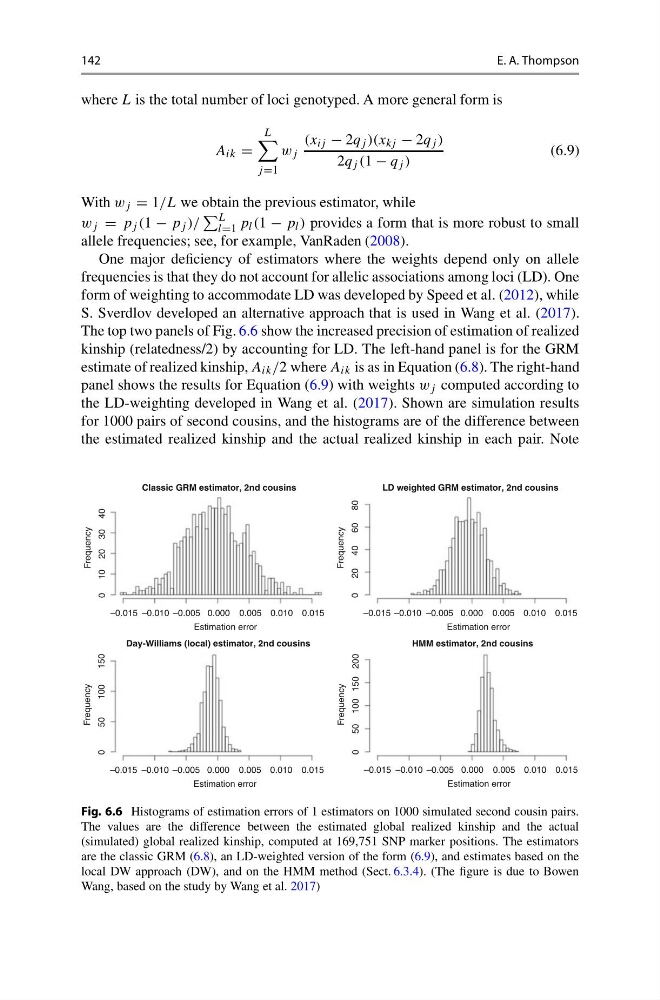
The top two panels of Fig. 6.6 show the increased precision of estimation of realized
kinship (relatedness/2) by accounting for LD. The left-hand panel is for the GRM
estimate of realized kinship, A ik /2 where A ik is as in Equation (6.8). The right-hand
panel shows the results for Equation (6.9) with weights w j computed according to
the LD-weighting developed in Wang et al. (2017). Shown are simulation results
for 1000 pairs of second cousins, and the histograms are of the difference between
the estimated realized kinship and the actual realized kinship in each pair. Note
–0.015
0
10 20 30
Frequency
40
–0.010
Classic GRM estimator, 2nd cousins
–0.005
Estimation error
0.000 0.005 0.010 0.015
–0.015
0
50
100
Frequency
150
–0.010 –0.005
Estimation error
0.000 0.005 0.010 0.015
–0.015
0
50 100
Frequency
150 200
–0.010 –0.005
Estimation error
0.000 0.005 0.010 0.015
–0.015
0
20 40 60
Frequency
80
–0.010
LD weighted GRM estimator, 2nd cousins
HMM estimator, 2nd cousins
Day-Williams (local) estimator, 2nd cousins
–0.005
Estimation error
0.000 0.005 0.010 0.015
Fig. 6.6 Histograms of estimation errors of 1 estimators on 1000 simulated second cousin pairs.
The values are the difference between the estimated global realized kinship and the actual
(simulated) global realized kinship, computed at 169,751 SNP marker positions. The estimators
are the classic GRM (6.8), an LD-weighted version of the form (6.9), and estimates based on the
local DW approach (DW), and on the HMM method (Sect. 6.3.4). (The figure is due to Bowen
Wang, based on the study by Wang et al. 2017)
E. A. Thompson
where L is the total number of loci genotyped. A more general form is
A ik =
L
j =1
w j
(x ij − 2q j )(x kj − 2q j )
2q j (1 − q j )
(6.9)
With w j = 1/L we obtain the previous estimator, while
w j = p j (1 − p j )/
L
l=1 p l (1 − p l ) provides a form that is more robust to small
allele frequencies; see, for example, VanRaden (2008).
One major deficiency of estimators where the weights depend only on allele
frequencies is that they do not account for allelic associations among loci (LD). One
form of weighting to accommodate LD was developed by Speed et al. (2012), while
S. Sverdlov developed an alternative approach that is used in Wang et al. (2017).
The top two panels of Fig. 6.6 show the increased precision of estimation of realized
kinship (relatedness/2) by accounting for LD. The left-hand panel is for the GRM
estimate of realized kinship, A ik /2 where A ik is as in Equation (6.8). The right-hand
panel shows the results for Equation (6.9) with weights w j computed according to
the LD-weighting developed in Wang et al. (2017). Shown are simulation results
for 1000 pairs of second cousins, and the histograms are of the difference between
the estimated realized kinship and the actual realized kinship in each pair. Note
–0.015
0
10 20 30
Frequency
40
–0.010
Classic GRM estimator, 2nd cousins
–0.005
Estimation error
0.000 0.005 0.010 0.015
–0.015
0
50
100
Frequency
150
–0.010 –0.005
Estimation error
0.000 0.005 0.010 0.015
–0.015
0
50 100
Frequency
150 200
–0.010 –0.005
Estimation error
0.000 0.005 0.010 0.015
–0.015
0
20 40 60
Frequency
80
–0.010
LD weighted GRM estimator, 2nd cousins
HMM estimator, 2nd cousins
Day-Williams (local) estimator, 2nd cousins
–0.005
Estimation error
0.000 0.005 0.010 0.015
Fig. 6.6 Histograms of estimation errors of 1 estimators on 1000 simulated second cousin pairs.
The values are the difference between the estimated global realized kinship and the actual
(simulated) global realized kinship, computed at 169,751 SNP marker positions. The estimators
are the classic GRM (6.8), an LD-weighted version of the form (6.9), and estimates based on the
local DW approach (DW), and on the HMM method (Sect. 6.3.4). (The figure is due to Bowen
Wang, based on the study by Wang et al. 2017)