

254 Fabien Girard and Manohisoa Rakotondrabe
la Présidence en charge de l’agriculture et de l’élevage, 2016). It is not clear how
much work this committee carried out, but it is known for a fact that the “kômity
mpanorona”, which came to life with the blessing of the facilitator (who probably
saw in it an expedient for agreeing on a draft in a timely manner), contributed
decisively to the content of the BCP.
A similar confusion permeates the other entity that was also born out
of the implementation of the Darwin project at Analavory: the Fa.M.A.
seed-producing cooperative that brings together the two SPGs and unaffiliated community members interested in the production and sale of seeds (rice,
maize, groundnuts and sorghum). Quite apart from the fact that the cooperative increases uncertainty around community delineation (its members are
more or less all those who makes up the “kômity mpanorona”), the Koperativa
Fa.M.A. appears to have taken hold of the outcomes of the development process in Analavory, namely the BCP, the seed registry and the community seed
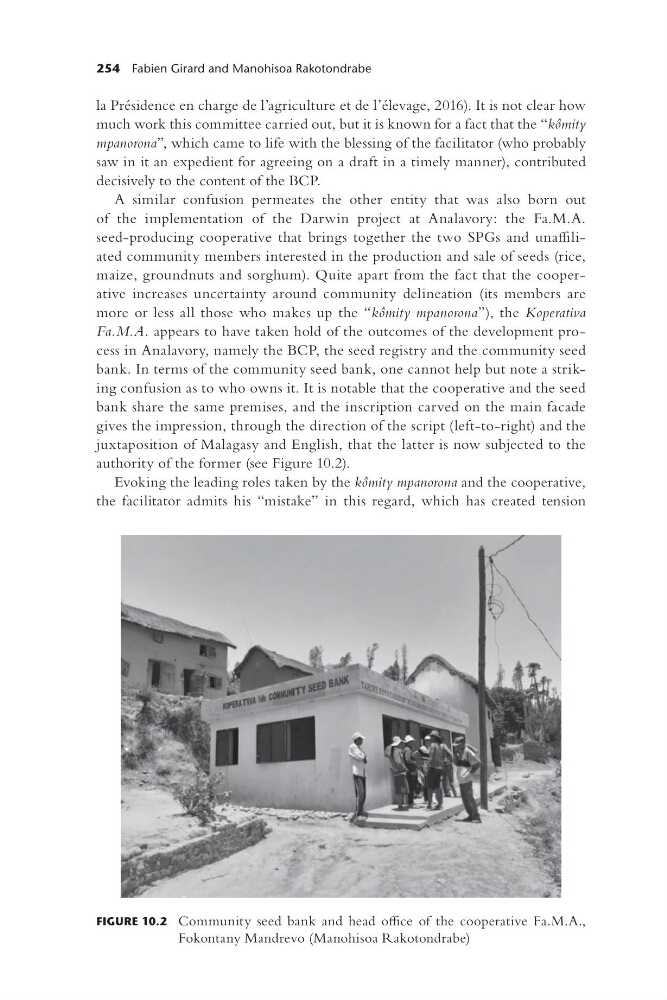
bank. In terms of the community seed bank, one cannot help but note a striking confusion as to who owns it. It is notable that the cooperative and the seed
bank share the same premises, and the inscription carved on the main facade
gives the impression, through the direction of the script (left-to-right) and the
juxtaposition of Malagasy and English, that the latter is now subjected to the
authority of the former (see Figure 10.2).
Evoking the leading roles taken by the kômity mpanorona and the cooperative,
the facilitator admits his “mistake” in this regard, which has created tension
FIGURE 10.2 Community seed bank and head office of the cooperative Fa.M.A.,
Fokontany Mandrevo (Manohisoa Rakotondrabe)
la Présidence en charge de l’agriculture et de l’élevage, 2016). It is not clear how
much work this committee carried out, but it is known for a fact that the “kômity
mpanorona”, which came to life with the blessing of the facilitator (who probably
saw in it an expedient for agreeing on a draft in a timely manner), contributed
decisively to the content of the BCP.
A similar confusion permeates the other entity that was also born out
of the implementation of the Darwin project at Analavory: the Fa.M.A.
seed-producing cooperative that brings together the two SPGs and unaffiliated community members interested in the production and sale of seeds (rice,
maize, groundnuts and sorghum). Quite apart from the fact that the cooperative increases uncertainty around community delineation (its members are
more or less all those who makes up the “kômity mpanorona”), the Koperativa
Fa.M.A. appears to have taken hold of the outcomes of the development process in Analavory, namely the BCP, the seed registry and the community seed
bank. In terms of the community seed bank, one cannot help but note a striking confusion as to who owns it. It is notable that the cooperative and the seed
bank share the same premises, and the inscription carved on the main facade
gives the impression, through the direction of the script (left-to-right) and the
juxtaposition of Malagasy and English, that the latter is now subjected to the
authority of the former (see Figure 10.2).
Evoking the leading roles taken by the kômity mpanorona and the cooperative,
the facilitator admits his “mistake” in this regard, which has created tension
FIGURE 10.2 Community seed bank and head office of the cooperative Fa.M.A.,
Fokontany Mandrevo (Manohisoa Rakotondrabe)