

BCPs and Boundary Work in Madagascar 253
leaders of the Analavory commune and members of the SPG. Subsequently, the
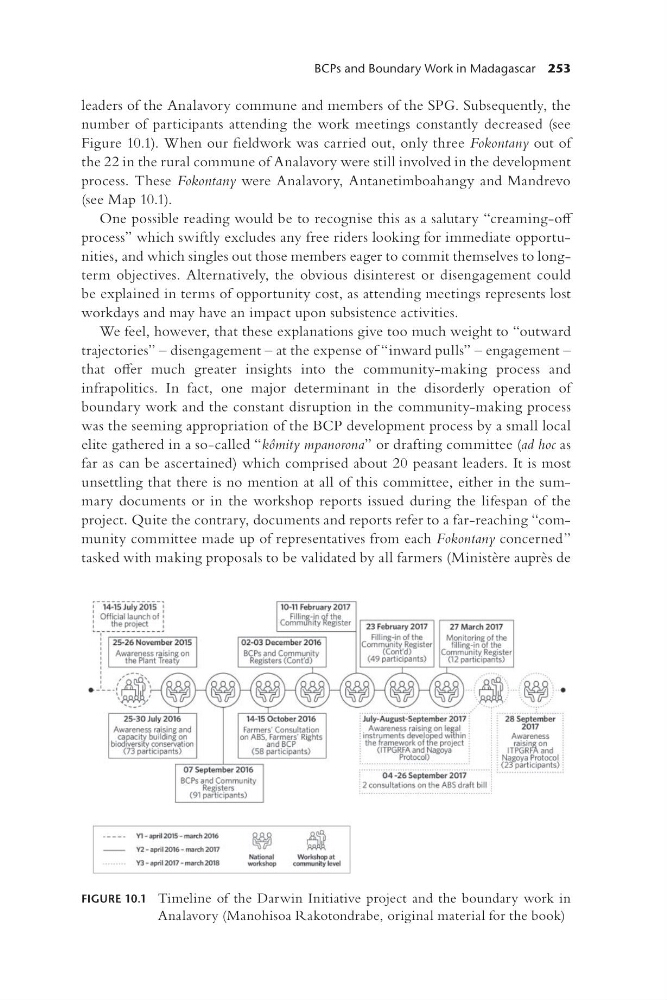
number of participants attending the work meetings constantly decreased (see
Figure 10.1). When our fieldwork was carried out, only three Fokontany out of
the 22 in the rural commune of Analavory were still involved in the development
process. These Fokontany were Analavory, Antanetimboahangy and Mandrevo
(see Map 10.1).
One possible reading would be to recognise this as a salutary “creaming-off
process” which swiftly excludes any free riders looking for immediate opportunities, and which singles out those members eager to commit themselves to longterm objectives. Alternatively, the obvious disinterest or disengagement could
be explained in terms of opportunity cost, as attending meetings represents lost
workdays and may have an impact upon subsistence activities.
We feel, however, that these explanations give too much weight to “outward
trajectories” – disengagement – at the expense of “inward pulls” – e ngagement –
that offer much greater insights into the community-making process and
infrapolitics. In fact, one major determinant in the disorderly operation of
boundary work and the constant disruption in the community-making process
was the seeming appropriation of the BCP development process by a small local
elite gathered in a so-called “kômity mpanorona” or drafting committee (ad hoc as
far as can be ascertained) which comprised about 20 peasant leaders. It is most
unsettling that there is no mention at all of this committee, either in the summary documents or in the workshop reports issued during the lifespan of the
project. Quite the contrary, documents and reports refer to a far-reaching “community committee made up of representatives from each Fokontany concerned”
tasked with making proposals to be validated by all farmers (Ministère auprès de
FIGURE 10.1 Timeline of the Darwin Initiative project and the boundary work in
Analavory (Manohisoa Rakotondrabe, original material for the book)
leaders of the Analavory commune and members of the SPG. Subsequently, the
number of participants attending the work meetings constantly decreased (see
Figure 10.1). When our fieldwork was carried out, only three Fokontany out of
the 22 in the rural commune of Analavory were still involved in the development
process. These Fokontany were Analavory, Antanetimboahangy and Mandrevo
(see Map 10.1).
One possible reading would be to recognise this as a salutary “creaming-off
process” which swiftly excludes any free riders looking for immediate opportunities, and which singles out those members eager to commit themselves to longterm objectives. Alternatively, the obvious disinterest or disengagement could
be explained in terms of opportunity cost, as attending meetings represents lost
workdays and may have an impact upon subsistence activities.
We feel, however, that these explanations give too much weight to “outward
trajectories” – disengagement – at the expense of “inward pulls” – e ngagement –
that offer much greater insights into the community-making process and
infrapolitics. In fact, one major determinant in the disorderly operation of
boundary work and the constant disruption in the community-making process
was the seeming appropriation of the BCP development process by a small local
elite gathered in a so-called “kômity mpanorona” or drafting committee (ad hoc as
far as can be ascertained) which comprised about 20 peasant leaders. It is most
unsettling that there is no mention at all of this committee, either in the summary documents or in the workshop reports issued during the lifespan of the
project. Quite the contrary, documents and reports refer to a far-reaching “community committee made up of representatives from each Fokontany concerned”
tasked with making proposals to be validated by all farmers (Ministère auprès de
FIGURE 10.1 Timeline of the Darwin Initiative project and the boundary work in
Analavory (Manohisoa Rakotondrabe, original material for the book)