

94 Ingrid Hall
this genetic material has acquired greater urgency. In addition, peasant agriculture
in Peru depends heavily on seeds from these landraces: less than 10% of seeds
come from the commercial sector (Lapeña, 2012a, 2012b). Production is mainly
for self-consumption by peasants themselves and seeds are chosen at harvest time.
In situ conservation of this genetic material is thus closely linked to food security.
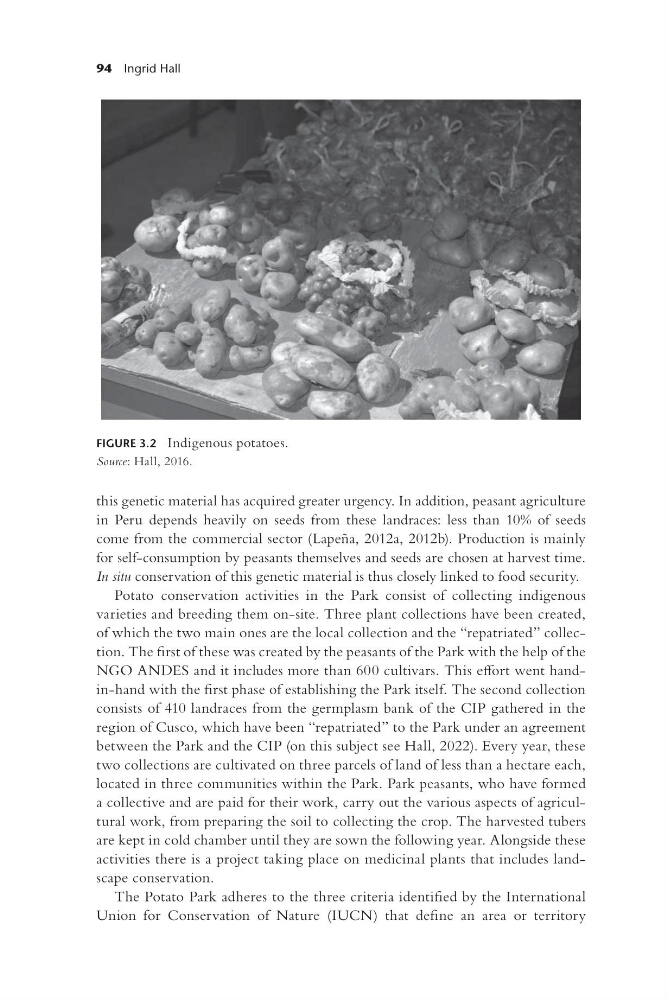
Potato conservation activities in the Park consist of collecting indigenous
varieties and breeding them on-site. Three plant collections have been created,
of which the two main ones are the local collection and the “repatriated” collection. The first of these was created by the peasants of the Park with the help of the
NGO ANDES and it includes more than 600 cultivars. This effort went handin-hand with the first phase of establishing the Park itself. The second collection
consists of 410 landraces from the germplasm bank of the CIP gathered in the
region of Cusco, which have been “repatriated” to the Park under an agreement
between the Park and the CIP (on this subject see Hall, 2022). Every year, these
two collections are cultivated on three parcels of land of less than a hectare each,
located in three communities within the Park. Park peasants, who have formed
a collective and are paid for their work, carry out the various aspects of agricultural work, from preparing the soil to collecting the crop. The harvested tubers
are kept in cold chamber until they are sown the following year. Alongside these
activities there is a project taking place on medicinal plants that includes landscape conservation.
The Potato Park adheres to the three criteria identified by the International
Union for Conservation of Nature (IUCN) that define an area or territory
FIGURE 3.2 Indigenous potatoes.
Source: Hall, 2016.
this genetic material has acquired greater urgency. In addition, peasant agriculture
in Peru depends heavily on seeds from these landraces: less than 10% of seeds
come from the commercial sector (Lapeña, 2012a, 2012b). Production is mainly
for self-consumption by peasants themselves and seeds are chosen at harvest time.
In situ conservation of this genetic material is thus closely linked to food security.
Potato conservation activities in the Park consist of collecting indigenous
varieties and breeding them on-site. Three plant collections have been created,
of which the two main ones are the local collection and the “repatriated” collection. The first of these was created by the peasants of the Park with the help of the
NGO ANDES and it includes more than 600 cultivars. This effort went handin-hand with the first phase of establishing the Park itself. The second collection
consists of 410 landraces from the germplasm bank of the CIP gathered in the
region of Cusco, which have been “repatriated” to the Park under an agreement
between the Park and the CIP (on this subject see Hall, 2022). Every year, these
two collections are cultivated on three parcels of land of less than a hectare each,
located in three communities within the Park. Park peasants, who have formed
a collective and are paid for their work, carry out the various aspects of agricultural work, from preparing the soil to collecting the crop. The harvested tubers
are kept in cold chamber until they are sown the following year. Alongside these
activities there is a project taking place on medicinal plants that includes landscape conservation.
The Potato Park adheres to the three criteria identified by the International
Union for Conservation of Nature (IUCN) that define an area or territory
FIGURE 3.2 Indigenous potatoes.
Source: Hall, 2016.