

Good Living and Indigenous Potatoes 93
The Potato Park, an “area of indigenous biocultural heritage”
6
The Potato Park is located within the territory of five peasant communities
(comunidad campesina)
7 in the high part of the district of Pisac in the southern
Peruvian Andes, in the region of Cusco. The Park covers 12,000 hectares at an
altitude between 3,500m and 5,000m above sea level. It is home to around 6,000
people, who self-identify as “campesinos”, which I translate as peasants (despite its
awkward connotations in English, on the local terminology see Robin, 2004). The
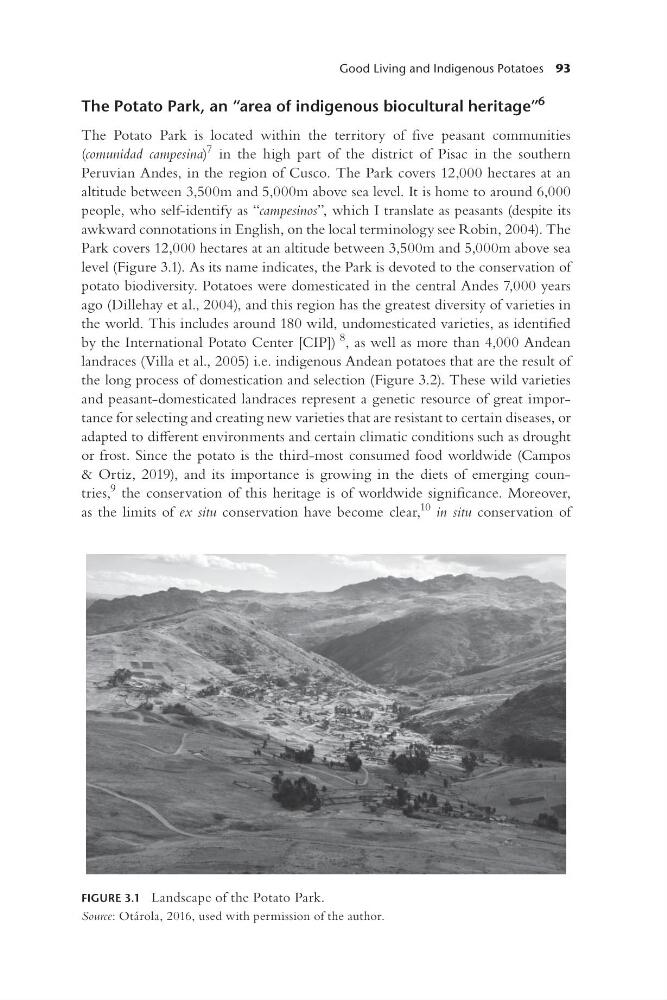
Park covers 12,000 hectares at an altitude between 3,500m and 5,000m above sea
level (Figure 3.1). As its name indicates, the Park is devoted to the conservation of
potato biodiversity. Potatoes were domesticated in the central Andes 7,000 years
ago (Dillehay et al., 2004), and this region has the greatest diversity of varieties in
the world. This includes around 180 wild, undomesticated varieties, as identified
by the International Potato Center [CIP])
8 , as well as more than 4,000 Andean
landraces (Villa et al., 2005) i.e. indigenous Andean potatoes that are the result of
the long process of domestication and selection (Figure 3.2). These wild varieties
and peasant-domesticated landraces represent a genetic resource of great importance for selecting and creating new varieties that are resistant to certain diseases, or
adapted to different environments and certain climatic conditions such as drought
or frost. Since the potato is the third-most consumed food worldwide (Campos
& Ortiz, 2019), and its importance is growing in the diets of emerging countries,
9 the conservation of this heritage is of worldwide significance. Moreover,
as the limits of ex situ conservation have become clear,
10
in situ conservation of
FIGURE 3.1 Landscape of the Potato Park.
Source: Otárola, 2016, used with permission of the author.
The Potato Park, an “area of indigenous biocultural heritage”
6
The Potato Park is located within the territory of five peasant communities
(comunidad campesina)
7 in the high part of the district of Pisac in the southern
Peruvian Andes, in the region of Cusco. The Park covers 12,000 hectares at an
altitude between 3,500m and 5,000m above sea level. It is home to around 6,000
people, who self-identify as “campesinos”, which I translate as peasants (despite its
awkward connotations in English, on the local terminology see Robin, 2004). The
Park covers 12,000 hectares at an altitude between 3,500m and 5,000m above sea
level (Figure 3.1). As its name indicates, the Park is devoted to the conservation of
potato biodiversity. Potatoes were domesticated in the central Andes 7,000 years
ago (Dillehay et al., 2004), and this region has the greatest diversity of varieties in
the world. This includes around 180 wild, undomesticated varieties, as identified
by the International Potato Center [CIP])
8 , as well as more than 4,000 Andean
landraces (Villa et al., 2005) i.e. indigenous Andean potatoes that are the result of
the long process of domestication and selection (Figure 3.2). These wild varieties
and peasant-domesticated landraces represent a genetic resource of great importance for selecting and creating new varieties that are resistant to certain diseases, or
adapted to different environments and certain climatic conditions such as drought
or frost. Since the potato is the third-most consumed food worldwide (Campos
& Ortiz, 2019), and its importance is growing in the diets of emerging countries,
9 the conservation of this heritage is of worldwide significance. Moreover,
as the limits of ex situ conservation have become clear,
10
in situ conservation of
FIGURE 3.1 Landscape of the Potato Park.
Source: Otárola, 2016, used with permission of the author.