

Reducing Greenhouse Gas Emissions and Improving Air Quality
140
1 4 0
15.4 Common Resources Can Be Maintained
Because the atmosphere is quite large, good quality air has historically
been free. Clean air has been a common pool resource that has been nonexcludable and only marginally (if at all) rivalrous (i.e. another person technically cannot have the breath of air that I use, but it is trivially easy for
them to get air of their own). Due to these properties, clean air has remained
a common resource even as other common resources (land, minerals, fish,
timber, and even drinking water) have shifted towards becoming public
goods, and then private goods.
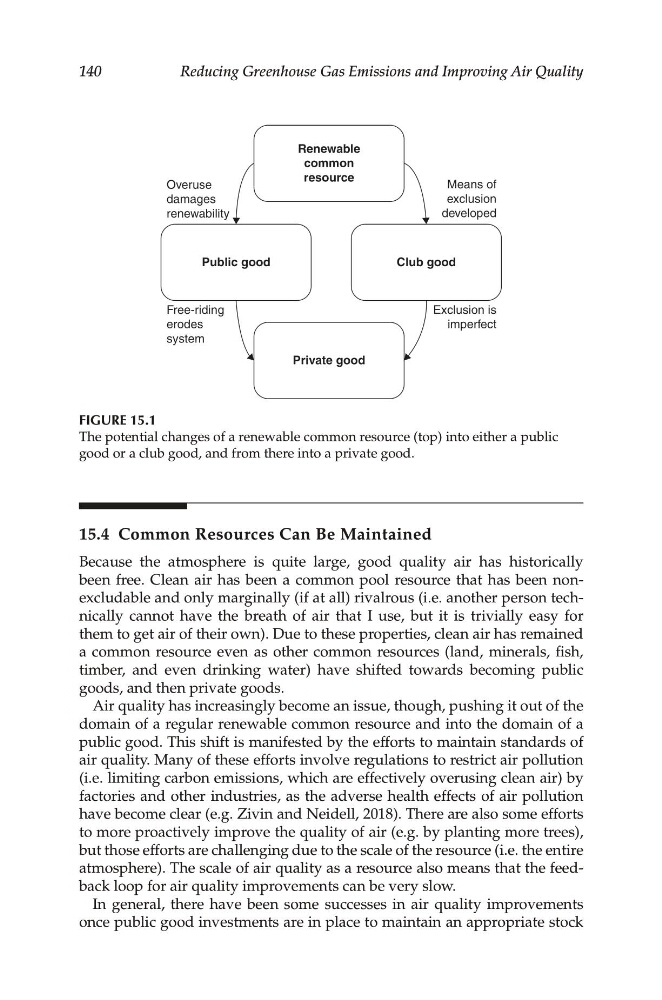
Air quality has increasingly become an issue, though, pushing it out of the
domain of a regular renewable common resource and into the domain of a
public good. This shift is manifested by the efforts to maintain standards of
air quality. Many of these efforts involve regulations to restrict air pollution
(i.e. limiting carbon emissions, which are effectively overusing clean air) by
factories and other industries, as the adverse health effects of air pollution
have become clear (e.g. Zivin and Neidell, 2018). There are also some efforts
to more proactively improve the quality of air (e.g. by planting more trees),
but those efforts are challenging due to the scale of the resource (i.e. the entire
atmosphere). The scale of air quality as a resource also means that the feedback loop for air quality improvements can be very slow.
In general, there have been some successes in air quality improvements
once public good investments are in place to maintain an appropriate stock
Renewable
common
resource
Means of
exclusion
developed
Club good
Private good
Public good
Exclusion is
imperfect
Free-riding
erodes
system
Overuse
damages
renewability
FIGURE 15.1
The potential changes of a renewable common resource (top) into either a public
good or a club good, and from there into a private good.
140
1 4 0
15.4 Common Resources Can Be Maintained
Because the atmosphere is quite large, good quality air has historically
been free. Clean air has been a common pool resource that has been nonexcludable and only marginally (if at all) rivalrous (i.e. another person technically cannot have the breath of air that I use, but it is trivially easy for
them to get air of their own). Due to these properties, clean air has remained
a common resource even as other common resources (land, minerals, fish,
timber, and even drinking water) have shifted towards becoming public
goods, and then private goods.
Air quality has increasingly become an issue, though, pushing it out of the
domain of a regular renewable common resource and into the domain of a
public good. This shift is manifested by the efforts to maintain standards of
air quality. Many of these efforts involve regulations to restrict air pollution
(i.e. limiting carbon emissions, which are effectively overusing clean air) by
factories and other industries, as the adverse health effects of air pollution
have become clear (e.g. Zivin and Neidell, 2018). There are also some efforts
to more proactively improve the quality of air (e.g. by planting more trees),
but those efforts are challenging due to the scale of the resource (i.e. the entire
atmosphere). The scale of air quality as a resource also means that the feedback loop for air quality improvements can be very slow.
In general, there have been some successes in air quality improvements
once public good investments are in place to maintain an appropriate stock
Renewable
common
resource
Means of
exclusion
developed
Club good
Private good
Public good
Exclusion is
imperfect
Free-riding
erodes
system
Overuse
damages
renewability
FIGURE 15.1
The potential changes of a renewable common resource (top) into either a public
good or a club good, and from there into a private good.