

259
Case Study of PRB Application for the Remediation of Groundwater
The pilot-scale barrier was constructed in February 1999. John Vogan visited the site to supervise the construction. He also updated the CLC during
a construction site visit on the status of PRBs for groundwater treatment. By
February 1999, there were 22 full-scale and 14 pilot-scale installations around
the world (all in North America and Europe).
Construction of the pilot-scale barrier at Botany occurred in a number of
steps:
1. Sheet piles of 12 m length were installed 11 m bgs (see Figure 12.4).
Although this was the design depth, piling to this depth was difficult due to the dense-flowing sand. The water table in the construction area was approximately 1 m b gs or less.
2. The soil within the nominally 5 × 1.5 m sheet-piled “rectangle” (see
Figure 12.10) was excavated to 7.5 m b gs.
3. Prior to backfilling the excavation, it was filled with water. (The
excavation had only been partially dewatered to prevent sheet pile
collapse.) The water served two purposes:
• It prevented upwelling of sand and groundwater from the base
of the excavation.
• It enabled the backfilled iron and sand to settle more uniformly
across the entire length and breadth of the excavation.
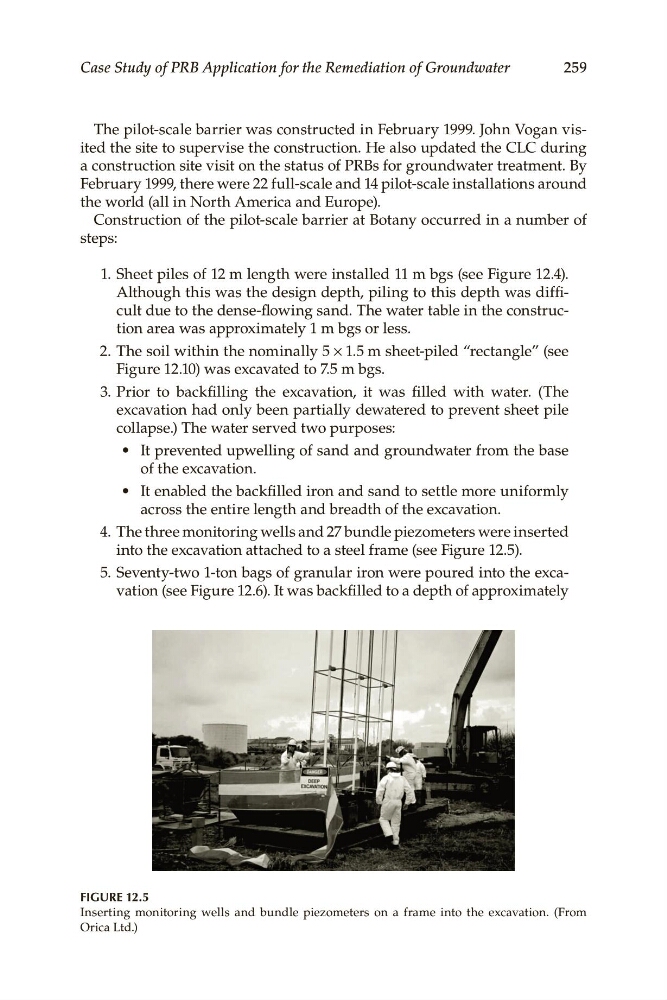
4. The three monitoring wells and 27 bundle piezometers were inserted
into the excavation attached to a steel frame (see Figure 12.5).
5. Seventy-two 1-ton bags of granular iron were poured into the excavation (see Figure 12.6). It was backfilled to a depth of approximately
FIGURE 12.5
Inserting monitoring wells and bundle piezometers on a frame into the excavation. (From
Orica Ltd.)
Case Study of PRB Application for the Remediation of Groundwater
The pilot-scale barrier was constructed in February 1999. John Vogan visited the site to supervise the construction. He also updated the CLC during
a construction site visit on the status of PRBs for groundwater treatment. By
February 1999, there were 22 full-scale and 14 pilot-scale installations around
the world (all in North America and Europe).
Construction of the pilot-scale barrier at Botany occurred in a number of
steps:
1. Sheet piles of 12 m length were installed 11 m bgs (see Figure 12.4).
Although this was the design depth, piling to this depth was difficult due to the dense-flowing sand. The water table in the construction area was approximately 1 m b gs or less.
2. The soil within the nominally 5 × 1.5 m sheet-piled “rectangle” (see
Figure 12.10) was excavated to 7.5 m b gs.
3. Prior to backfilling the excavation, it was filled with water. (The
excavation had only been partially dewatered to prevent sheet pile
collapse.) The water served two purposes:
• It prevented upwelling of sand and groundwater from the base
of the excavation.
• It enabled the backfilled iron and sand to settle more uniformly
across the entire length and breadth of the excavation.
4. The three monitoring wells and 27 bundle piezometers were inserted
into the excavation attached to a steel frame (see Figure 12.5).
5. Seventy-two 1-ton bags of granular iron were poured into the excavation (see Figure 12.6). It was backfilled to a depth of approximately
FIGURE 12.5
Inserting monitoring wells and bundle piezometers on a frame into the excavation. (From
Orica Ltd.)