

258
Permeable Reactive Barrier
• Barrier flow-through thickness: 1.5 m (equivalent to about 10 days’
residence time in the barrier based on a conservative 0.15 m/day
estimate for groundwater velocity)
The large flow-through thickness was recommended to ensure complete
degradation of the PCE and evaluation of the formation and destruction of
degradation products through the barrier.
Groundwater modeling demonstrated that the intended iron had a suitable permeability relative to the aquifer material. Pea gravel was therefore
not required to be installed upgradient or downgradient of the barrier.
The design of the barrier and the construction method were collaboratively developed by ETI, Woodward-Clyde, and Orica. Two key considerations were given to the design and construction method:
1. The precision of the barrier dimensions
2. The quality of the data that could be obtained from monitoring the
barrier
To achieve these, it was decided to construct the barrier using sheet piling
and to install the monitoring wells and bundle piezometers in the barrier
attached to a frame (which ensured that the precise location—laterally and
vertically—of each monitoring point was known). Installing the monitoring
wells and piezometers attached to a frame also made construction significantly easier—the complete monitoring network could be inserted into the
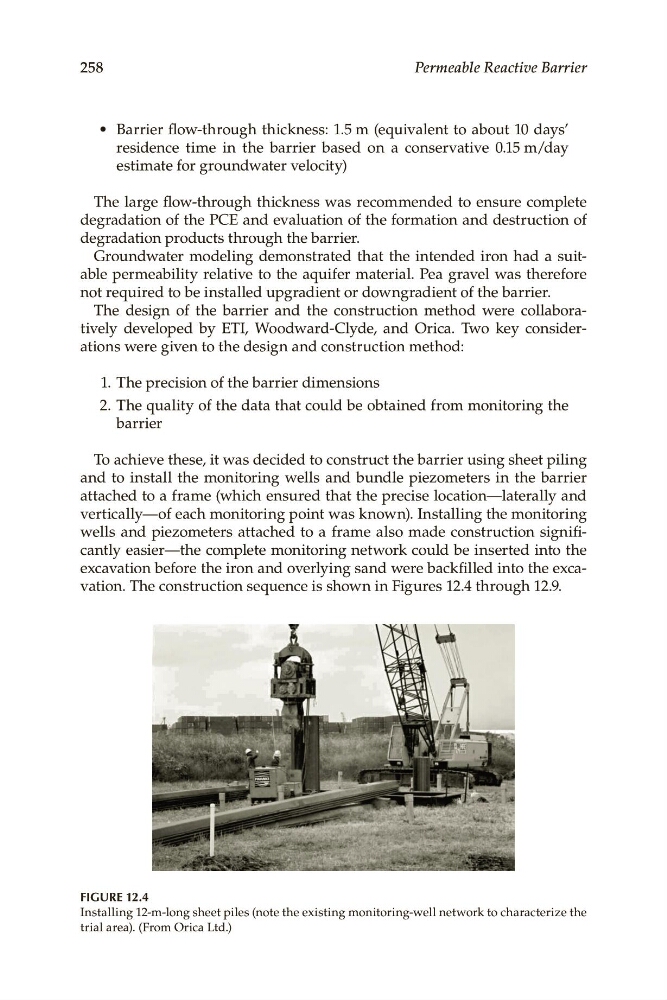
excavation before the iron and overlying sand were backfilled into the excavation. The construction sequence is shown in Figures 12.4 through 12.9.
FIGURE 12.4
Installing 12-m-long sheet piles (note the existing monitoring-well network to characterize the
trial area). (From Orica Ltd.)
Permeable Reactive Barrier
• Barrier flow-through thickness: 1.5 m (equivalent to about 10 days’
residence time in the barrier based on a conservative 0.15 m/day
estimate for groundwater velocity)
The large flow-through thickness was recommended to ensure complete
degradation of the PCE and evaluation of the formation and destruction of
degradation products through the barrier.
Groundwater modeling demonstrated that the intended iron had a suitable permeability relative to the aquifer material. Pea gravel was therefore
not required to be installed upgradient or downgradient of the barrier.
The design of the barrier and the construction method were collaboratively developed by ETI, Woodward-Clyde, and Orica. Two key considerations were given to the design and construction method:
1. The precision of the barrier dimensions
2. The quality of the data that could be obtained from monitoring the
barrier
To achieve these, it was decided to construct the barrier using sheet piling
and to install the monitoring wells and bundle piezometers in the barrier
attached to a frame (which ensured that the precise location—laterally and
vertically—of each monitoring point was known). Installing the monitoring
wells and piezometers attached to a frame also made construction significantly easier—the complete monitoring network could be inserted into the
excavation before the iron and overlying sand were backfilled into the excavation. The construction sequence is shown in Figures 12.4 through 12.9.
FIGURE 12.4
Installing 12-m-long sheet piles (note the existing monitoring-well network to characterize the
trial area). (From Orica Ltd.)