

250
1.0
pH
2
3
4
5
6
7
8
2-Methylquinoline
c 0 = 11–24 mg/L
Fit exp. load
Fraction neutral molecule
in solution (pK a = 5.86)
Exp. load (calculated using
Freundlich model)
Calculated load of
mixture (IAS, Freundlich)
0.4
100
0.2
50
0.0
Fraction neutral molecule in solution
q (for c
0 = 10 mg L –1
)/mg g –1
0.8
200
0.6
150
400
200
100
80
60
q
eq /mg g –1
40
20
2
4
6
8
10
Acenaphthene
Dibenzothiophene
Benzene
Phenanthene
9-Methylacridine
1
0.001
0.01
0.1
1
c eq /mg L –1
1 0
100
1000
229
Remediation of PAHs and NSO-Heterocycles
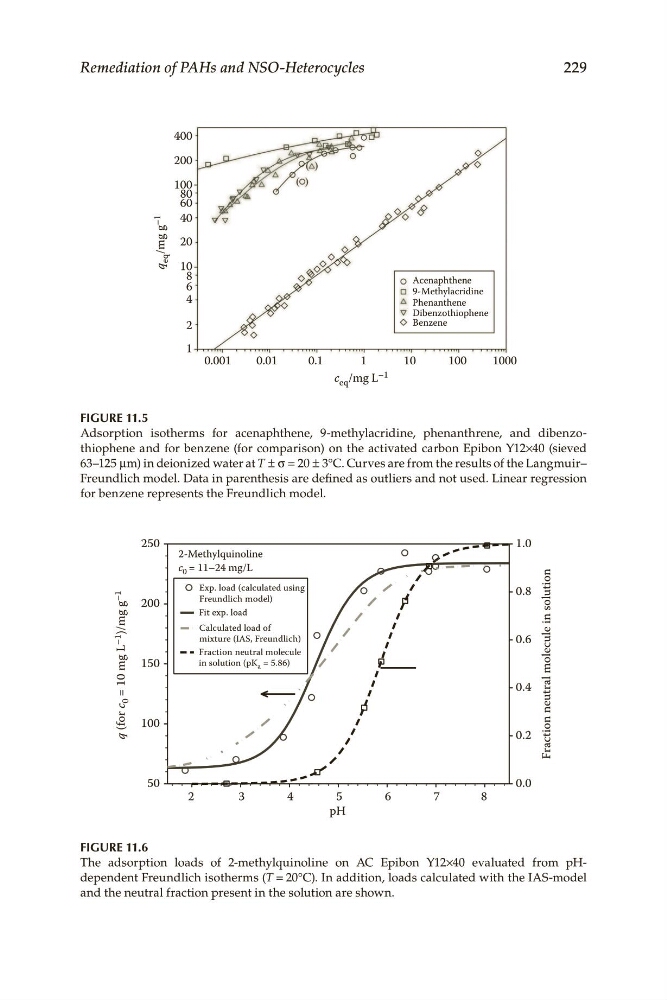
FIGURE 11.5
Adsorption isotherms for acenaphthene, 9-methylacridine, phenanthrene, and dibenzothiophene and for benzene (for comparison) on the activated carbon Epibon Y12×40 (sieved
63–125 μm) in deionized water at T ± σ = 20 ± 3°C. Curves are from the results of the Langmuir–
Freundlich model. Data in parenthesis are defined as outliers and not used. Linear regression
for benzene represents the Freundlich model.
FIGURE 11.6
The adsorption loads of 2-methylquinoline on AC Epibon Y12×40 evaluated from pHdependent Freundlich isotherms (T = 20°C). In addition, loads calculated with the IAS-model
and the neutral fraction present in the solution are shown.
1.0
pH
2
3
4
5
6
7
8
2-Methylquinoline
c 0 = 11–24 mg/L
Fit exp. load
Fraction neutral molecule
in solution (pK a = 5.86)
Exp. load (calculated using
Freundlich model)
Calculated load of
mixture (IAS, Freundlich)
0.4
100
0.2
50
0.0
Fraction neutral molecule in solution
q (for c
0 = 10 mg L –1
)/mg g –1
0.8
200
0.6
150
400
200
100
80
60
q
eq /mg g –1
40
20
2
4
6
8
10
Acenaphthene
Dibenzothiophene
Benzene
Phenanthene
9-Methylacridine
1
0.001
0.01
0.1
1
c eq /mg L –1
1 0
100
1000
229
Remediation of PAHs and NSO-Heterocycles
FIGURE 11.5
Adsorption isotherms for acenaphthene, 9-methylacridine, phenanthrene, and dibenzothiophene and for benzene (for comparison) on the activated carbon Epibon Y12×40 (sieved
63–125 μm) in deionized water at T ± σ = 20 ± 3°C. Curves are from the results of the Langmuir–
Freundlich model. Data in parenthesis are defined as outliers and not used. Linear regression
for benzene represents the Freundlich model.
FIGURE 11.6
The adsorption loads of 2-methylquinoline on AC Epibon Y12×40 evaluated from pHdependent Freundlich isotherms (T = 20°C). In addition, loads calculated with the IAS-model
and the neutral fraction present in the solution are shown.