

Mean
Pressure
Flow Rate
Propagation
Difference at
(STP) at
Velocity over
Flow Type/ Injection
Injection Point Injection Point
ROI
Type, Frequency
Δp IP (kPa)
Q g,IP (m³/h)
v g,ROI (m/h)
–
NDI,
<30
<1.0
0.01–0.1
Pervasive or bubbly/
low
continuous or pulsed f < 1/d
NDI,
30–100
1.0–3.5
0.1–10.0
Channelized or bubbly/
high
pulsed f < 1/h
HDI
>300
>5
>5.0
Channelized or bubbly/
pulsed f > 1/min
187
Reactive (Oxygen) Gas Barrier and Zone Technologies
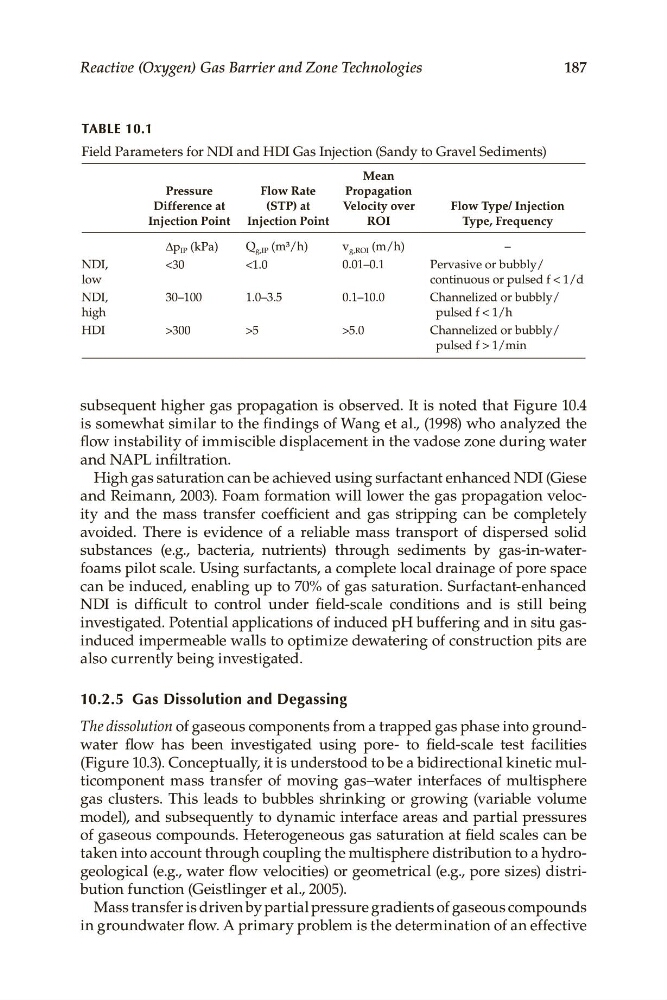
TABLE 10.1
Field Parameters for NDI and HDI Gas Injection (Sandy to Gravel Sediments)
subsequent higher gas propagation is observed. It is noted that Figure 10.4
is somewhat similar to the findings of Wang et al., (1998) who analyzed the
flow instability of immiscible displacement in the vadose zone during water
and NAPL infiltration.
High gas saturation can be achieved using surfactant enhanced NDI (Giese
and Reimann, 2003). Foam formation will lower the gas propagation velocity and the mass transfer coefficient and gas stripping can be completely
avoided. There is evidence of a reliable mass transport of dispersed solid
substances (e.g., bacteria, nutrients) through sediments by gas-in-waterfoams pilot scale. Using surfactants, a complete local drainage of pore space
can be induced, enabling up to 70% of gas saturation. Surfactant-enhanced
NDI is difficult to control under field-scale conditions and is still being
investigated. Potential applications of induced pH buffering and in situ gasinduced impermeable walls to optimize dewatering of construction pits are
also currently being investigated.
10.2.5 Gas Dissolution and Degassing
The dissolution of gaseous components from a trapped gas phase into groundwater flow has been investigated using pore- to field-scale test facilities
(Figure 10.3). Conceptually, it is understood to be a bidirectional kinetic multicomponent mass transfer of moving gas–water interfaces of multisphere
gas clusters. This leads to bubbles shrinking or growing (variable volume
model), and subsequently to dynamic interface areas and partial pressures
of gaseous compounds. Heterogeneous gas saturation at field scales can be
taken into account through coupling the multisphere distribution to a hydrogeological (e.g., water flow velocities) or geometrical (e.g., pore sizes) distribution function (Geistlinger et al., 2005).
Mass transfer is driven by partial pressure gradients of gaseous compounds
in groundwater flow. A primary problem is the determination of an effective
Pressure
Flow Rate
Propagation
Difference at
(STP) at
Velocity over
Flow Type/ Injection
Injection Point Injection Point
ROI
Type, Frequency
Δp IP (kPa)
Q g,IP (m³/h)
v g,ROI (m/h)
–
NDI,
<30
<1.0
0.01–0.1
Pervasive or bubbly/
low
continuous or pulsed f < 1/d
NDI,
30–100
1.0–3.5
0.1–10.0
Channelized or bubbly/
high
pulsed f < 1/h
HDI
>300
>5
>5.0
Channelized or bubbly/
pulsed f > 1/min
187
Reactive (Oxygen) Gas Barrier and Zone Technologies
TABLE 10.1
Field Parameters for NDI and HDI Gas Injection (Sandy to Gravel Sediments)
subsequent higher gas propagation is observed. It is noted that Figure 10.4
is somewhat similar to the findings of Wang et al., (1998) who analyzed the
flow instability of immiscible displacement in the vadose zone during water
and NAPL infiltration.
High gas saturation can be achieved using surfactant enhanced NDI (Giese
and Reimann, 2003). Foam formation will lower the gas propagation velocity and the mass transfer coefficient and gas stripping can be completely
avoided. There is evidence of a reliable mass transport of dispersed solid
substances (e.g., bacteria, nutrients) through sediments by gas-in-waterfoams pilot scale. Using surfactants, a complete local drainage of pore space
can be induced, enabling up to 70% of gas saturation. Surfactant-enhanced
NDI is difficult to control under field-scale conditions and is still being
investigated. Potential applications of induced pH buffering and in situ gasinduced impermeable walls to optimize dewatering of construction pits are
also currently being investigated.
10.2.5 Gas Dissolution and Degassing
The dissolution of gaseous components from a trapped gas phase into groundwater flow has been investigated using pore- to field-scale test facilities
(Figure 10.3). Conceptually, it is understood to be a bidirectional kinetic multicomponent mass transfer of moving gas–water interfaces of multisphere
gas clusters. This leads to bubbles shrinking or growing (variable volume
model), and subsequently to dynamic interface areas and partial pressures
of gaseous compounds. Heterogeneous gas saturation at field scales can be
taken into account through coupling the multisphere distribution to a hydrogeological (e.g., water flow velocities) or geometrical (e.g., pore sizes) distribution function (Geistlinger et al., 2005).
Mass transfer is driven by partial pressure gradients of gaseous compounds
in groundwater flow. A primary problem is the determination of an effective