

As (µg/L)
250
200
150
100
50
0
PRB
Groundwater flow
TEPA-2A TEPA-2B TEPA-2C TEPA-2D TEPA-2E TEPA-2F TEPA-2G TEPA-2H
2006 2007
2008 2009 2010
Organic-Based PRBs for the Treatment of Heavy Metals, Arsenic, and Acidity 145
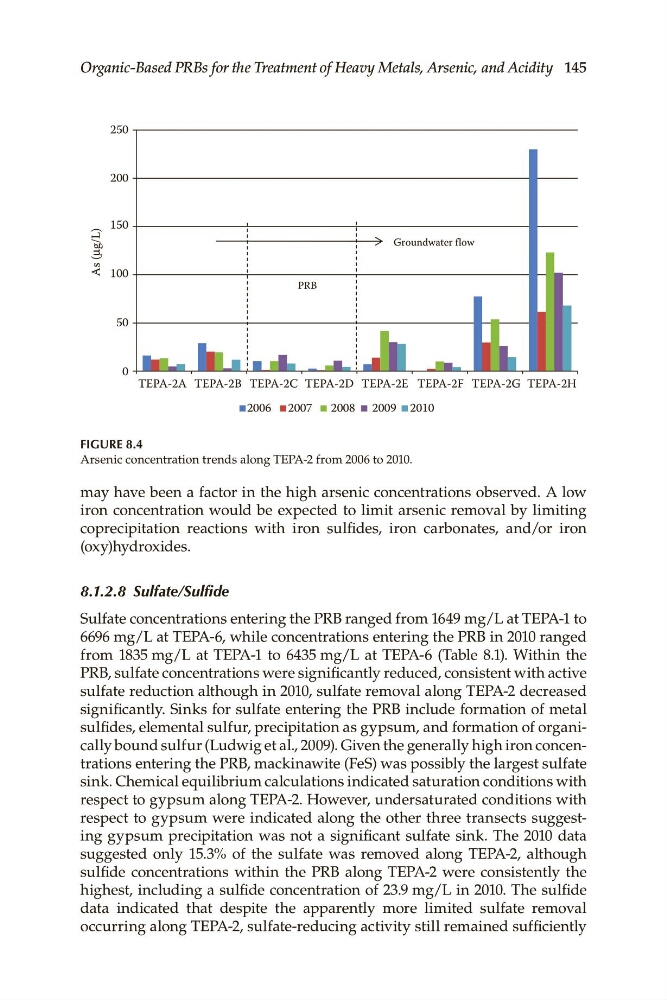
FIGURE 8.4
Arsenic concentration trends along TEPA-2 from 2006 to 2010.
may have been a factor in the high arsenic concentrations observed. A low
iron concentration would be expected to limit arsenic removal by limiting
coprecipitation reactions with iron sulfides, iron carbonates, and/or iron
(oxy)hydroxides.
8.1.2.8 Sulfate/Sulfide
Sulfate concentrations entering the PRB ranged from 1649 mg/L at TEPA-1 to
6696 mg/L at TEPA-6, while concentrations entering the PRB in 2010 ranged
from 1835 mg/L at TEPA-1 to 6435 mg/L at TEPA-6 (Table 8.1). Within the
PRB, sulfate concentrations were significantly reduced, consistent with active
sulfate reduction although in 2010, sulfate removal along TEPA-2 decreased
significantly. Sinks for sulfate entering the PRB include formation of metal
sulfides, elemental sulfur, precipitation as gypsum, and formation of organically bound sulfur (Ludwig et al., 2009). Given the generally high iron concentrations entering the PRB, mackinawite (FeS) was possibly the largest sulfate
sink. Chemical equilibrium calculations indicated saturation conditions with
respect to gypsum along TEPA-2. However, undersaturated conditions with
respect to gypsum were indicated along the other three transects suggesting gypsum precipitation was not a significant sulfate sink. The 2010 data
suggested only 15.3% of the sulfate was removed along TEPA-2, although
sulfide concentrations within the PRB along TEPA-2 were consistently the
highest, including a sulfide concentration of 23.9 mg/L in 2010. The sulfide
data indicated that despite the apparently more limited sulfate removal
occurring along TEPA-2, sulfate-reducing activity still remained sufficiently
250
200
150
100
50
0
PRB
Groundwater flow
TEPA-2A TEPA-2B TEPA-2C TEPA-2D TEPA-2E TEPA-2F TEPA-2G TEPA-2H
2006 2007
2008 2009 2010
Organic-Based PRBs for the Treatment of Heavy Metals, Arsenic, and Acidity 145
FIGURE 8.4
Arsenic concentration trends along TEPA-2 from 2006 to 2010.
may have been a factor in the high arsenic concentrations observed. A low
iron concentration would be expected to limit arsenic removal by limiting
coprecipitation reactions with iron sulfides, iron carbonates, and/or iron
(oxy)hydroxides.
8.1.2.8 Sulfate/Sulfide
Sulfate concentrations entering the PRB ranged from 1649 mg/L at TEPA-1 to
6696 mg/L at TEPA-6, while concentrations entering the PRB in 2010 ranged
from 1835 mg/L at TEPA-1 to 6435 mg/L at TEPA-6 (Table 8.1). Within the
PRB, sulfate concentrations were significantly reduced, consistent with active
sulfate reduction although in 2010, sulfate removal along TEPA-2 decreased
significantly. Sinks for sulfate entering the PRB include formation of metal
sulfides, elemental sulfur, precipitation as gypsum, and formation of organically bound sulfur (Ludwig et al., 2009). Given the generally high iron concentrations entering the PRB, mackinawite (FeS) was possibly the largest sulfate
sink. Chemical equilibrium calculations indicated saturation conditions with
respect to gypsum along TEPA-2. However, undersaturated conditions with
respect to gypsum were indicated along the other three transects suggesting gypsum precipitation was not a significant sulfate sink. The 2010 data
suggested only 15.3% of the sulfate was removed along TEPA-2, although
sulfide concentrations within the PRB along TEPA-2 were consistently the
highest, including a sulfide concentration of 23.9 mg/L in 2010. The sulfide
data indicated that despite the apparently more limited sulfate removal
occurring along TEPA-2, sulfate-reducing activity still remained sufficiently