

136
Permeable Reactive Barrier
8.1 Louisiana PRBs
Activities at the Louisiana battery recycling facility site included spent leadacid battery demolition and lead smelting of battery lead plates to produce
lead ingots. Initial remedial action at the site included excavation, treatment,
and off-site disposal of approximately 32,400 cubic meters of impacted soils.
A large low pH, high acidity, metal-laden groundwater plume remained on
site and continued to discharge into a nearby creek. A full-scale PRB, consisting of 67% composted cow manure (v/v) and 33% limestone gravel, was
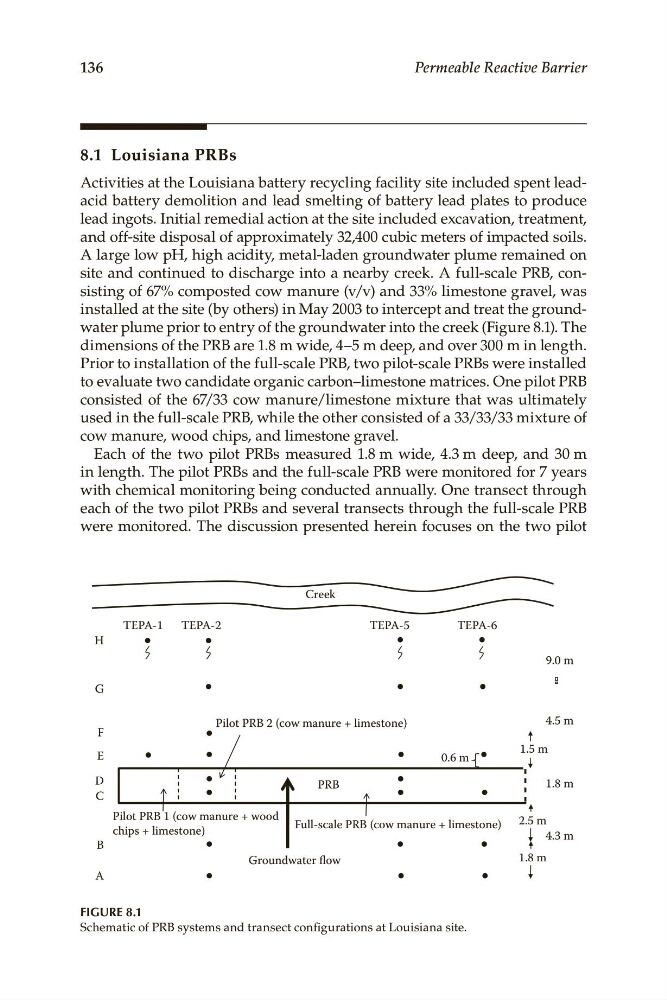
installed at the site (by others) in May 2003 to intercept and treat the groundwater plume prior to entry of the groundwater into the creek (Figure 8.1). The
dimensions of the PRB are 1.8 m wide, 4–5 m deep, and over 300 m in length.
Prior to installation of the full-scale PRB, two pilot-scale PRBs were installed
to evaluate two candidate organic carbon–limestone matrices. One pilot PRB
consisted of the 67/33 cow manure/limestone mixture that was ultimately
used in the full-scale PRB, while the other consisted of a 33/33/33 mixture of
cow manure, wood chips, and limestone gravel.
Each of the two pilot PRBs measured 1.8 m wide, 4.3 m deep, and 30 m
in length. The pilot PRBs and the full-scale PRB were monitored for 7 years
with chemical monitoring being conducted annually. One transect through
each of the two pilot PRBs and several transects through the full-scale PRB
were monitored. The discussion presented herein focuses on the two pilot
Creek
TEPA-1
H
G
F
E
D
C
B
A
TEPA-2
Pilot PRB 2 (cow manure + limestone)
Full-scale PRB (cow manure + limestone)
Pilot PRB 1 (cow manure + wood
chips + limestone)
Groundwater flow
TEPA-5
TEPA-6
9.0 m
4.5 m
1.8 m
4.3 m
2.5 m
1.8 m
1.5 m
0.6 m
PRB
FIGURE 8.1
Schematic of PRB systems and transect configurations at Louisiana site.
Permeable Reactive Barrier
8.1 Louisiana PRBs
Activities at the Louisiana battery recycling facility site included spent leadacid battery demolition and lead smelting of battery lead plates to produce
lead ingots. Initial remedial action at the site included excavation, treatment,
and off-site disposal of approximately 32,400 cubic meters of impacted soils.
A large low pH, high acidity, metal-laden groundwater plume remained on
site and continued to discharge into a nearby creek. A full-scale PRB, consisting of 67% composted cow manure (v/v) and 33% limestone gravel, was
installed at the site (by others) in May 2003 to intercept and treat the groundwater plume prior to entry of the groundwater into the creek (Figure 8.1). The
dimensions of the PRB are 1.8 m wide, 4–5 m deep, and over 300 m in length.
Prior to installation of the full-scale PRB, two pilot-scale PRBs were installed
to evaluate two candidate organic carbon–limestone matrices. One pilot PRB
consisted of the 67/33 cow manure/limestone mixture that was ultimately
used in the full-scale PRB, while the other consisted of a 33/33/33 mixture of
cow manure, wood chips, and limestone gravel.
Each of the two pilot PRBs measured 1.8 m wide, 4.3 m deep, and 30 m
in length. The pilot PRBs and the full-scale PRB were monitored for 7 years
with chemical monitoring being conducted annually. One transect through
each of the two pilot PRBs and several transects through the full-scale PRB
were monitored. The discussion presented herein focuses on the two pilot
Creek
TEPA-1
H
G
F
E
D
C
B
A
TEPA-2
Pilot PRB 2 (cow manure + limestone)
Full-scale PRB (cow manure + limestone)
Pilot PRB 1 (cow manure + wood
chips + limestone)
Groundwater flow
TEPA-5
TEPA-6
9.0 m
4.5 m
1.8 m
4.3 m
2.5 m
1.8 m
1.5 m
0.6 m
PRB
FIGURE 8.1
Schematic of PRB systems and transect configurations at Louisiana site.