

76 m
7.5
Elevation (mAHD)
–2.5
5.0
Panel
Panel
Panel
A
B
C
2.5
0.0
Transition zone
Inferred clay
Leederville formation
A
–5.0
Southwest
A'
Northeast
0
5
10 meters
122
Permeable Reactive Barrier
As the difference between the sawdust and woodchips was not consistent,
it was decided to use a carbon source consisting of a variable combination of
pine sawdust and woodchips for the denitrification PRB. Owing to the production methodology, a mixture of sawdust and woodchips is much easier to
source from local producers.
ETI recommended that consideration be given to retaining a section of natural aquifer between the denitrification PRB and the ZVI PRB as this could
act as a buffer and reduce the transport of TOC into the ZVI PRB and thereby
increase ZVI longevity. This recommendation was incorporated into the preliminary design of the remediation system.
7.6 Implementation
The preliminary design included material specifications and minimum sizes
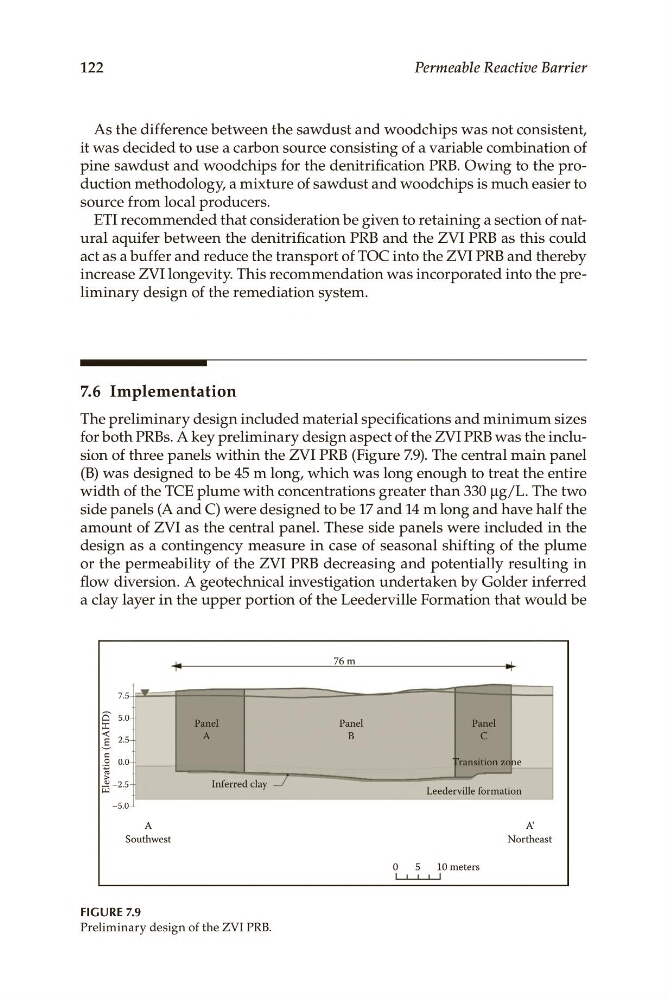
for both PRBs. A key preliminary design aspect of the ZVI PRB was the inclusion of three panels within the ZVI PRB (Figure 7.9). The central main panel
(B) was designed to be 45 m long, which was long enough to treat the entire
width of the TCE plume with concentrations greater than 330 μg/L. The two
side panels (A and C) were designed to be 17 and 14 m long and have half the
amount of ZVI as the central panel. These side panels were included in the
design as a contingency measure in case of seasonal shifting of the plume
or the permeability of the ZVI PRB decreasing and potentially resulting in
flow diversion. A geotechnical investigation undertaken by Golder inferred
a clay layer in the upper portion of the Leederville Formation that would be
FIGURE 7.9
Preliminary design of the ZVI PRB.
7.5
Elevation (mAHD)
–2.5
5.0
Panel
Panel
Panel
A
B
C
2.5
0.0
Transition zone
Inferred clay
Leederville formation
A
–5.0
Southwest
A'
Northeast
0
5
10 meters
122
Permeable Reactive Barrier
As the difference between the sawdust and woodchips was not consistent,
it was decided to use a carbon source consisting of a variable combination of
pine sawdust and woodchips for the denitrification PRB. Owing to the production methodology, a mixture of sawdust and woodchips is much easier to
source from local producers.
ETI recommended that consideration be given to retaining a section of natural aquifer between the denitrification PRB and the ZVI PRB as this could
act as a buffer and reduce the transport of TOC into the ZVI PRB and thereby
increase ZVI longevity. This recommendation was incorporated into the preliminary design of the remediation system.
7.6 Implementation
The preliminary design included material specifications and minimum sizes
for both PRBs. A key preliminary design aspect of the ZVI PRB was the inclusion of three panels within the ZVI PRB (Figure 7.9). The central main panel
(B) was designed to be 45 m long, which was long enough to treat the entire
width of the TCE plume with concentrations greater than 330 μg/L. The two
side panels (A and C) were designed to be 17 and 14 m long and have half the
amount of ZVI as the central panel. These side panels were included in the
design as a contingency measure in case of seasonal shifting of the plume
or the permeability of the ZVI PRB decreasing and potentially resulting in
flow diversion. A geotechnical investigation undertaken by Golder inferred
a clay layer in the upper portion of the Leederville Formation that would be
FIGURE 7.9
Preliminary design of the ZVI PRB.