

0.45
0.4
0.35
0.3
GGG1
Y = 0.0043x
R 2 = 0.9514
Y = 0.0027x
R 2 = 0.9883
Y = 2E–05x
Y = 0.002x
R 2 = 0.9731
60
80
100
1 20
GGG3
k(obs) in 1/h
0.25
GGG3 rusted
GGG3 calcinated
0.2
Linear (GGG1)
Linear (GGG3)
0.15
Linear (GGG3 rusted)
Linear (GGG3 calcinated)
0.1
0.05
0
0
2 0
4 0
m(ZVI) in g
94
Permeable Reactive Barrier
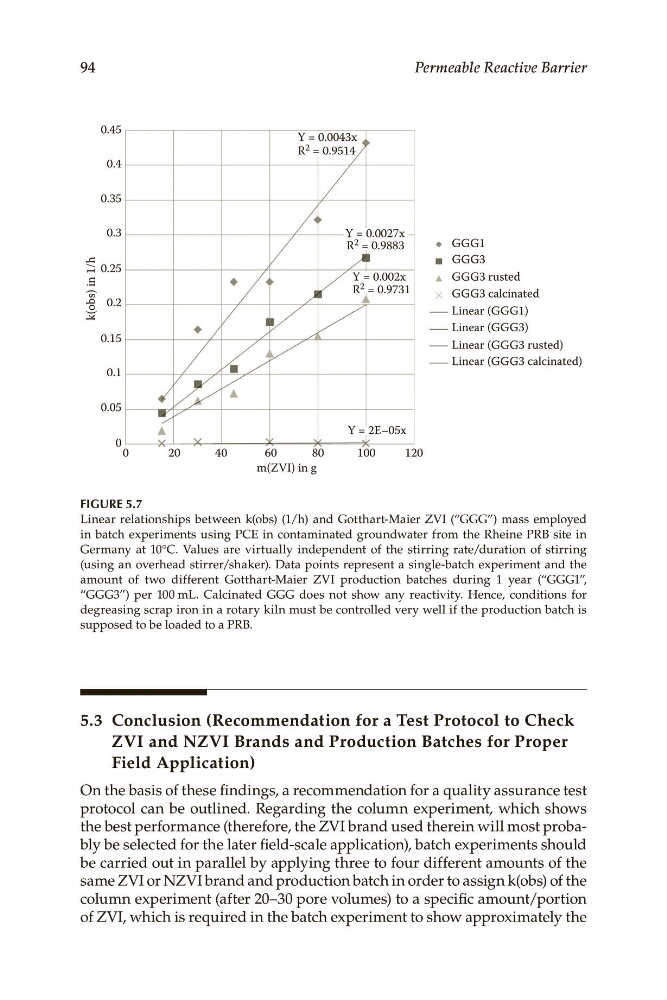
FIGURE 5.7
Linear relationships between k(obs) (1/h) and Gotthart-Maier ZVI (“GGG”) mass employed
in batch experiments using PCE in contaminated groundwater from the Rheine PRB site in
Germany at 10°C. Values are virtually independent of the stirring rate/duration of stirring
(using an overhead stirrer/shaker). Data points represent a single-batch experiment and the
amount of two different Gotthart-Maier ZVI production batches during 1 year (“GGG1”,
“GGG3”) per 100 mL. Calcinated GGG does not show any reactivity. Hence, conditions for
degreasing scrap iron in a rotary kiln must be controlled very well if the production batch is
supposed to be loaded to a PRB.
5.3 C onclusion (Recommendation for a Test Protocol to Check
ZVI and NZVI Brands and Production Batches for Proper
Field Application)
On the basis of these findings, a recommendation for a quality assurance test
protocol can be outlined. Regarding the column experiment, which shows
the best performance (therefore, the ZVI brand used therein will most probably be selected for the later field-scale application), batch experiments should
be carried out in parallel by applying three to four different amounts of the
same ZVI or NZVI brand and production batch in order to assign k(obs) of the
column experiment (after 20–30 pore volumes) to a specific amount/portion
of ZVI, which is required in the batch experiment to show approximately the
0.4
0.35
0.3
GGG1
Y = 0.0043x
R 2 = 0.9514
Y = 0.0027x
R 2 = 0.9883
Y = 2E–05x
Y = 0.002x
R 2 = 0.9731
60
80
100
1 20
GGG3
k(obs) in 1/h
0.25
GGG3 rusted
GGG3 calcinated
0.2
Linear (GGG1)
Linear (GGG3)
0.15
Linear (GGG3 rusted)
Linear (GGG3 calcinated)
0.1
0.05
0
0
2 0
4 0
m(ZVI) in g
94
Permeable Reactive Barrier
FIGURE 5.7
Linear relationships between k(obs) (1/h) and Gotthart-Maier ZVI (“GGG”) mass employed
in batch experiments using PCE in contaminated groundwater from the Rheine PRB site in
Germany at 10°C. Values are virtually independent of the stirring rate/duration of stirring
(using an overhead stirrer/shaker). Data points represent a single-batch experiment and the
amount of two different Gotthart-Maier ZVI production batches during 1 year (“GGG1”,
“GGG3”) per 100 mL. Calcinated GGG does not show any reactivity. Hence, conditions for
degreasing scrap iron in a rotary kiln must be controlled very well if the production batch is
supposed to be loaded to a PRB.
5.3 C onclusion (Recommendation for a Test Protocol to Check
ZVI and NZVI Brands and Production Batches for Proper
Field Application)
On the basis of these findings, a recommendation for a quality assurance test
protocol can be outlined. Regarding the column experiment, which shows
the best performance (therefore, the ZVI brand used therein will most probably be selected for the later field-scale application), batch experiments should
be carried out in parallel by applying three to four different amounts of the
same ZVI or NZVI brand and production batch in order to assign k(obs) of the
column experiment (after 20–30 pore volumes) to a specific amount/portion
of ZVI, which is required in the batch experiment to show approximately the