

24 M. M. Bugge et al.
and four articles did not list any address. Therefore, we have a sample of 449
papers for the analysis of organisational affiliation. For all articles, the shares of
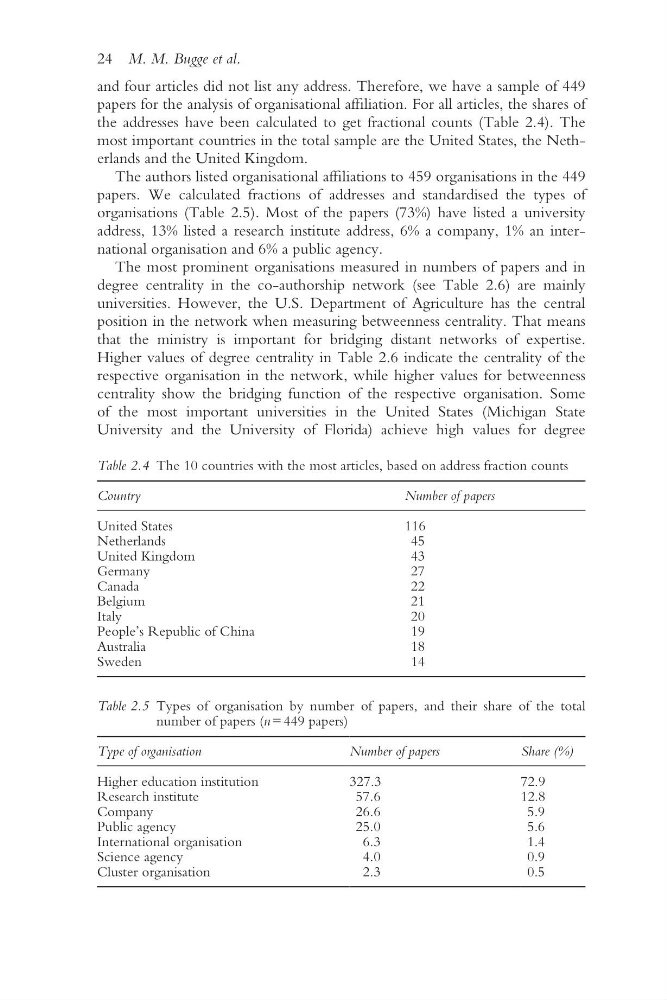
the addresses have been calculated to get fractional counts (Table 2.4). The
most important countries in the total sample are the United States, the Netherlands and the United Kingdom.
The authors listed organisational affiliations to 459 organisations in the 449
papers. We calculated fractions of addresses and standardised the types of
organisations (Table 2.5). Most of the papers (73%) have listed a university
address, 13% listed a research institute address, 6% a company, 1% an international organisation and 6% a public agency.
The most prominent organisations measured in numbers of papers and in
degree centrality in the co- authorship network (see Table 2.6) are mainly
universities. However, the U.S. Department of Agriculture has the central
position in the network when measuring betweenness centrality. That means
that the ministry is important for bridging distant networks of expertise.
Higher values of degree centrality in Table 2.6 indicate the centrality of the
respective organisation in the network, while higher values for betweenness
centrality show the bridging function of the respective organisation. Some
of the most important universities in the United States (Michigan State
University and the University of Florida) achieve high values for degree
Table 2.4 The 10 countries with the most articles, based on address fraction counts
Country
Number of papers
United States
116
Netherlands
45
United Kingdom
43
Germany
27
Canada
22
Belgium
21
Italy
20
People’s Republic of China
19
Australia
18
Sweden
14
Table 2.5 Types of organisation by number of papers, and their share of the total
number of papers (n = 449 papers)
Type of organisation
Number of papers
Share (%)
Higher education institution
327.3
72.9
Research institute
57.6
12.8
Company
26.6
5.9
Public agency
25.0
5.6
International organisation
6.3
1.4
Science agency
4.0
0.9
Cluster organisation
2.3
0.5
and four articles did not list any address. Therefore, we have a sample of 449
papers for the analysis of organisational affiliation. For all articles, the shares of
the addresses have been calculated to get fractional counts (Table 2.4). The
most important countries in the total sample are the United States, the Netherlands and the United Kingdom.
The authors listed organisational affiliations to 459 organisations in the 449
papers. We calculated fractions of addresses and standardised the types of
organisations (Table 2.5). Most of the papers (73%) have listed a university
address, 13% listed a research institute address, 6% a company, 1% an international organisation and 6% a public agency.
The most prominent organisations measured in numbers of papers and in
degree centrality in the co- authorship network (see Table 2.6) are mainly
universities. However, the U.S. Department of Agriculture has the central
position in the network when measuring betweenness centrality. That means
that the ministry is important for bridging distant networks of expertise.
Higher values of degree centrality in Table 2.6 indicate the centrality of the
respective organisation in the network, while higher values for betweenness
centrality show the bridging function of the respective organisation. Some
of the most important universities in the United States (Michigan State
University and the University of Florida) achieve high values for degree
Table 2.4 The 10 countries with the most articles, based on address fraction counts
Country
Number of papers
United States
116
Netherlands
45
United Kingdom
43
Germany
27
Canada
22
Belgium
21
Italy
20
People’s Republic of China
19
Australia
18
Sweden
14
Table 2.5 Types of organisation by number of papers, and their share of the total
number of papers (n = 449 papers)
Type of organisation
Number of papers
Share (%)
Higher education institution
327.3
72.9
Research institute
57.6
12.8
Company
26.6
5.9
Public agency
25.0
5.6
International organisation
6.3
1.4
Science agency
4.0
0.9
Cluster organisation
2.3
0.5