

258 J. Szulecka et al.
In comparison, FUSIONS (Food Use for Social Innovation by Optimizing
Waste Prevention Strategies), a European project in which Norway is an
active participant, used a different and notably less ‘strict’ definition, understanding food waste as ‘any food, and inedible parts of food, removed from
the food supply chain to be recovered or disposed (including composted,
crops ploughed in/not harvested, anaerobic digestion, bio- energy production,
co- generation, incineration, disposal to sewer, landfill or discarded in the
ocean)’ (FUSIONS, 2014).
2
13.3.2 Food waste hierarchy
The waste pyramid is a framework created to define, prevent and manage
waste (see also Chapter 3) which has since been adopted for surplus food and
food waste concerns. Taking a combined sustainability perspective, it lists
strategies for dealing with food waste from ‘best’ to ‘worst’ (Bugge, Dybdahl
& Szulecka, 2018). According to the hierarchy, the best possible option is
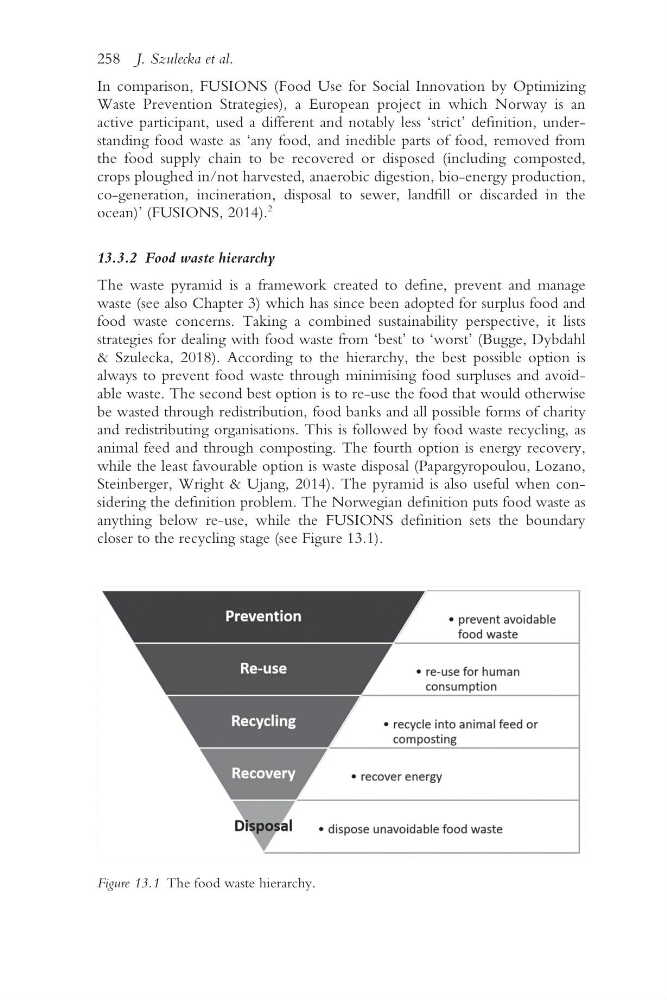
always to prevent food waste through minimising food surpluses and avoidable waste. The second best option is to re- use the food that would otherwise
be wasted through redistribution, food banks and all possible forms of charity
and redistributing organisations. This is followed by food waste recycling, as
animal feed and through composting. The fourth option is energy recovery,
while the least favourable option is waste disposal (Papargyropoulou, Lozano,
Steinberger, Wright & Ujang, 2014). The pyramid is also useful when considering the definition problem. The Norwegian definition puts food waste as
anything below re- use, while the FUSIONS definition sets the boundary
closer to the recycling stage (see Figure 13.1).
Figure 13.1 The food waste hierarchy.
In comparison, FUSIONS (Food Use for Social Innovation by Optimizing
Waste Prevention Strategies), a European project in which Norway is an
active participant, used a different and notably less ‘strict’ definition, understanding food waste as ‘any food, and inedible parts of food, removed from
the food supply chain to be recovered or disposed (including composted,
crops ploughed in/not harvested, anaerobic digestion, bio- energy production,
co- generation, incineration, disposal to sewer, landfill or discarded in the
ocean)’ (FUSIONS, 2014).
2
13.3.2 Food waste hierarchy
The waste pyramid is a framework created to define, prevent and manage
waste (see also Chapter 3) which has since been adopted for surplus food and
food waste concerns. Taking a combined sustainability perspective, it lists
strategies for dealing with food waste from ‘best’ to ‘worst’ (Bugge, Dybdahl
& Szulecka, 2018). According to the hierarchy, the best possible option is
always to prevent food waste through minimising food surpluses and avoidable waste. The second best option is to re- use the food that would otherwise
be wasted through redistribution, food banks and all possible forms of charity
and redistributing organisations. This is followed by food waste recycling, as
animal feed and through composting. The fourth option is energy recovery,
while the least favourable option is waste disposal (Papargyropoulou, Lozano,
Steinberger, Wright & Ujang, 2014). The pyramid is also useful when considering the definition problem. The Norwegian definition puts food waste as
anything below re- use, while the FUSIONS definition sets the boundary
closer to the recycling stage (see Figure 13.1).
Figure 13.1 The food waste hierarchy.