

The knowledge base of the bioeconomy 203
The table confirms that RD&I work in the bioeconomy is not isolated to
a single field of science. It shows that the bioeconomy is based on an array of
fields, ranging from the agricultural sciences and the life sciences, engineering
and the physical sciences, to a variety of social sciences and professional
studies. To further get a sense of the contributing knowledge, the table disaggregates these broad fields into more specific subfields. For example, veterinary sciences can be distinguished from other parts of the broader field of
agriculture, while life sciences can be separated from physical sciences. This
helps us to appreciate the relative importance of life sciences, engineering and
business administration in particular.
10.5.3 Sectors and seniority
As indicated above, many of the project participants are currently affiliated
with the PRO sector, principally SINTEF, NOFIMA and the former Norwegian Forest and Landscape Institute, now merged with Bioforsk and the
Norwegian Agricultural Economics Research Institute into the Norwegian
Institute of Bioeconomy Research. The importance of this sector extends
through many of the fields and subfields. The HEI sector accounts for the
second largest group, largely from the Norwegian University of Life Sciences,
the Norwegian University of Science and Technology (NTNU) and the
University of Oslo. We note that a number of the major institutes were
merged or otherwise reorganised during the reference period, and some
research institutes became part of the HEI. In addition, we see that bioeconomy research is not led solely by universities or even the HEI and the PRO
sector; the private and government sectors are also very much involved.
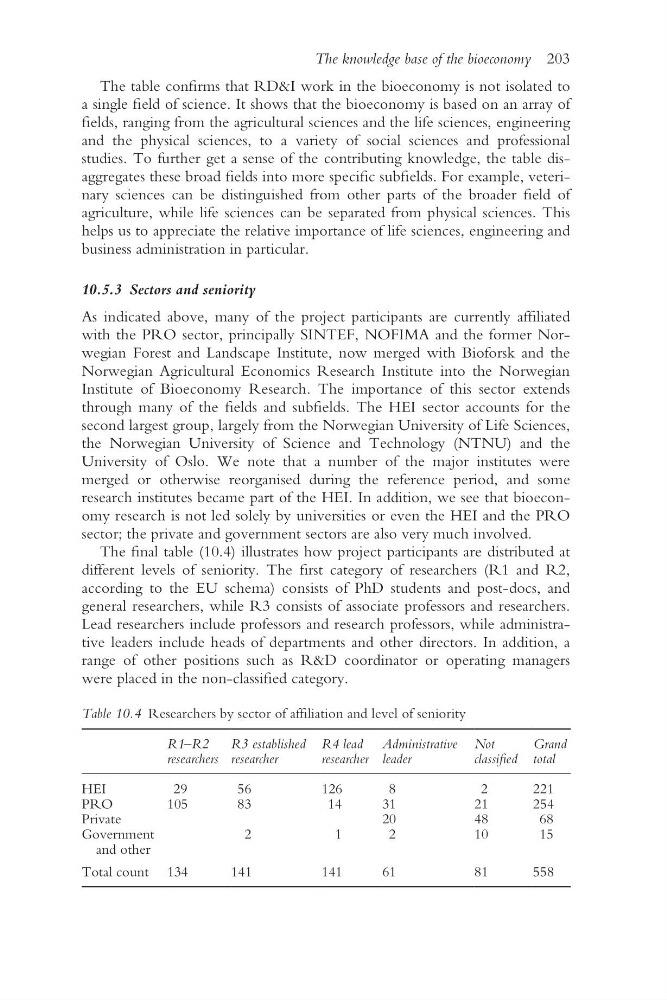
The final table (10.4) illustrates how project participants are distributed at
different levels of seniority. The first category of researchers (R1 and R2,
according to the EU schema) consists of PhD students and post- docs, and
general researchers, while R3 consists of associate professors and researchers.
Lead researchers include professors and research professors, while administrative leaders include heads of departments and other directors. In addition, a
range of other positions such as R&D coordinator or operating managers
were placed in the non- classified category.
Table 10.4 Researchers by sector of affiliation and level of seniority
R1–R2
researchers
R3 established
researcher
R4 lead
researcher
Administrative
leader
Not
classified
Grand
total
HEI
29
56
126
8
2
221
PRO
105
83
14
31
21
254
Private
20
48
68
Government
and other
2
1
2
10
15
Total count 134
141
141
61
81
558
The table confirms that RD&I work in the bioeconomy is not isolated to
a single field of science. It shows that the bioeconomy is based on an array of
fields, ranging from the agricultural sciences and the life sciences, engineering
and the physical sciences, to a variety of social sciences and professional
studies. To further get a sense of the contributing knowledge, the table disaggregates these broad fields into more specific subfields. For example, veterinary sciences can be distinguished from other parts of the broader field of
agriculture, while life sciences can be separated from physical sciences. This
helps us to appreciate the relative importance of life sciences, engineering and
business administration in particular.
10.5.3 Sectors and seniority
As indicated above, many of the project participants are currently affiliated
with the PRO sector, principally SINTEF, NOFIMA and the former Norwegian Forest and Landscape Institute, now merged with Bioforsk and the
Norwegian Agricultural Economics Research Institute into the Norwegian
Institute of Bioeconomy Research. The importance of this sector extends
through many of the fields and subfields. The HEI sector accounts for the
second largest group, largely from the Norwegian University of Life Sciences,
the Norwegian University of Science and Technology (NTNU) and the
University of Oslo. We note that a number of the major institutes were
merged or otherwise reorganised during the reference period, and some
research institutes became part of the HEI. In addition, we see that bioeconomy research is not led solely by universities or even the HEI and the PRO
sector; the private and government sectors are also very much involved.
The final table (10.4) illustrates how project participants are distributed at
different levels of seniority. The first category of researchers (R1 and R2,
according to the EU schema) consists of PhD students and post- docs, and
general researchers, while R3 consists of associate professors and researchers.
Lead researchers include professors and research professors, while administrative leaders include heads of departments and other directors. In addition, a
range of other positions such as R&D coordinator or operating managers
were placed in the non- classified category.
Table 10.4 Researchers by sector of affiliation and level of seniority
R1–R2
researchers
R3 established
researcher
R4 lead
researcher
Administrative
leader
Not
classified
Grand
total
HEI
29
56
126
8
2
221
PRO
105
83
14
31
21
254
Private
20
48
68
Government
and other
2
1
2
10
15
Total count 134
141
141
61
81
558