

202 L. M. Dybdahl and E. J. Iversen
doctorate degrees in another country, indicating a level of spill- over from
other innovation systems.
10.5.2 Field of science
Formal education provides an important indication of where knowledge of
the formative field comes from. We used the CV information to categorise
the fields of science in which the project participant held his/her highest
degree. The fields of science were translated and manually categorised into a
standardised (ISCED) schema which distinguishes between a number of main
fields, namely agricultural sciences, engineering sciences, health sciences,
physical and life sciences, social sciences and other categories such as humanities or applied service fields (e.g. accountancy).
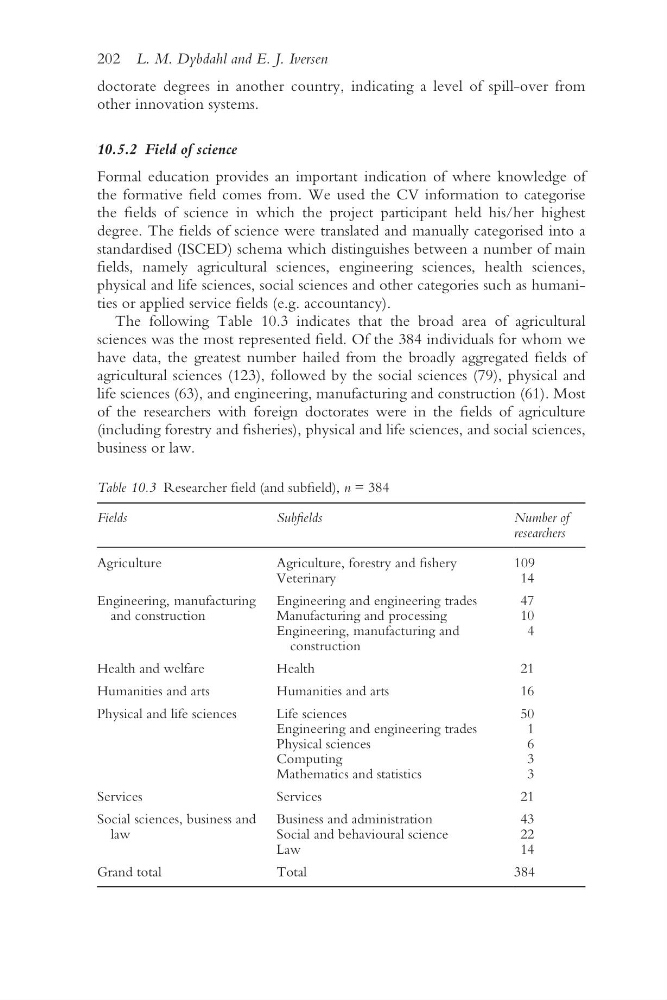
The following Table 10.3 indicates that the broad area of agricultural
sciences was the most represented field. Of the 384 individuals for whom we
have data, the greatest number hailed from the broadly aggregated fields of
agricultural sciences (123), followed by the social sciences (79), physical and
life sciences (63), and engineering, manufacturing and construction (61). Most
of the researchers with foreign doctorates were in the fields of agriculture
(including forestry and fisheries), physical and life sciences, and social sciences,
business or law.
Table 10.3 Researcher field (and subfield), n = 384
Fields
Subfields
Number of
researchers
Agriculture
Agriculture, forestry and fishery
109
Veterinary
14
Engineering, manufacturing
and construction
Engineering and engineering trades
47
Manufacturing and processing
10
Engineering, manufacturing and
construction
4
Health and welfare
Health
21
Humanities and arts
Humanities and arts
16
Physical and life sciences
Life sciences
50
Engineering and engineering trades
1
Physical sciences
6
Computing
3
Mathematics and statistics
3
Services
Services
21
Social sciences, business and
law
Business and administration
43
Social and behavioural science
22
Law
14
Grand total
Total
384
doctorate degrees in another country, indicating a level of spill- over from
other innovation systems.
10.5.2 Field of science
Formal education provides an important indication of where knowledge of
the formative field comes from. We used the CV information to categorise
the fields of science in which the project participant held his/her highest
degree. The fields of science were translated and manually categorised into a
standardised (ISCED) schema which distinguishes between a number of main
fields, namely agricultural sciences, engineering sciences, health sciences,
physical and life sciences, social sciences and other categories such as humanities or applied service fields (e.g. accountancy).
The following Table 10.3 indicates that the broad area of agricultural
sciences was the most represented field. Of the 384 individuals for whom we
have data, the greatest number hailed from the broadly aggregated fields of
agricultural sciences (123), followed by the social sciences (79), physical and
life sciences (63), and engineering, manufacturing and construction (61). Most
of the researchers with foreign doctorates were in the fields of agriculture
(including forestry and fisheries), physical and life sciences, and social sciences,
business or law.
Table 10.3 Researcher field (and subfield), n = 384
Fields
Subfields
Number of
researchers
Agriculture
Agriculture, forestry and fishery
109
Veterinary
14
Engineering, manufacturing
and construction
Engineering and engineering trades
47
Manufacturing and processing
10
Engineering, manufacturing and
construction
4
Health and welfare
Health
21
Humanities and arts
Humanities and arts
16
Physical and life sciences
Life sciences
50
Engineering and engineering trades
1
Physical sciences
6
Computing
3
Mathematics and statistics
3
Services
Services
21
Social sciences, business and
law
Business and administration
43
Social and behavioural science
22
Law
14
Grand total
Total
384