

Meat processing and animal by-products 131
spongiform encephalopathy), used for experiments and illegal treatments,
infected with diseases and environmental contaminants and specified risk
materials (SRMs). CAT1 should be incinerated and only approved combustion plants can receive CAT1 for treatment. Sources of energy such as electricity and biodiesel can be obtained through incineration. Category 2 (CAT2)
is classified as high risk, including animals and parts of animals unfit for
human consumption such as animals killed for disease control purposes, ABPs
containing residues of authorised substances or contaminants exceeding the
permitted levels and manure. CAT2 can be incinerated with or without prior
processing, converted into organic fertilisers or soil improvers after processing, or used as fuel for combustion. Category 3 is classified as low risk,
including carcases and animal parts being left from slaughterhouses, fit
for human consumption, but not used due to commercial reasons. CAT3 can
be processed to make pet food, or mink food, or utilised in even higher
value- added applications in other industries like cosmetics, pharmaceutics or
foodstuff.
The meat processing industry has utilised ABPs for centuries. However,
recent literature suggests that rich and multiple opportunities exist for upgrading the utilisation of ABPs (see, for instance, Jayathilakan, Sultana, Radhakrishna & Bawa, 2012; Lin et al., 2013; Matharu, de Melo & Houghton,
2016; Mirabella, Castellani & Sala, 2014; Ravindran & Jaiswal, 2016; Toldrá,
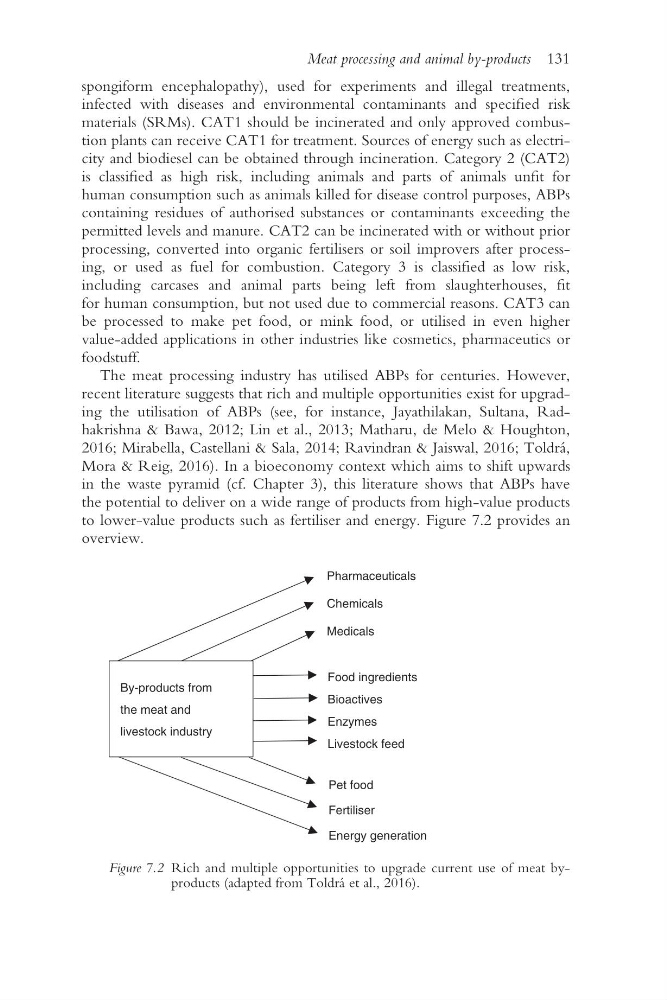
Mora & Reig, 2016). In a bioeconomy context which aims to shift upwards
in the waste pyramid (cf. Chapter 3), this literature shows that ABPs have
the potential to deliver on a wide range of products from high- value products
to lower- value products such as fertiliser and energy. Figure 7.2 provides an
overview.
Pharmaceuticals
Chemicals
Medicals
Food ingredients
Bioactives
Enzymes
Livestock feed
Pet food
Fertiliser
Energy generation
By-products from
the meat and
livestock industry
Figure 7.2 Rich and multiple opportunities to upgrade current use of meat byproducts (adapted from Toldrá et al., 2016).
spongiform encephalopathy), used for experiments and illegal treatments,
infected with diseases and environmental contaminants and specified risk
materials (SRMs). CAT1 should be incinerated and only approved combustion plants can receive CAT1 for treatment. Sources of energy such as electricity and biodiesel can be obtained through incineration. Category 2 (CAT2)
is classified as high risk, including animals and parts of animals unfit for
human consumption such as animals killed for disease control purposes, ABPs
containing residues of authorised substances or contaminants exceeding the
permitted levels and manure. CAT2 can be incinerated with or without prior
processing, converted into organic fertilisers or soil improvers after processing, or used as fuel for combustion. Category 3 is classified as low risk,
including carcases and animal parts being left from slaughterhouses, fit
for human consumption, but not used due to commercial reasons. CAT3 can
be processed to make pet food, or mink food, or utilised in even higher
value- added applications in other industries like cosmetics, pharmaceutics or
foodstuff.
The meat processing industry has utilised ABPs for centuries. However,
recent literature suggests that rich and multiple opportunities exist for upgrading the utilisation of ABPs (see, for instance, Jayathilakan, Sultana, Radhakrishna & Bawa, 2012; Lin et al., 2013; Matharu, de Melo & Houghton,
2016; Mirabella, Castellani & Sala, 2014; Ravindran & Jaiswal, 2016; Toldrá,
Mora & Reig, 2016). In a bioeconomy context which aims to shift upwards
in the waste pyramid (cf. Chapter 3), this literature shows that ABPs have
the potential to deliver on a wide range of products from high- value products
to lower- value products such as fertiliser and energy. Figure 7.2 provides an
overview.
Pharmaceuticals
Chemicals
Medicals
Food ingredients
Bioactives
Enzymes
Livestock feed
Pet food
Fertiliser
Energy generation
By-products from
the meat and
livestock industry
Figure 7.2 Rich and multiple opportunities to upgrade current use of meat byproducts (adapted from Toldrá et al., 2016).