

98 M. M. Bugge and A. M. Fevolden
and soil, and for the planning and development, management and operation
of municipal urban spaces. These agencies are coordinated by the Vice Mayor
for Environment and Transport.
These municipal departments do not operate in isolation. There are both
national and international regulations that the municipality of Oslo must
adhere to when developing their organic waste system. Among others, the
municipality must adhere to the EU landfill ban of 2009 and the EU Waste
Framework Directive of 2008, which Norwegian authorities have transposed
into Norwegian law. The municipality must also adhere to The Norwegian
Pollution Act, which states that municipalities have sole responsibility for the
collection and processing of household waste, while private businesses are
responsible for processing their own waste. According to the same Act, the
municipality’s handling of household waste should also be self- financed
through fees and governed by waste regulations.
The municipality of Oslo has implemented a two- bin system, consisting of
one bin for plastic, food and residual waste, collected one to six times a week,
and one bin for paper collected one to four times a month. Citizens collect
their food waste in green bags, their plastic waste in blue bags and their residual waste in neutral bags. All the bags are disposed of in the same household
waste bin. Additionally, there are 910 collection points for glass, metals and
textiles across the city. Moreover, the city has collections for hazardous waste,
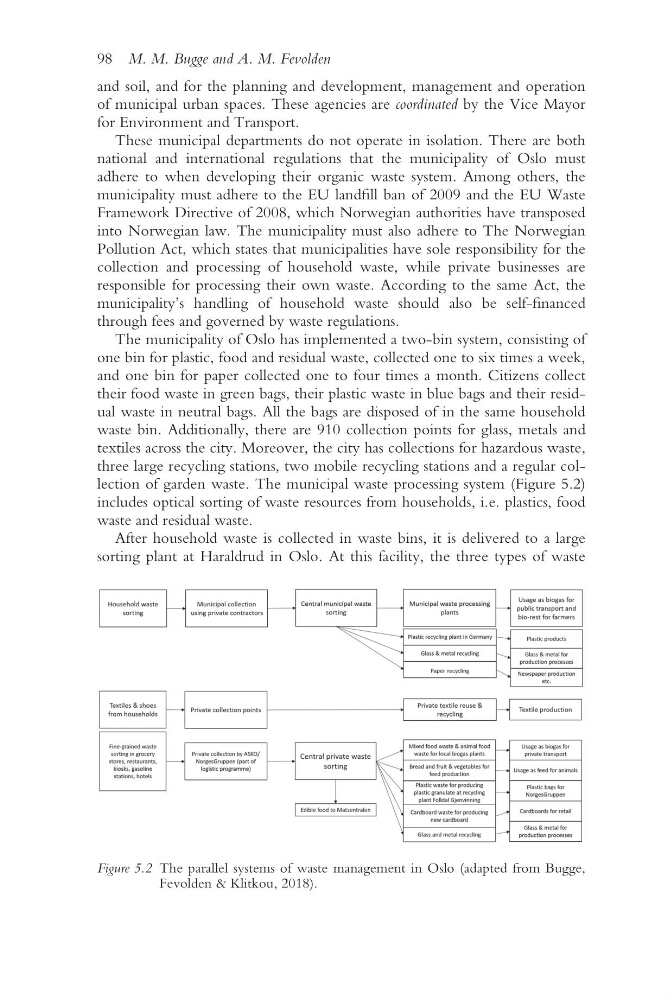
three large recycling stations, two mobile recycling stations and a regular collection of garden waste. The municipal waste processing system (Figure 5.2)
includes optical sorting of waste resources from households, i.e. plastics, food
waste and residual waste.
After household waste is collected in waste bins, it is delivered to a large
sorting plant at Haraldrud in Oslo. At this facility, the three types of waste
Figure 5.2 The parallel systems of waste management in Oslo (adapted from Bugge,
Fevolden & Klitkou, 2018).
and soil, and for the planning and development, management and operation
of municipal urban spaces. These agencies are coordinated by the Vice Mayor
for Environment and Transport.
These municipal departments do not operate in isolation. There are both
national and international regulations that the municipality of Oslo must
adhere to when developing their organic waste system. Among others, the
municipality must adhere to the EU landfill ban of 2009 and the EU Waste
Framework Directive of 2008, which Norwegian authorities have transposed
into Norwegian law. The municipality must also adhere to The Norwegian
Pollution Act, which states that municipalities have sole responsibility for the
collection and processing of household waste, while private businesses are
responsible for processing their own waste. According to the same Act, the
municipality’s handling of household waste should also be self- financed
through fees and governed by waste regulations.
The municipality of Oslo has implemented a two- bin system, consisting of
one bin for plastic, food and residual waste, collected one to six times a week,
and one bin for paper collected one to four times a month. Citizens collect
their food waste in green bags, their plastic waste in blue bags and their residual waste in neutral bags. All the bags are disposed of in the same household
waste bin. Additionally, there are 910 collection points for glass, metals and
textiles across the city. Moreover, the city has collections for hazardous waste,
three large recycling stations, two mobile recycling stations and a regular collection of garden waste. The municipal waste processing system (Figure 5.2)
includes optical sorting of waste resources from households, i.e. plastics, food
waste and residual waste.
After household waste is collected in waste bins, it is delivered to a large
sorting plant at Haraldrud in Oslo. At this facility, the three types of waste
Figure 5.2 The parallel systems of waste management in Oslo (adapted from Bugge,
Fevolden & Klitkou, 2018).